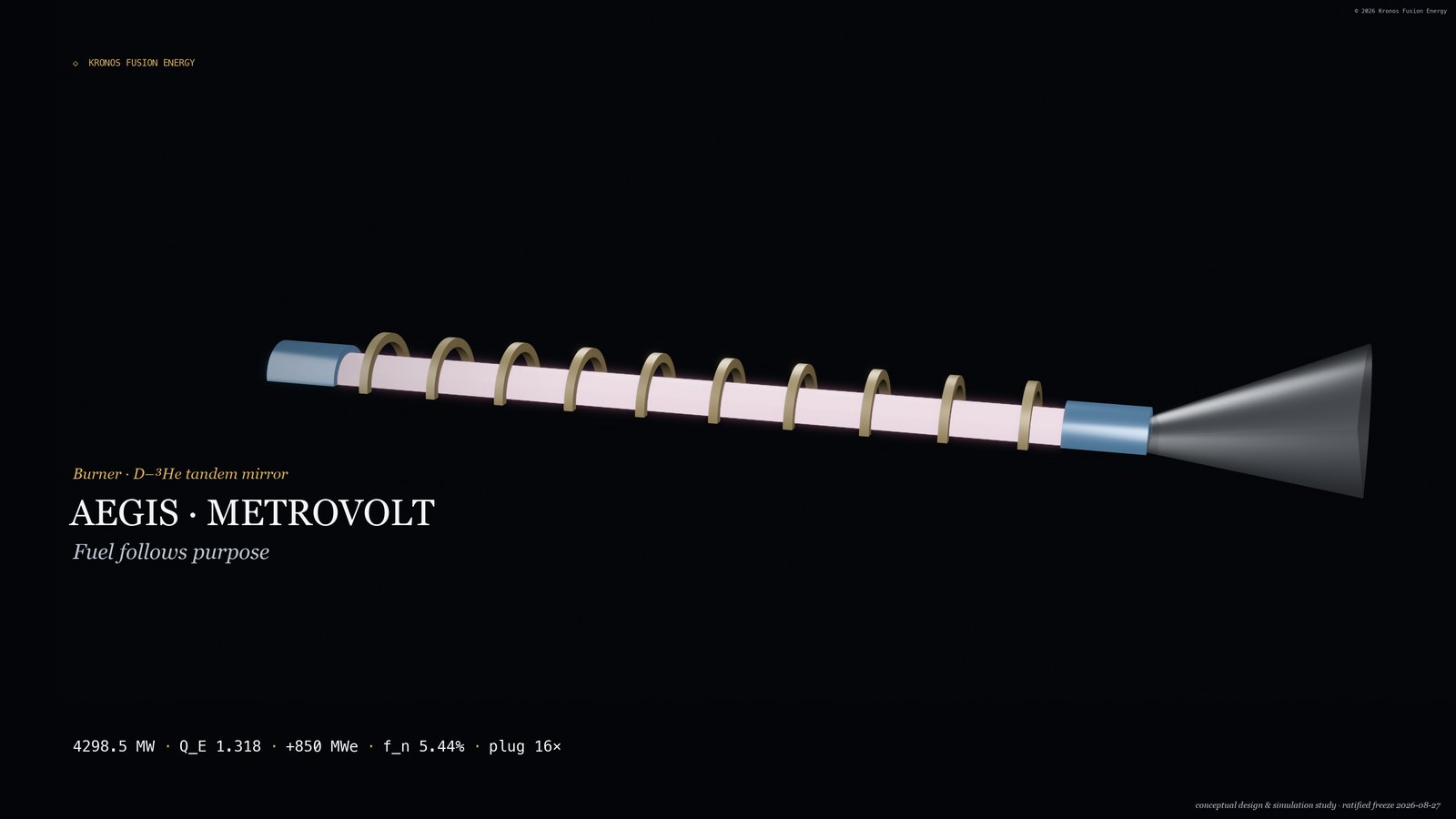
The Tandem Mirror
A long central cell confined by strong magnetic mirrors at each end, with electrostatic end plugs closing the loss cone that open mirrors suffer.
An open-ended machine, closed by potential
A magnetic mirror is an open field line pinched at both ends by regions of strong field. Ions and electrons spiralling along the line are reflected by the pinch — but only if their velocity is angled enough; those moving too straight along the field escape through the "loss cone." A simple mirror therefore leaks continuously. The tandem mirror fixes this by adding a confining electric potential at each end.
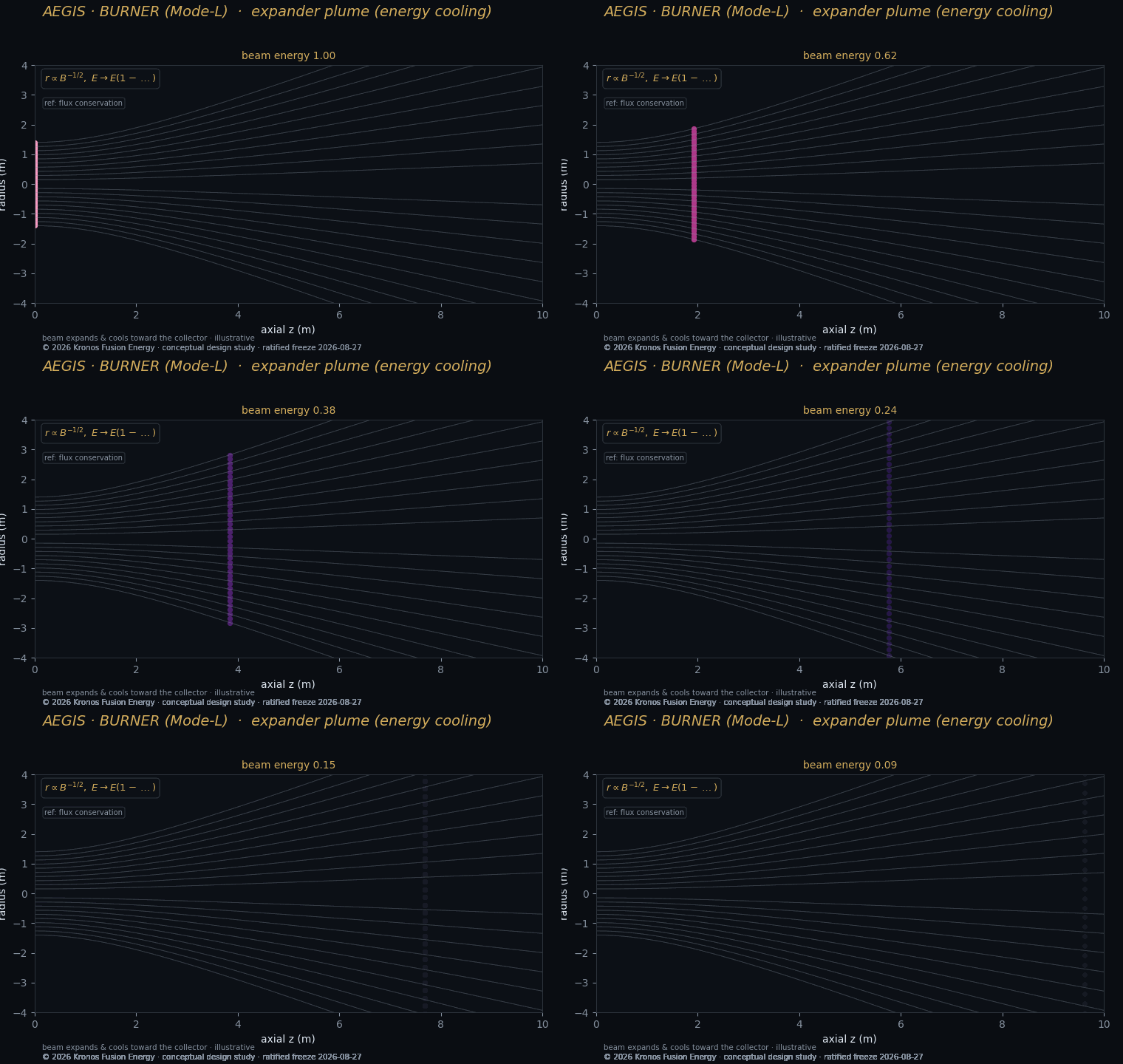
The burner's geometry is: a long central cell where the D–3He fuel burns, a high-field throat (17 T) at each end where the field pinches, a high-field plug (26.49 T) beyond it that builds the confining potential, and an expander where the exhaust plasma fans out into the direct converter.
Why open geometry at all
Open ends make direct energy conversion natural: charged particles that do leave stream along field lines straight into a collector, rather than being trapped in a closed torus. The trade-off is that the ends must be plugged electrostatically, which is where the tandem mirror's hardest physics — and its honest gates — live.
The concept dates to real experimental machines that demonstrated ambipolar plugging and thermal barriers at their scale; what is unproven is the extrapolation to the burner's field and regime. Reading the geometry with that history in mind is the honest frame: the mechanism is established physics, and the specific parameters the burner needs are not yet demonstrated.
- Central cell: D–3He burn region
- Throat: 17 T magnetic pinch
- Plug: 26.49 T, builds confining potential
- Expander: opens to the direct converter