The Expander Region
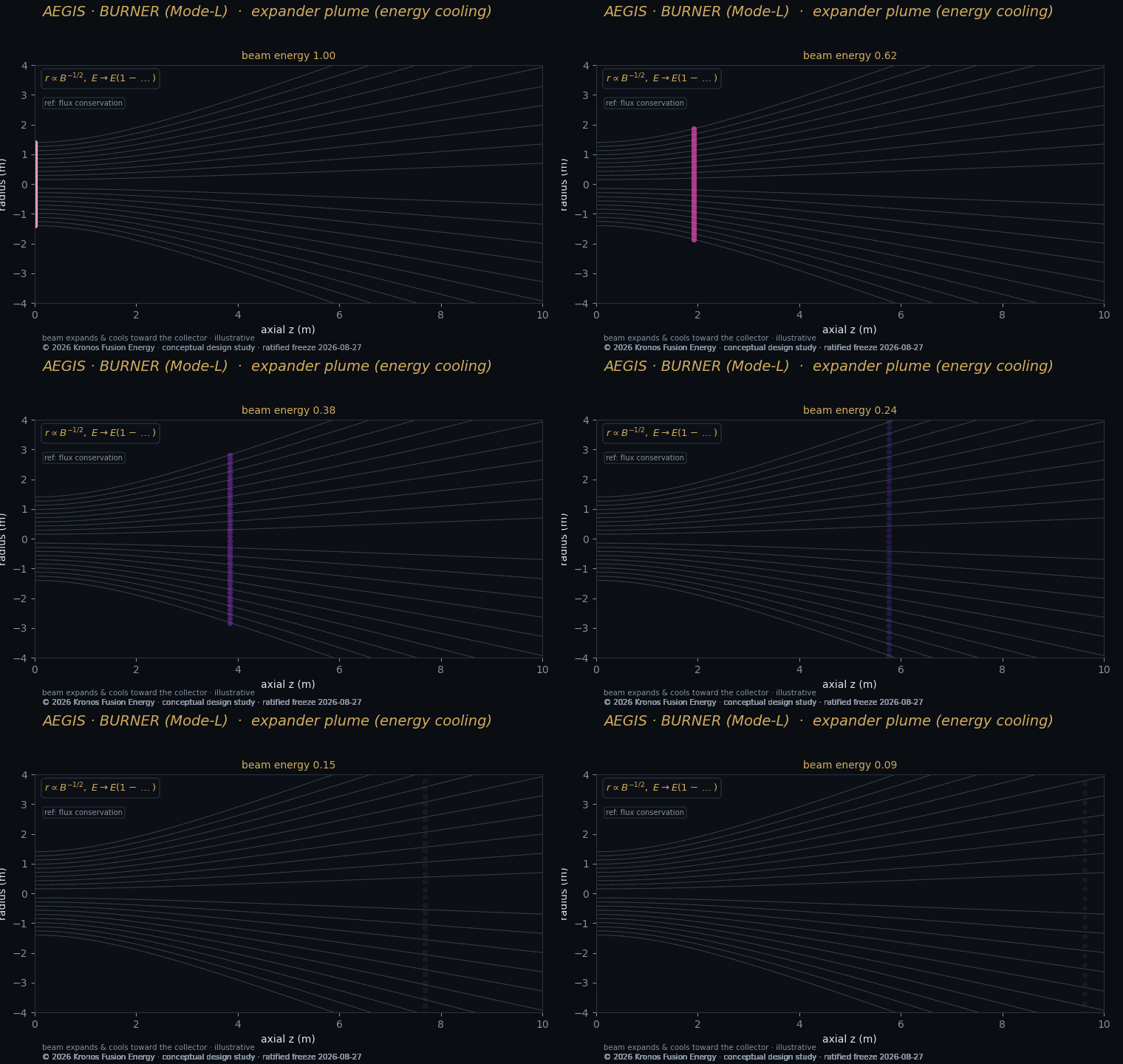
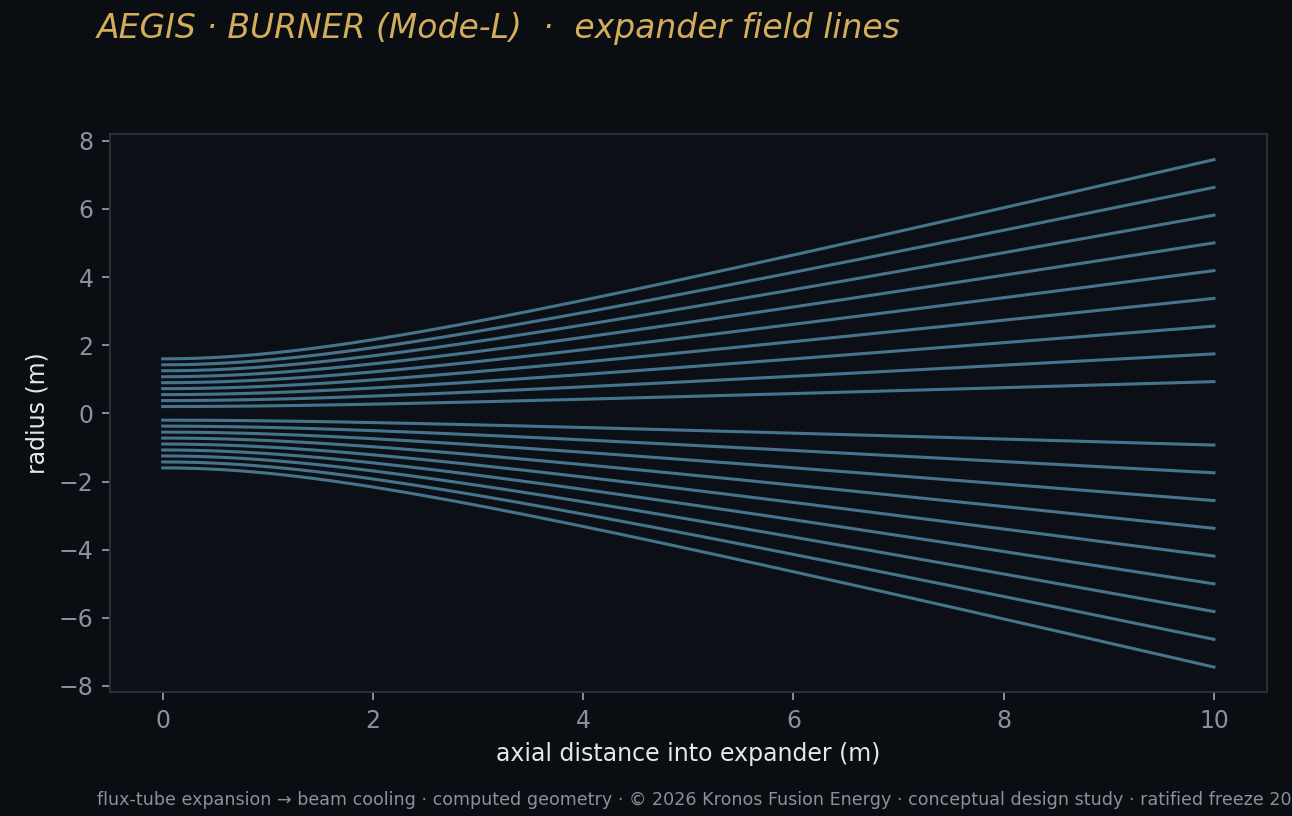
Beyond the throat the field fans out, reducing plasma density and heat flux so the exhaust can meet the direct converter and end walls.
Spreading the exhaust
Past the mirror throat the magnetic field diverges rapidly into an expander. As the field lines fan out, the plasma follows them and its density and power density drop by the ratio of field strengths. This spreading is essential: the raw exhaust leaving a 17 T throat would carry an impossible heat flux onto any surface if it were not expanded first.
The expander also matters for the potential structure. Because electron confinement depends on the potential drop from the plasma to the end wall, the expander is shaped to control that drop — a large expansion ratio lowers the plasma potential at the wall, which affects how electrons are confined and how the direct converter is biased.
Interface to conversion
The expander is the physical hand-off from confinement to conversion: it takes a dense, hot, magnetised exhaust and delivers a spread-out charged stream that the direct converter can decelerate and the end walls can survive. Its geometry couples confinement physics, heat handling, and conversion efficiency together.
The expansion ratio is a design knob with competing pulls: a larger expansion lowers heat flux and sets a favourable wall potential for electron confinement, but it demands more volume and more precisely shaped field at the ends. Balancing those against the direct converter's needs makes the expander a genuine three-way compromise between heat handling, confinement, and conversion.
- Field fans out beyond the throat
- Density and heat flux drop with expansion ratio
- Controls the plasma-to-wall potential drop
- Delivers exhaust to the direct converter