Ash Accumulation: Helium-4 & Protons
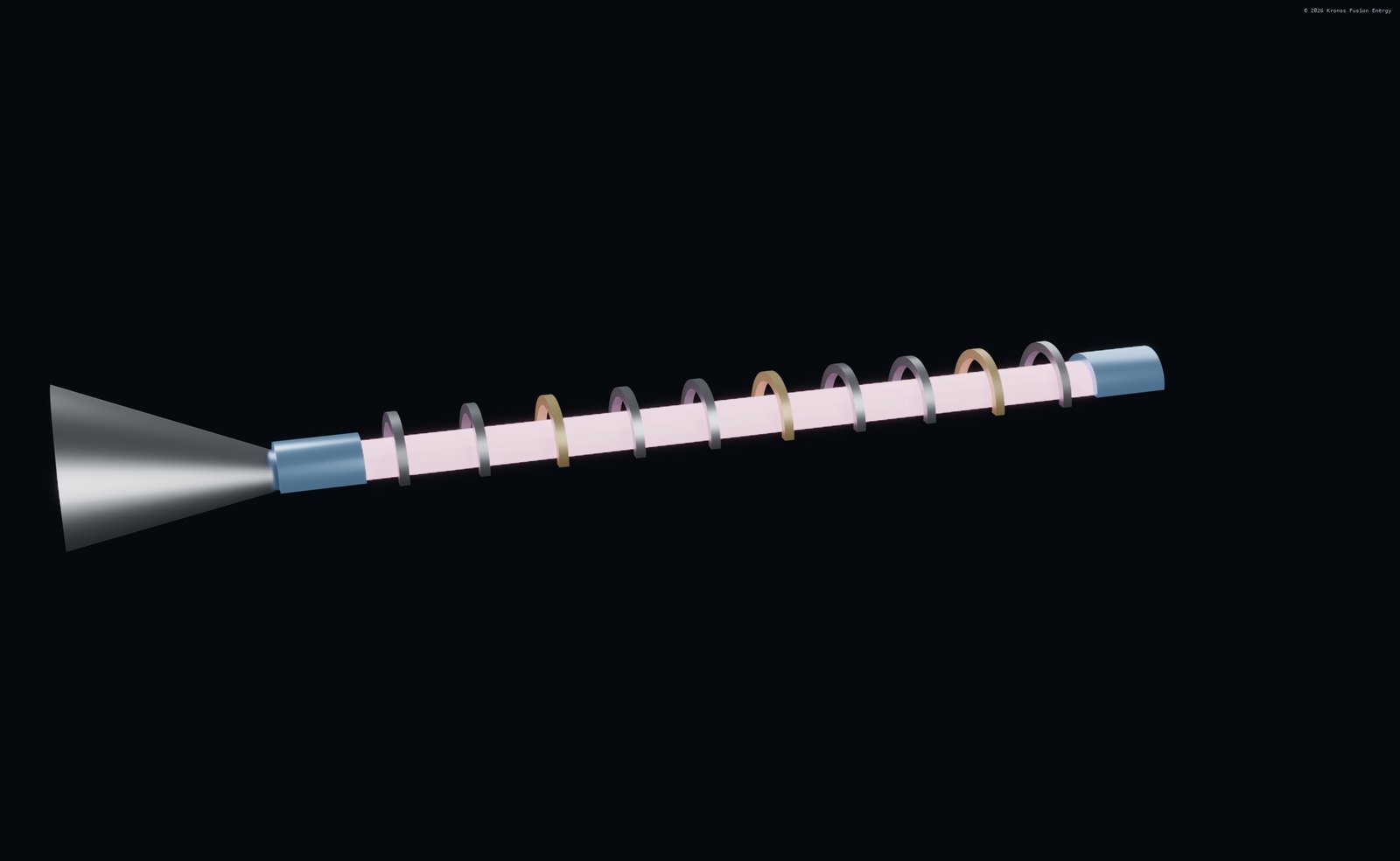
Fusion products left in the plasma dilute the fuel and radiate; the burner must exhaust helium-4 ash and protons to sustain the burn.
Cleaning the burn
Every D–3He reaction leaves a helium-4 nucleus and a proton in the plasma. If these fusion "ash" species build up, they dilute the fuel, raise Zeff (increasing bremsstrahlung), and eventually quench the reaction. An open-ended mirror has an advantage here: ash flows out the ends along the field with the rest of the exhaust.
The protons are themselves a useful product — a stream of energetic hydrogen ions — and both they and the helium-4 carry energy to the direct converter before leaving. The physics requirement is that the exhaust rate keeps the ash concentration low enough that fuel dilution and radiation stay within the power balance.
Balance, not accumulation
Ash exhaust competes with fuel confinement: the same end-loss channel that removes ash also removes fuel, so the plug potential and refuelling rate must be tuned to keep fuel confined while letting ash escape at a sufficient rate. This is a steady-state balance the design must maintain continuously.
An open geometry turns what is a difficult exhaust problem in a torus into a more natural one here, but it does not make it free — the exhausted ash carries fuel and energy with it, and the balance between removing ash and retaining fuel is maintained continuously by the plug potential and refuelling. Getting that steady state right is part of demonstrating a sustained burn.
- Products 4He and p accumulate as ash
- Ash dilutes fuel and raises bremsstrahlung
- Open ends exhaust ash along the field
- Exhaust rate balanced against fuel confinement