End-Wall Heat Flux
Plasma leaving along the field concentrates enormous heat flux at the ends; the expander and converter geometry must spread it to survivable levels.
The most loaded surfaces
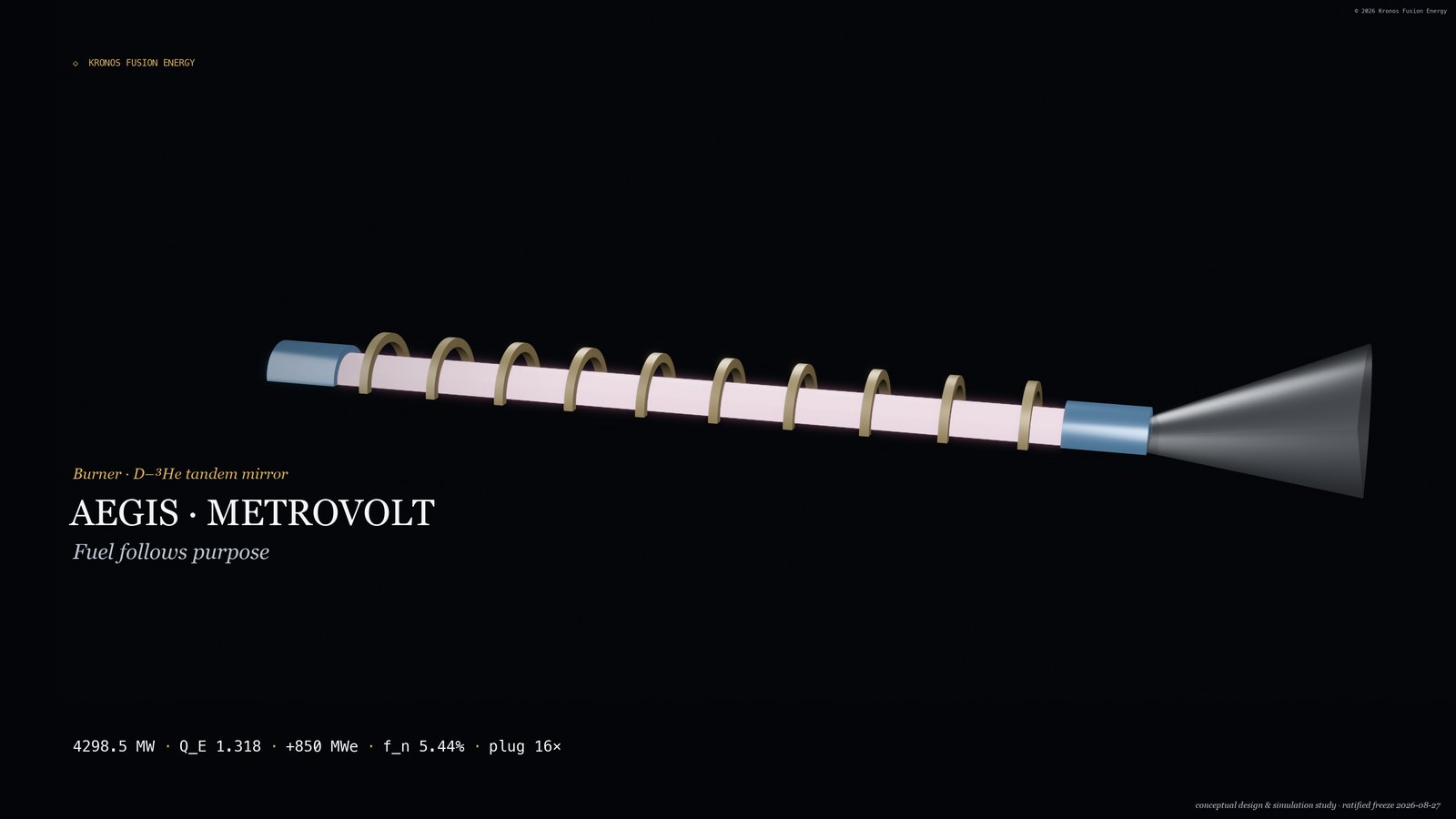
In a closed torus the exhaust is spread around a divertor; in an open mirror it all leaves through two ends. Without mitigation, the power streaming out of a 17 T throat would land on the end structures at a heat flux far beyond what any material survives. Managing this is a defining engineering problem of the geometry.
The remedy is the same magnetic expansion that serves conversion: fanning the field out drops the power density by the field-strength ratio, so a large end area receives a survivable flux. The direct converter is built to accept this expanded stream, absorbing charged-particle energy as collected current rather than as raw heat wherever possible.
A coupled problem
Heat flux, direct conversion, and end-loss confinement are one linked design: the expansion needed to protect the walls is also what makes conversion and electron confinement work. Getting the geometry right at reactor power is demanding engineering, though — unlike the plug — not an open physics gate.
The reassuring part of this problem is that it is engineering, not open physics: the magnetic expansion that solves it is well understood, and the loads, while severe, are quantifiable and can be designed against with material and geometry choices. Unlike the plug gates, the end-wall heat flux does not depend on an unmeasured regime — it depends on getting a known geometry built at scale.
- All exhaust leaves through two ends
- Raw flux from the throat is unsurvivable
- Magnetic expansion drops power density
- Coupled to conversion and electron confinement