The Proton Product
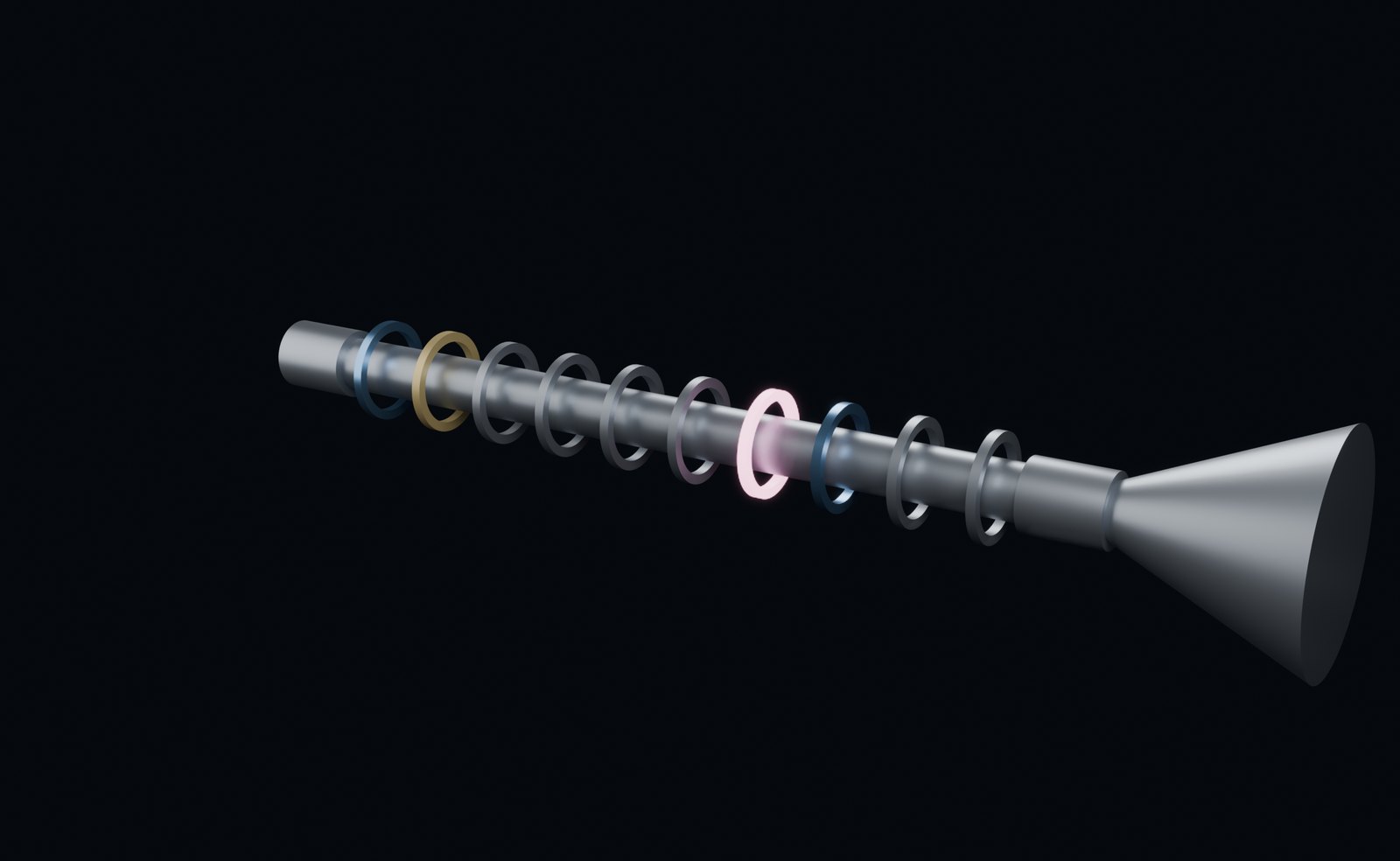
The 14.7 MeV proton from D–He-3 carries most of the reaction energy and, as a charged particle, is the burner's primary conversion channel.
The particle that carries the energy
Of the 18.35 MeV released by D + 3He, the proton carries 14.7 MeV and the helium-4 nucleus 3.6 MeV — by momentum conservation the lighter proton takes the larger share. Because the proton is charged, its energy is available to direct conversion; this single particle is the main reason D–3He suits a direct-conversion machine.
The proton's high energy is a benefit and a design constraint. It deposits some energy back into the plasma (helping sustain the burn) before it escapes, and it arrives at the direct converter as the highest-energy particle in the spectrum, setting the deepest collector voltage. Its interaction with the first wall and converter surfaces must be managed.
Not a neutron
The contrast with D–T is stark: there, the energy leaves in a 14.1 MeV neutron that cannot be steered or collected electrically and must be caught as heat. Here, the comparable-energy particle is a proton — charged, magnetically guided, and directly convertible. That difference is the physics behind the whole burner concept.
The proton stream is also a product in its own right — a flux of energetic hydrogen ions that carries information about the burn and can, in principle, be put to use downstream. But its primary role in the physics is as the dominant charged-energy carrier, the particle that makes direct conversion of D–3He worthwhile and that fixes the top of the converter's voltage ladder.
- Proton carries 14.7 MeV of the 18.35 MeV
- Charged → available to direct conversion
- Sets the deepest converter collector voltage
- Contrast: D–T energy leaves as an uncatchable neutron