Direct Energy Conversion
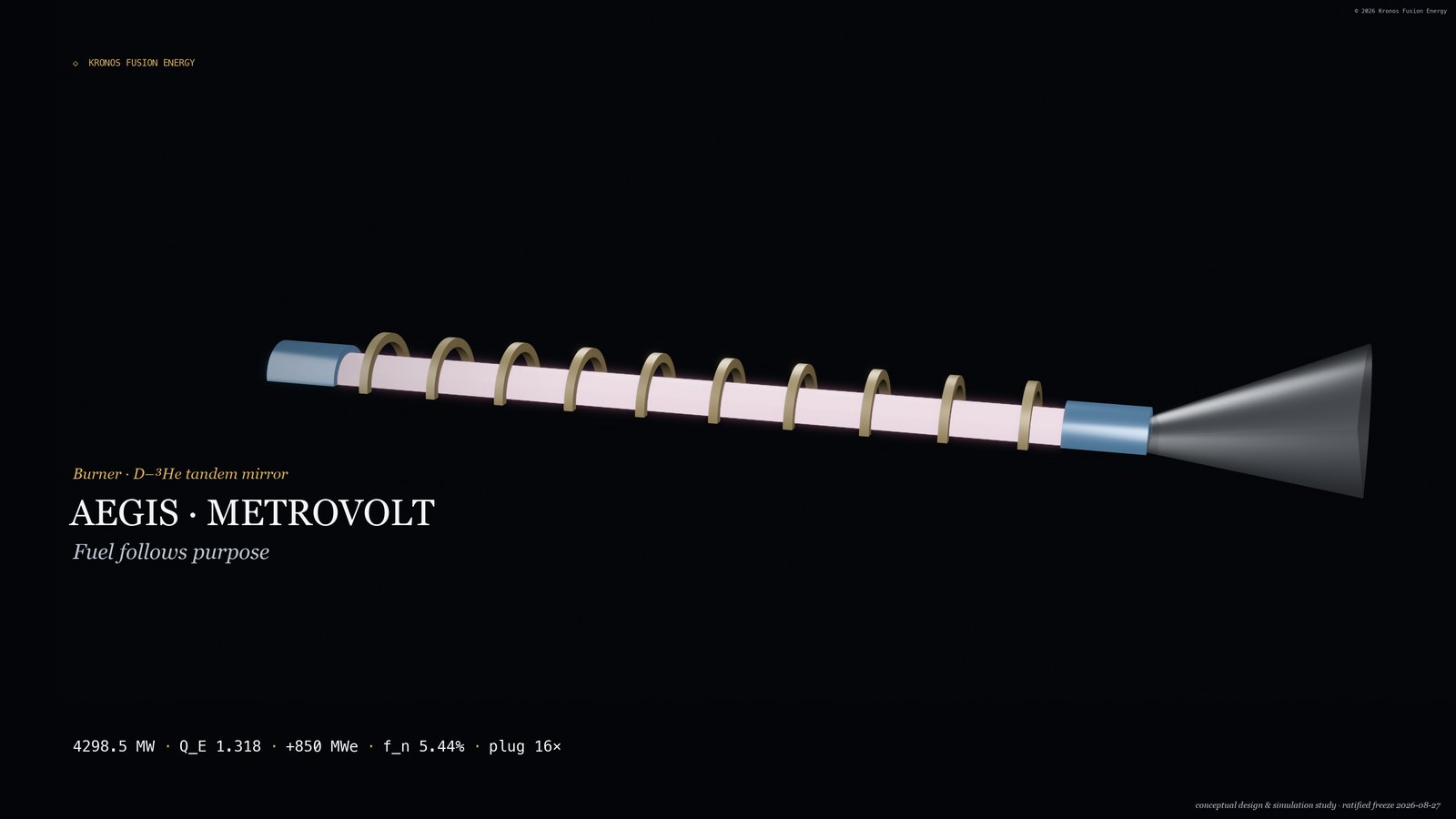
Charged fusion products stream out along the field and are decelerated against a voltage, converting their kinetic energy straight to DC electricity.
Electricity without a steam cycle
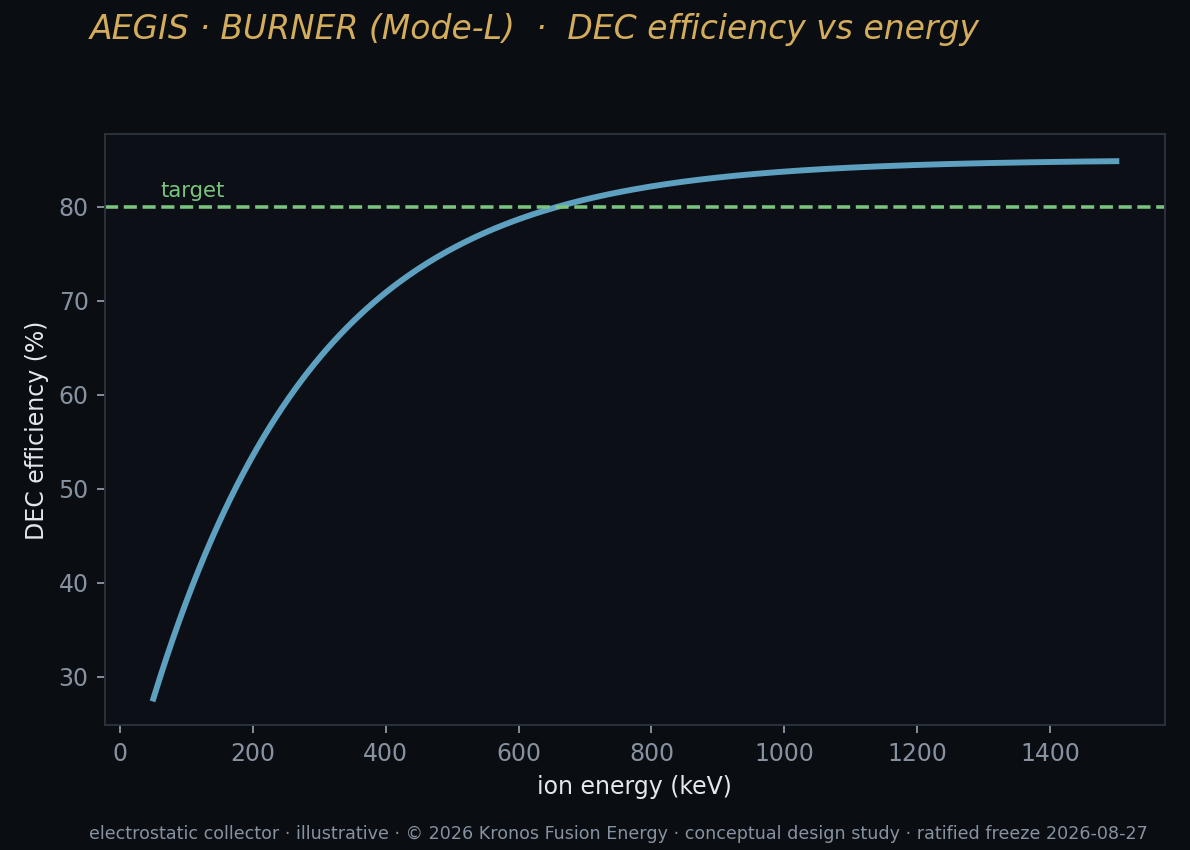
Because the D–3He reaction releases its energy as charged particles, the burner can convert most of it without heat. In direct energy conversion (DEC), the charged products escape along the diverging field into an expander, where they are decelerated against a series of biased collector electrodes. Their kinetic energy does work against the electric field and is collected as direct current.
This bypasses the Carnot limit that caps a thermal cycle. Where a steam plant converts heat to electricity at perhaps a third efficiency, direct conversion of a well-collimated charged beam can in principle reach much higher — the theoretical attraction of D–3He. The neutron fraction (5.44%) and any unconverted charged energy still appear as heat and are handled conventionally.
The real efficiency
Practical DEC efficiency is set by how monoenergetic and well-directed the collected particles are, by secondary-electron and space-charge effects at the collectors, and by the field geometry in the expander. It is high but not unity, and the recirculating power for plugs and injectors is charged against it in the engineering gain.
The concept only works because the products are both charged and reasonably directed along the field as they leave; a fuel whose energy left as neutrons or isotropic heat could not be converted this way. Direct conversion is therefore not a bolt-on efficiency trick but a consequence of the fuel and geometry chosen upstream — it is the payoff for accepting D–3He's harder ignition.
- Charged products decelerated against a voltage
- Kinetic energy → DC electricity directly
- Bypasses the Carnot limit of a steam cycle
- Neutron + unconverted energy still handled as heat