Sloshing Ions & Thermal Barriers
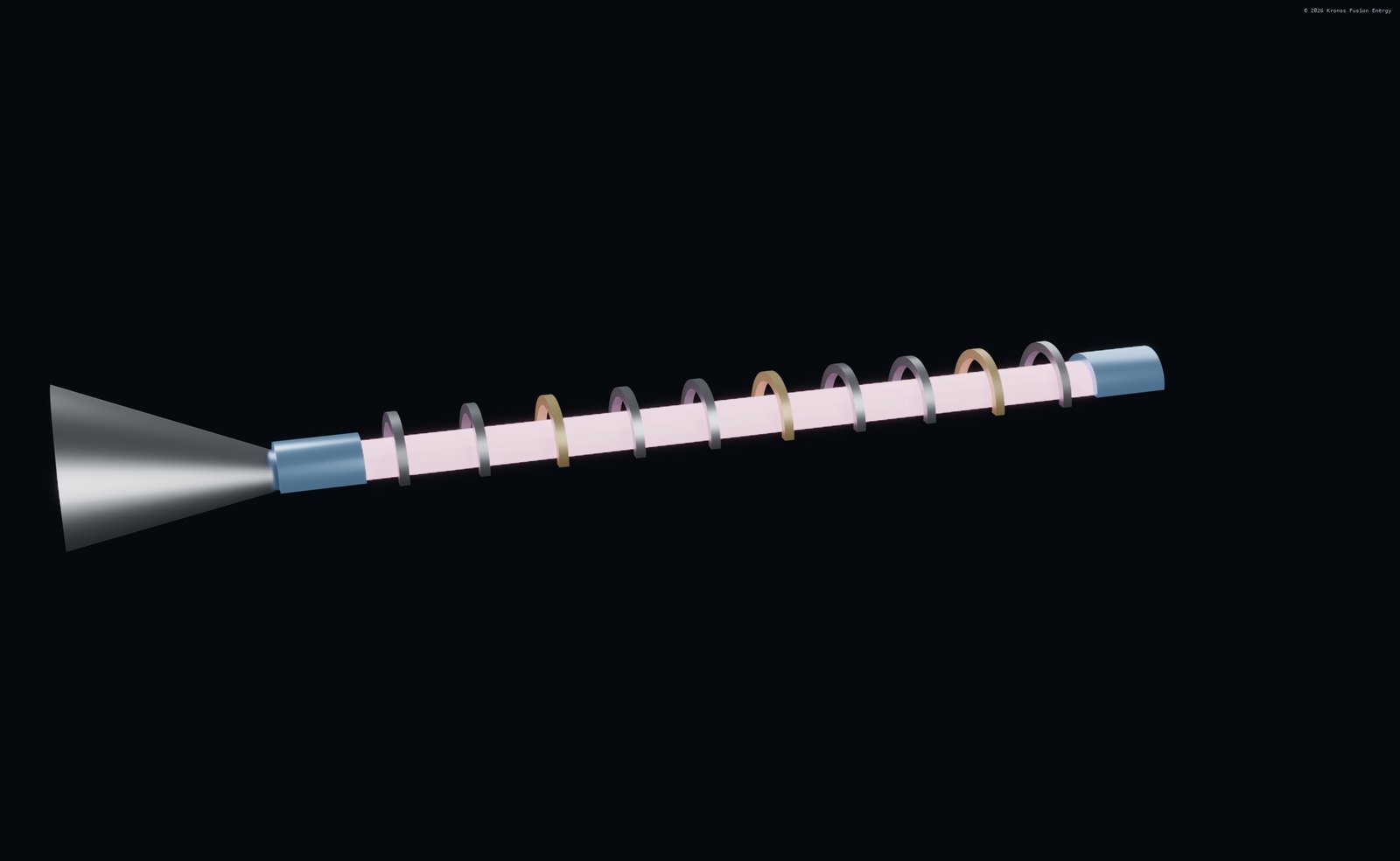
Angled neutral-beam injection creates ions that peak away from the midplane, shaping the potential; a thermal barrier decouples plug and cell electrons.
Shaping the plug potential
Injecting neutral beams at an angle to the field creates sloshing ions — fast ions that turn around near the mirror throats rather than at the midplane, so their density peaks off-centre. This double-humped density profile builds the potential structure the plug needs and helps stabilise loss-cone microinstabilities.
A thermal barrier goes further: by creating a local dip in the electron potential between the central cell and the plug, it thermally isolates the plug electrons from the colder central-cell electrons. That lets the plug electrons — and therefore the confining potential — run hotter and higher without an excessive power draw.
Why it is delicate
These structures depend on precisely sustained fast-ion populations and heating profiles. They are the mechanism by which the plug does its job, but they also mean the plug operates in a narrow, self-consistent regime — one that has never been sustained at the burner's parameters, which is the substance of the plug-regime gate.
Both structures are self-consistent: the fast ions build the potential, and the potential shapes where the fast ions turn around, so the equilibrium must be solved as a coupled system rather than imposed. This self-consistency is elegant on paper and demanding in practice, because a stable equilibrium at the burner's parameters has never been demonstrated — the substance of the plug-regime gate.
- Sloshing ions: off-midplane density peaks
- Shape the confining potential; damp instabilities
- Thermal barrier: isolates plug electrons
- Enables higher potential at lower power draw