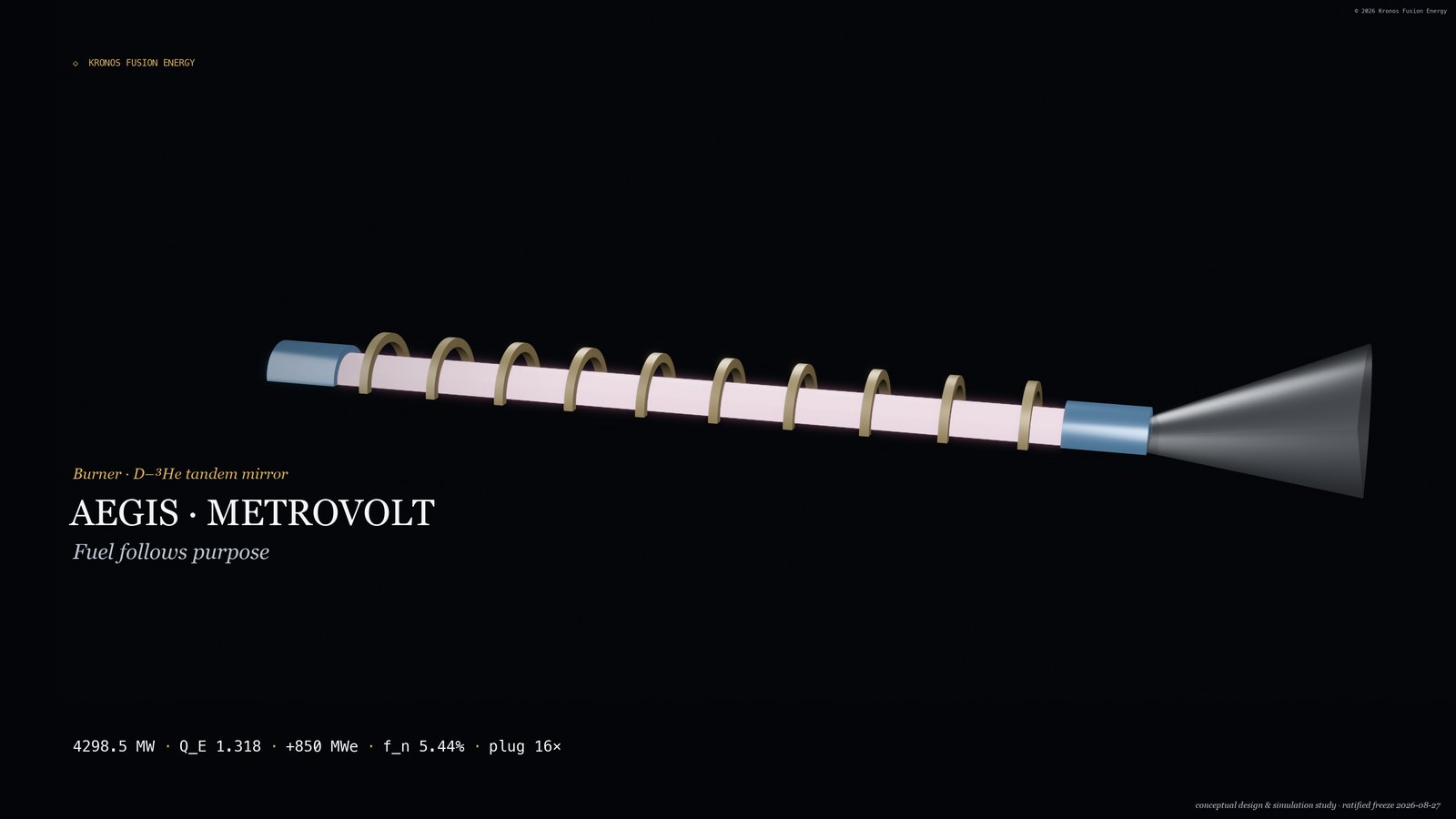
The 5.44% Neutron Fraction
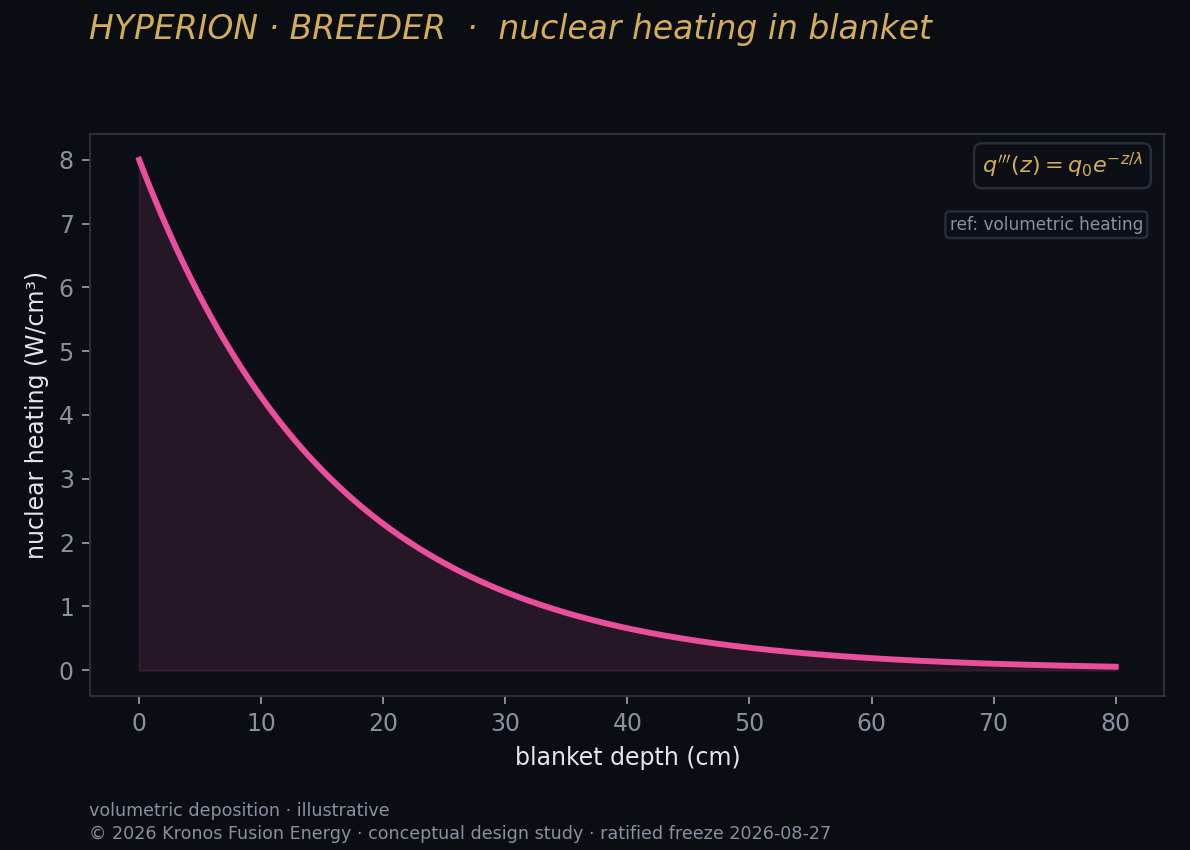
Low-neutron is not aneutronic: about 5.44% of the burner's fusion power leaves as neutrons from D–D side reactions.
Low-neutron, stated honestly
The burner's fusion power carries a 5.44% neutron fraction. This is low-neutron, not aneutronic. The primary D–3He branch makes no neutrons, but deuterium also reacts with deuterium, and one of those channels — plus secondary tritium burn-up — produces 2.45 MeV and 14.1 MeV neutrons. At ~90 keV with a realistic fuel mix, those side reactions leave roughly one part in eighteen of the power in neutrons.
This still matters. A 5.44% neutron fraction is low enough to make direct conversion worthwhile and to keep activation modest, but it is not zero: the first wall, plug region, and nearby structures still require neutron shielding and will see activation over their lifetime. Any claim of "clean" or "radiation-free" fusion would be false for this machine, and we do not make it.
Why not zero
Truly aneutronic fuels (such as p–11B) exist, but their ignition conditions are far beyond D–3He. Deuterium is in the fuel because it is abundant and its D–3He cross-section is favorable; the penalty for keeping deuterium is the D–D neutron tail.
The 5.44% is a design-point figure, not a universal constant: it moves with the fuel mix and operating temperature. What does not move is the qualitative statement — a deuterium-bearing plasma always makes some neutrons through D–D. Honest labelling matters here more than almost anywhere, because the temptation to call D–3He "aneutronic" is strong and, for this machine, wrong.
- 5.44% of fusion power in neutrons
- Source: D–D side reactions + secondary T burn
- Low-neutron, explicitly not aneutronic
- Shielding and activation are still required