The Charged-Particle Spectrum
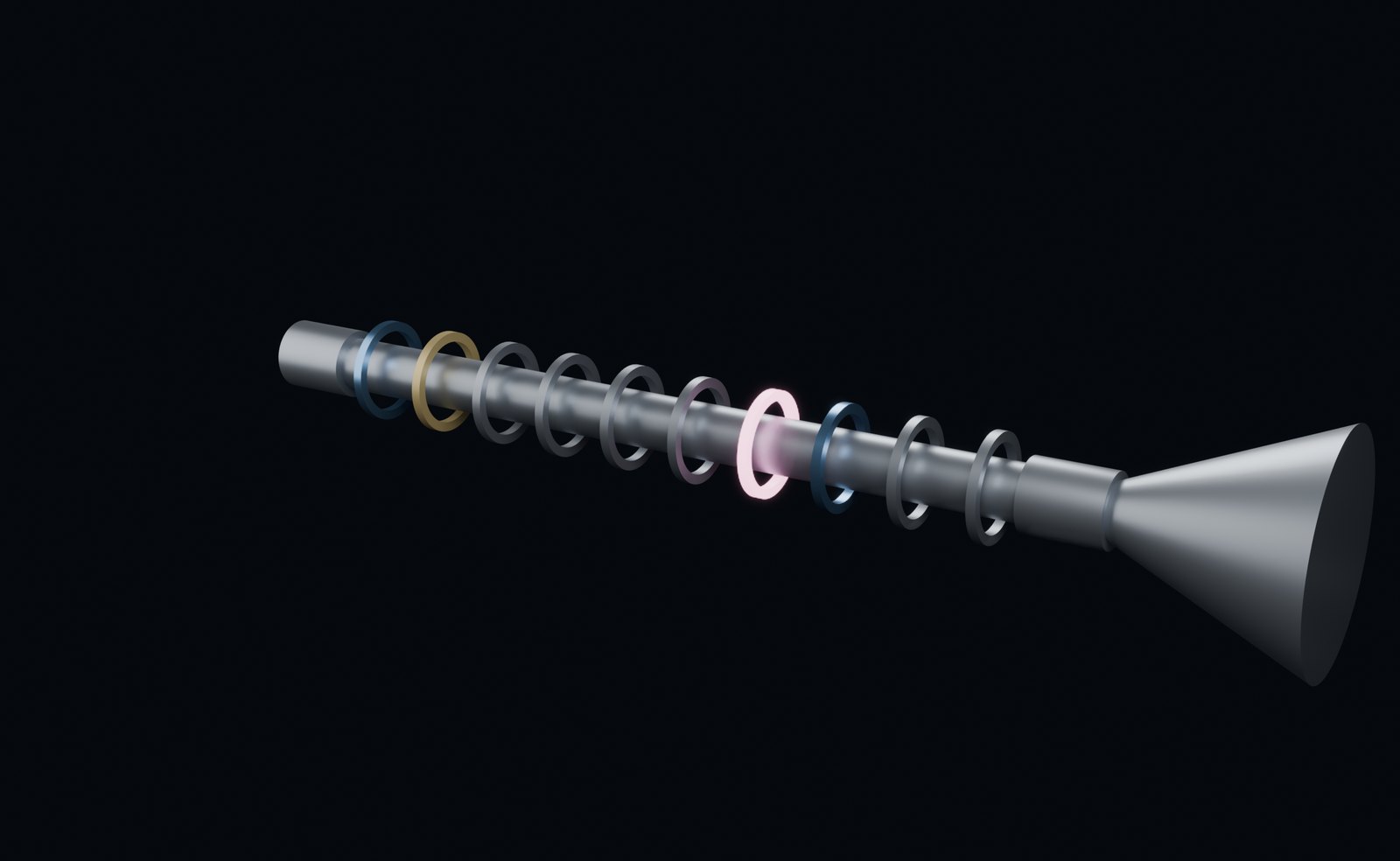
The direct converter sees alphas, protons, and thermal ions across a wide energy range; the spectrum sets the achievable conversion efficiency.
What arrives at the converter
The exhaust reaching the direct converter is a mix. The primary D–3He reaction contributes 3.6 MeV helium-4 nuclei and 14.7 MeV protons. On top of these fusion products sit the thermal fuel ions leaving the plasma at energies of order the ~90 keV operating temperature, plus electrons. The converter must handle all of them.
A broad spectrum is harder to convert efficiently than a monoenergetic beam, because a single collector voltage can only be well-matched to one energy. Staged collectors mitigate this, but the spread — especially the two orders of magnitude between thermal ions and the 14.7 MeV proton — is a real efficiency penalty that must be designed around.
Why the spectrum is fixed
The product energies are set by the reaction kinematics and cannot be changed; the thermal component is set by the operating temperature. So the converter design is constrained by physics on the input side: it must extract the most from a spectrum it does not control.
A practical converter recovers most, not all, of this spectrum's energy, and the fraction it misses reappears as heat that a conventional cycle must handle. Quoting an honest conversion efficiency therefore means integrating over this real spectrum rather than assuming a monoenergetic beam, and it is one of the inputs to the engineering gain the burner is judged on.
- 3.6 MeV α + 14.7 MeV p from the primary branch
- Thermal fuel ions near ~90 keV, plus electrons
- Broad spectrum limits single-stage efficiency
- Product energies fixed by reaction kinematics