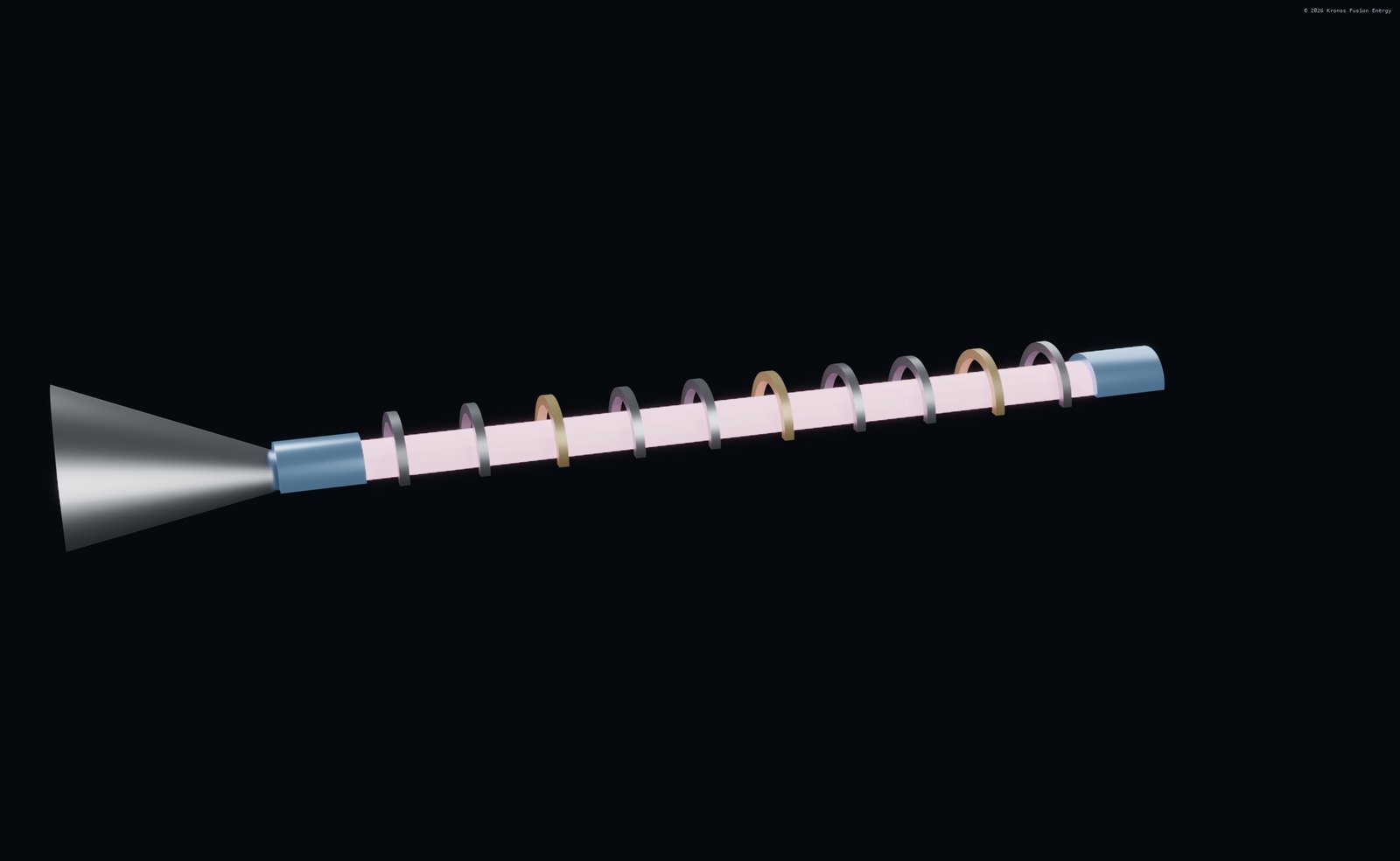
DEC Efficiency Versus the Thermal Cycle
Direct conversion of charged particles can exceed a steam cycle's efficiency, but real losses and the neutron fraction keep it below unity.
The efficiency case, honestly
A steam cycle is bounded by the Carnot limit and typically converts heat to electricity at roughly a third efficiency. Direct energy conversion sidesteps that bound because it never thermalises the charged energy — it decelerates ordered particle motion against a voltage. In principle this reaches much higher efficiency, which is the central appeal of pairing D–3He with an open geometry.
But it is not free. Real DEC efficiency is degraded by the broad particle spectrum, secondary-electron emission, space-charge limits, incomplete collection, and the fraction of energy that arrives as heat anyway — the 5.44% neutron energy and any thermalised losses. Those heat streams are recovered with a conventional (Carnot-limited) cycle.
Netting it out
The honest figure is a high but sub-unity conversion of the charged channel, combined with a modest thermal recovery of the rest, minus the recirculating power for plugs and injectors. That net number is what the engineering gain QE must be built on — not the theoretical ceiling.
The honest way to report the number is end-to-end: charged energy converted at high but sub-unity efficiency, plus a modest thermal recovery of the neutron and thermalised fraction, minus recirculating power. Any single headline figure that omits the recirculating draw or the thermal remainder would overstate the machine, which is why the engineering gain, not the converter efficiency, is the figure of record.
- Bypasses Carnot for the charged channel
- Degraded by spectrum, secondaries, space charge
- Neutron + thermal energy still Carnot-limited
- Recirculating power charged against the net