Plasma Heating Methods
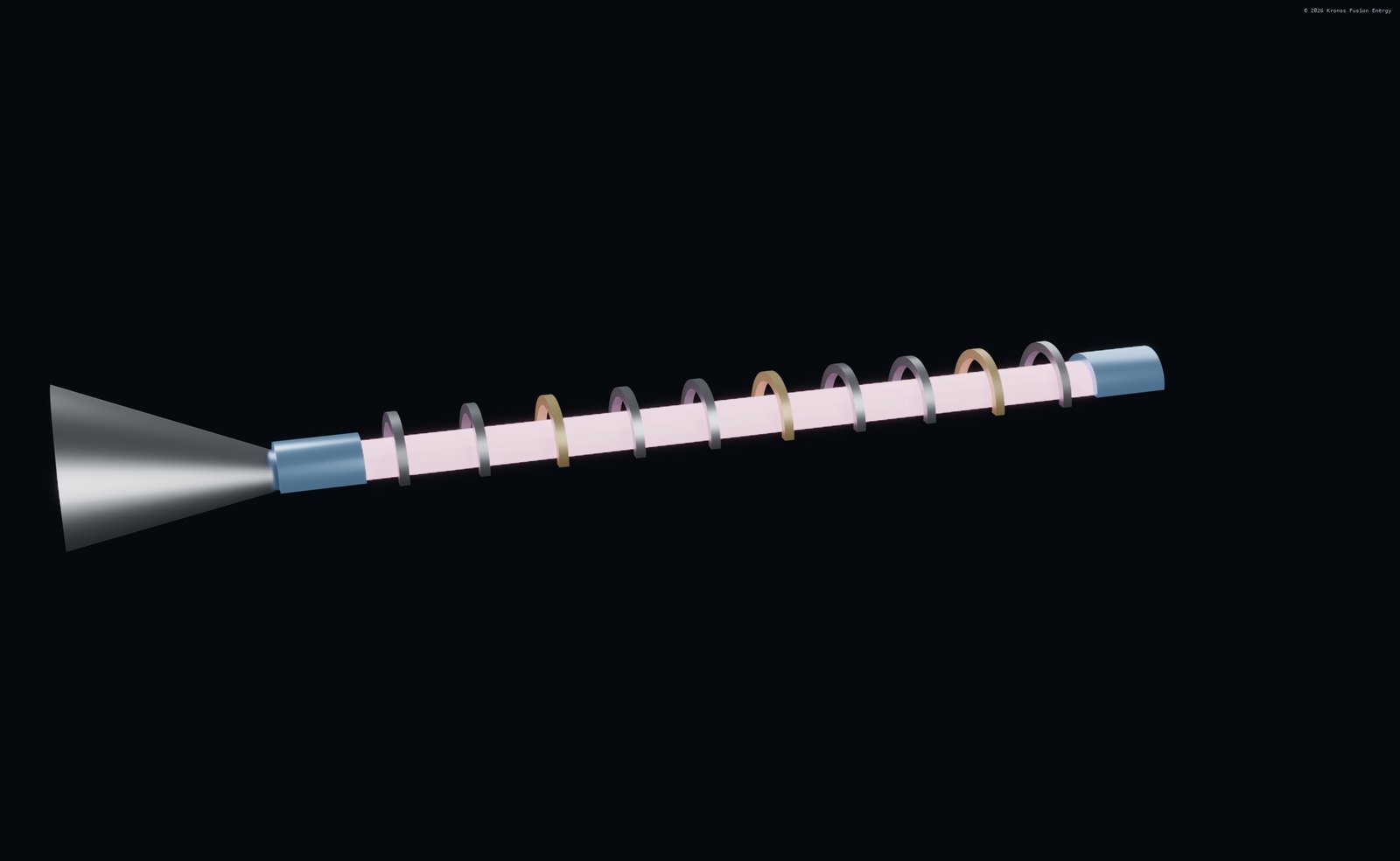
Neutral beams, ion-cyclotron and electron-cyclotron waves heat the plasma and build the plug populations that sustain confinement.
Reaching and holding 90 keV
No plasma heats itself to ~90 keV from cold. External heating both raises the temperature and, critically in a tandem mirror, creates the fast-ion and hot-electron populations that build the confining potential. Three methods carry the load: neutral-beam injection (NBI), ion-cyclotron resonance heating (ICRF), and electron-cyclotron heating (ECH).
NBI injects energetic neutral atoms that ionise and become the sloshing ions that shape the plug potential. ICRF deposits energy resonantly into the ions, supporting the hot-ion mode that keeps fusion power ahead of bremsstrahlung. ECH heats electrons locally, which is how the thermal barrier and the elevated plug potential are created and maintained.
Heating as confinement
In most machines heating and confinement are separate concerns; in a tandem mirror they are the same problem. The heating systems do not just warm the plasma — they build the very potential structure that confines it. Their power draw is therefore recirculating power that counts directly against the engineering gain.
Because the heating systems are also the confinement systems, their efficiency is a first-order term in the machine's viability rather than a secondary balance-of-plant concern. Improving injector and wave-heating efficiency directly raises the engineering gain, and any shortfall there compounds with the plug gates — which is why heating technology sits close to the centre of the burner's physics case.
- NBI: creates sloshing ions, shapes potential
- ICRF: sustains the hot-ion mode
- ECH: builds thermal barrier and plug potential
- Heating power is recirculating power