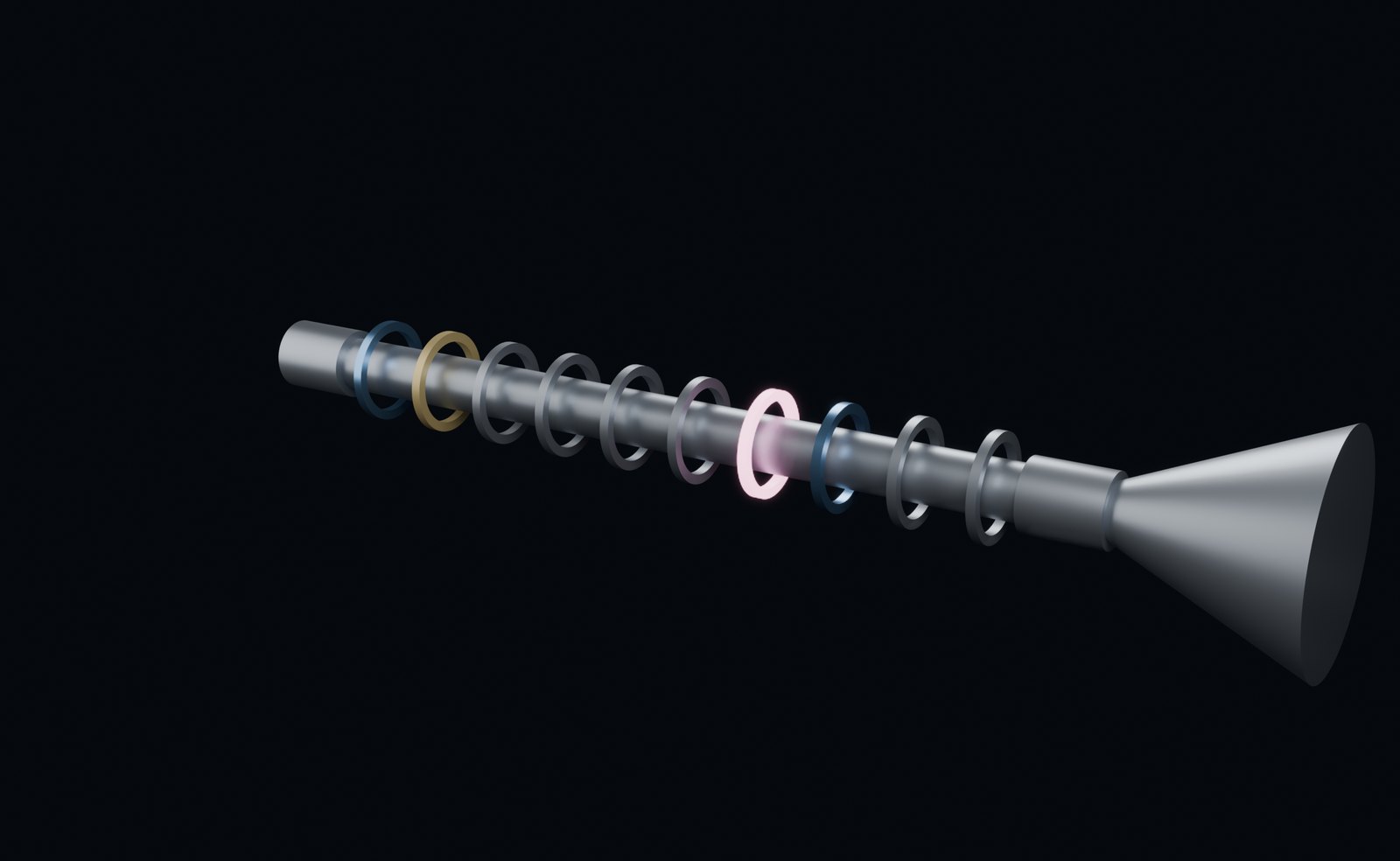
The Magnetic Mirror Principle
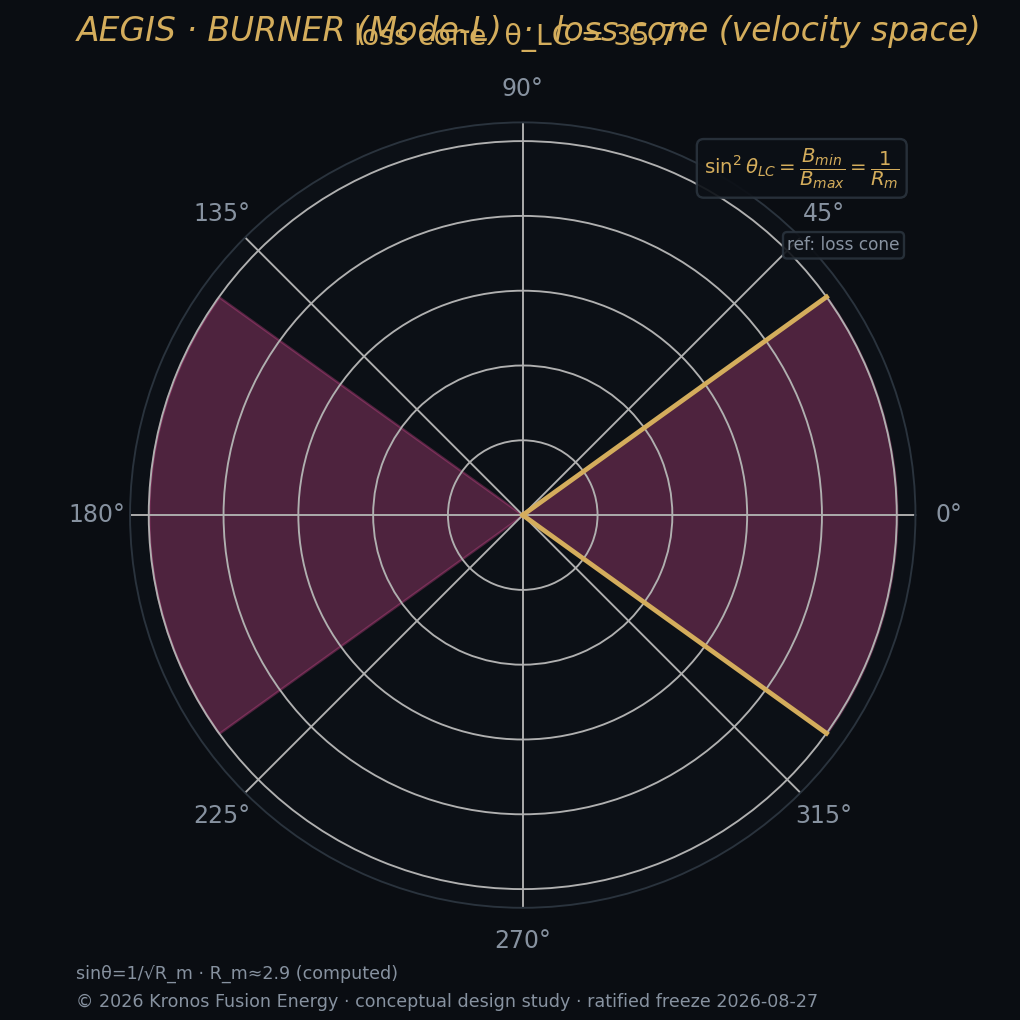
A charged particle's magnetic moment is conserved, so it is reflected where the field strengthens — unless its velocity lies inside the loss cone.
Reflection by a magnetic gradient
A charged particle gyrating around a field line has an adiabatic invariant, the magnetic moment μ = mv⊥2/2B. As it moves into a stronger field, B rises, so v⊥ must rise to keep μ fixed — and since total energy is conserved, v∥ falls. If the field is strong enough, v∥ reaches zero and the particle is reflected: a magnetic mirror.
Reflection only works if enough of the particle's energy is in perpendicular motion. Particles moving nearly parallel to the field — inside the loss cone — are not reflected and escape out the end. The mirror ratio R = Bmax/Bmin sets how wide the loss cone is: higher R, narrower cone, better confinement.
The limit of a simple mirror
Even a strong mirror always leaves a loss cone open, and collisions constantly scatter particles into it. A pure mirror therefore cannot confine a fusion plasma well enough on its own. The tandem mirror's electrostatic plugs are the answer to this fundamental leak.
The adiabatic invariance of μ holds only when the field changes slowly compared with a gyration; near the sharp throat this can break down, letting some particles slip through that a naive calculation would confine. Real designs account for this non-adiabaticity, which is one more reason the throat and plug fields, and their profiles, are specified so tightly.
- μ = mv⊥2/2B is conserved
- Rising B converts parallel to perpendicular motion
- Loss cone: particles too parallel escape
- Mirror ratio R = Bmax/Bmin sets cone width