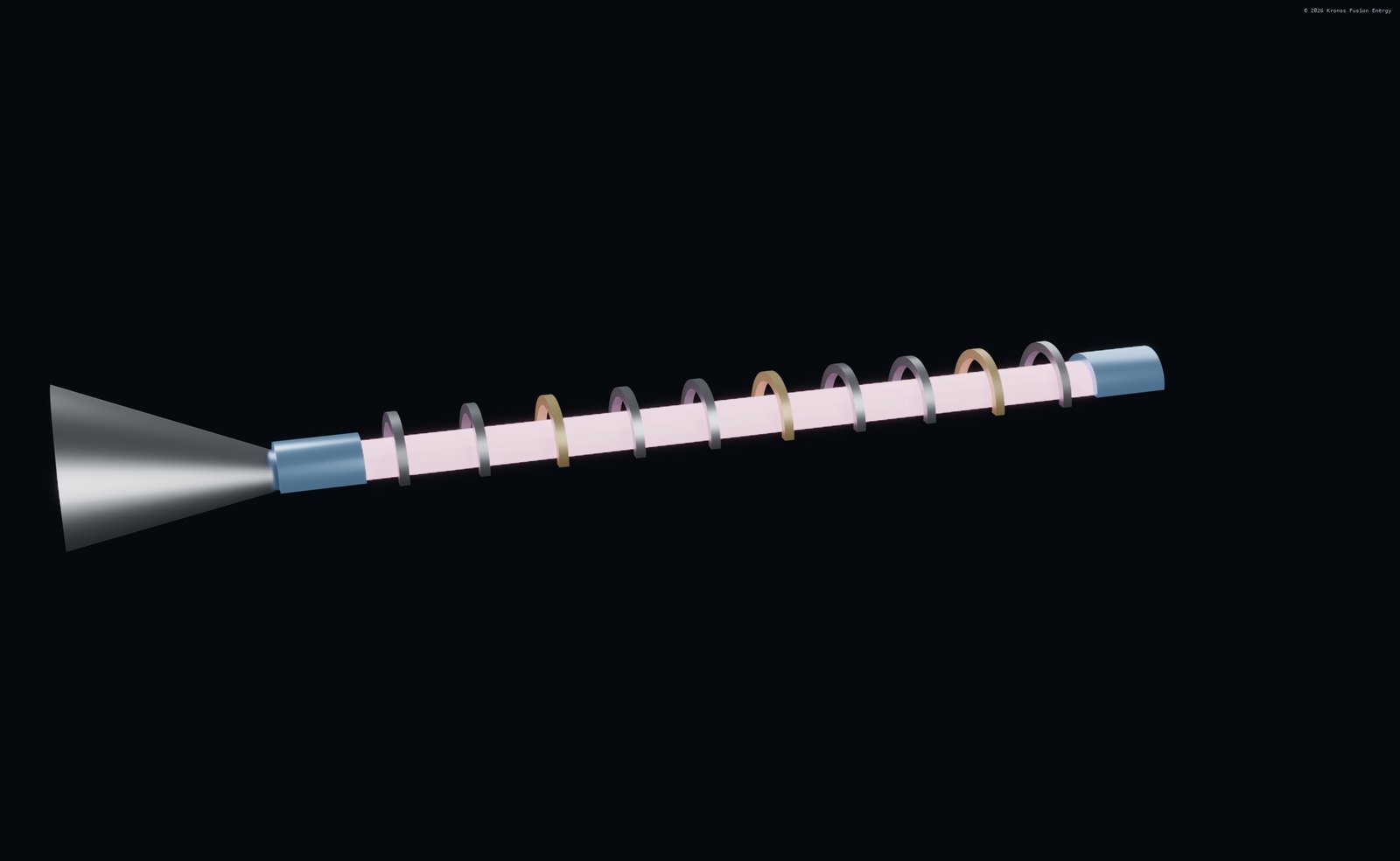
The Physics of the Burner at a Glance
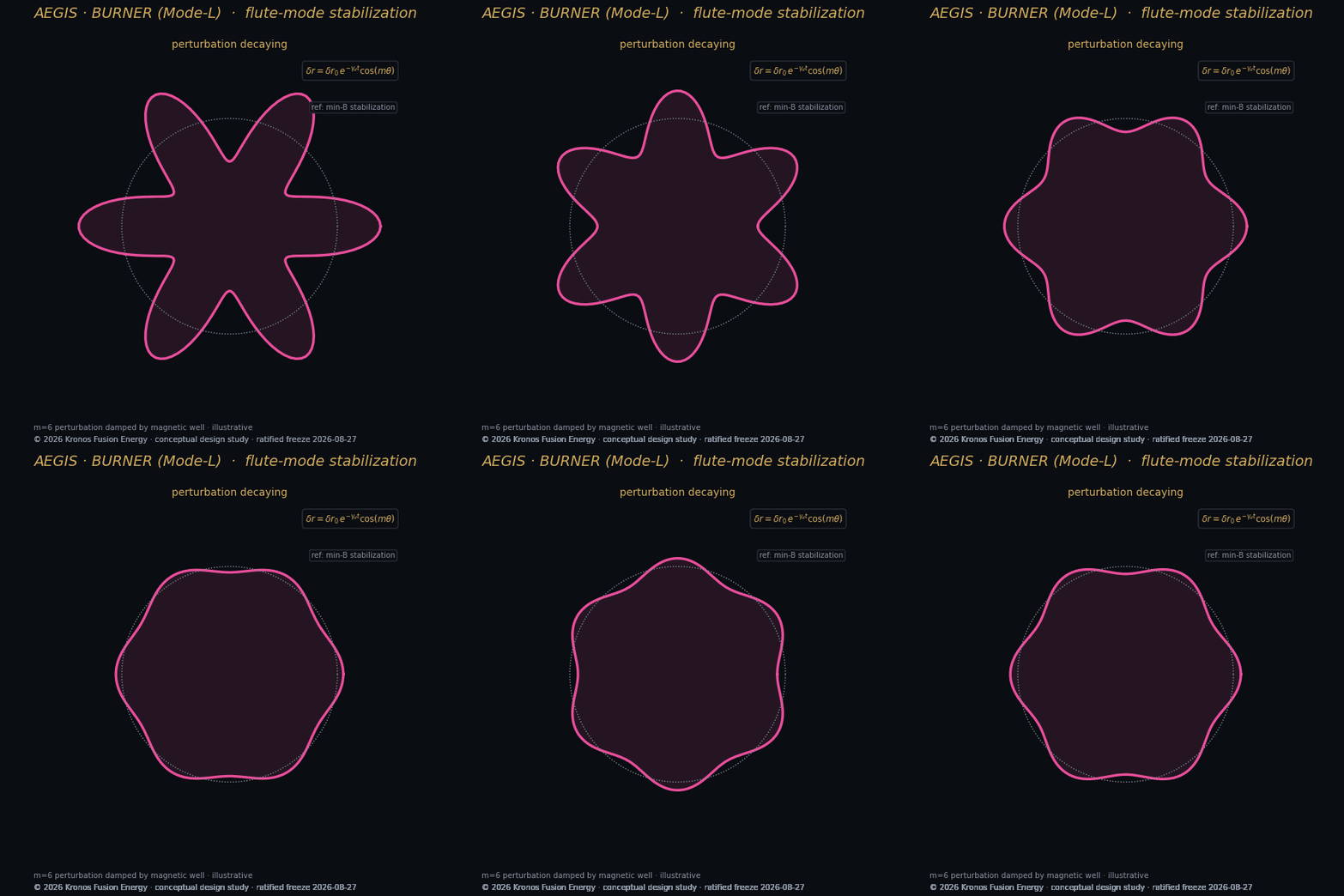
The burner (Aegis) runs deuterium and helium-3 in a tandem-mirror geometry, converting mostly charged products directly to electricity.
One reaction, one geometry, one conversion path
The burner (Aegis) is a deuterium–helium-3 (D–3He) tandem-mirror generator. Three physics choices define it: the fuel (D–3He, whose main branch releases its energy in charged particles), the confinement (an open-ended magnetic mirror plugged electrostatically at both ends), and the conversion (direct energy conversion of charged particles to DC electricity, with no steam cycle).
These choices are coupled. D–3He yields charged protons and alpha particles that an open geometry can let stream out along the field into a direct converter. That is only attractive if the neutron output stays low — here it is a 5.44% neutron fraction, which is low-neutron, not aneutronic. The operating point that makes this practical is around 90 keV ion temperature.
Design and Validation, stated plainly
Everything on these pages is an engineering program. The burner is not built. Its physics carries four honest gates — end-plug coil stress, an unprecedented plug operating regime, a helium-3 supply that does not yet exist at scale, and availability short of hyperscale requirements. We state each one at full strength rather than soften it; they are physics facts, not marketing.
Read as a system, the burner is legible: a fuel chosen for charged output, a geometry chosen to let that output stream to a converter, and a conversion path chosen to skip the steam cycle. Each choice tightens the others, and each carries a named gate. The pages in this section trace those couplings from the reaction kinematics through confinement to conversion, and they end where the physics ends today — at the four gates and the test burner meant to start retiring them.
- Fuel: D–3He, ~5.44% neutron fraction (low-neutron)
- Geometry: tandem mirror, 26.49 T plug / 17 T throat
- Operating point: ~90 keV ion temperature
- Conversion: direct energy conversion, no steam
- Status: design & simulation; test burner ~2032