Interchange & Ballooning Modes
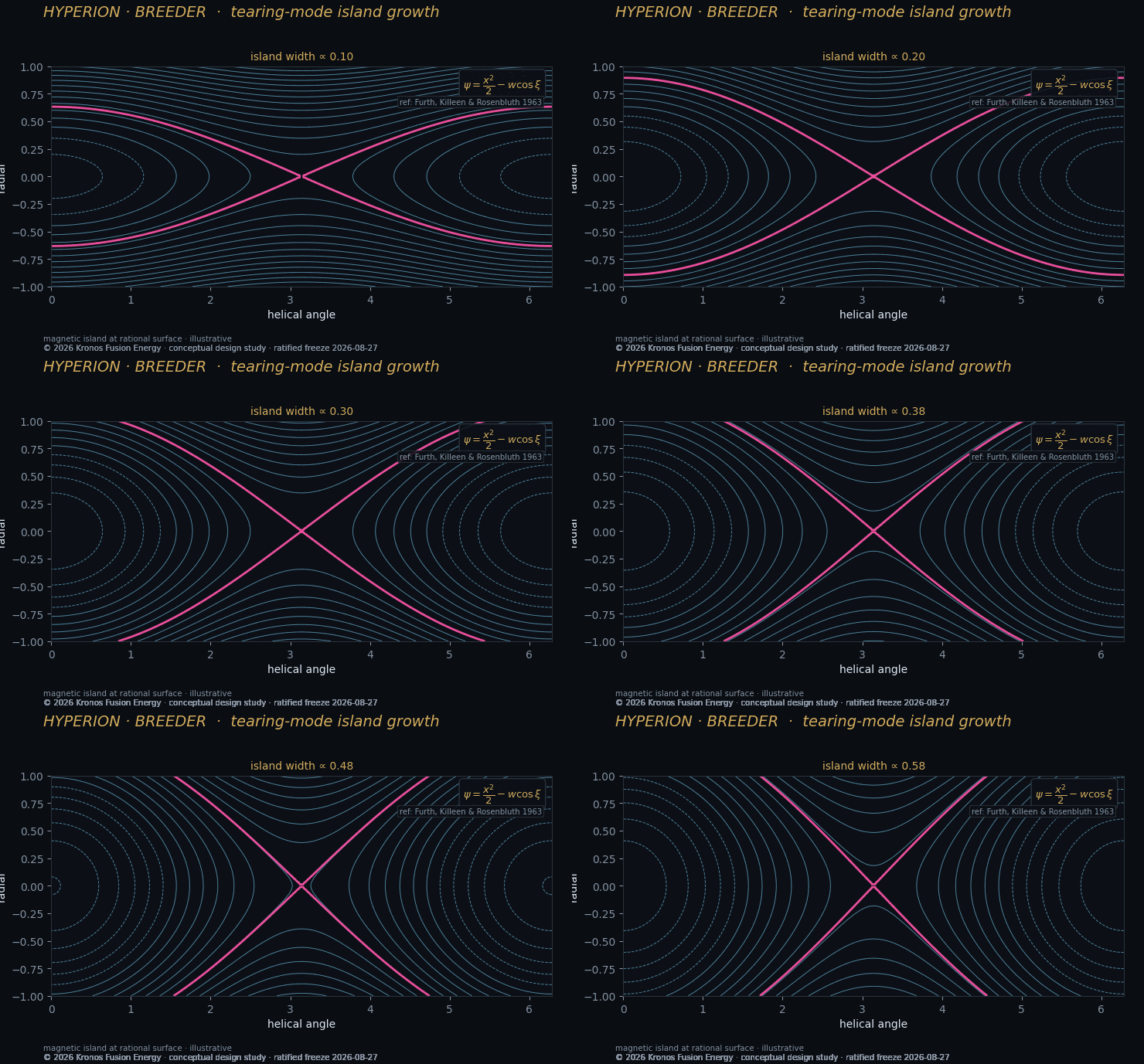
Pressure-driven MHD instabilities in bad-curvature regions must be suppressed for the mirror to hold; the magnetic well is the main defence.
How the plasma tries to escape
Two pressure-driven MHD instabilities threaten the mirror. The interchange (flute) mode swaps a tube of plasma with a tube of vacuum field where the curvature is bad, releasing energy — like a heavy fluid on top of a light one. The ballooning mode is a localised bulge that grows where pressure is high and curvature is unfavourable.
The primary defence is the minimum-B magnetic well, which gives good curvature and removes the free energy that drives interchange modes. Additional stabilisation can come from finite-Larmor-radius effects (which damp short-wavelength modes) and from careful pressure profiling. Sheared plasma rotation, driven by the radial electric field, can further suppress turbulence.
Why it stays on the list
Suppressing these modes at the burner's high beta and extreme fields, in a geometry that also has to satisfy confinement and buildability, has not been demonstrated. The stability of the full configuration at design parameters is part of the physics the test burner (~2032) is meant to probe.
Finite-Larmor-radius stabilisation is helpful precisely because the burner's ions are hot and their orbits large, so short-wavelength modes are naturally damped; the danger is in the long-wavelength interchange that only the well can hold. Distinguishing which modes are controlled by geometry and which by kinetic effects is central to trusting the configuration's stability.
- Interchange: swaps plasma and field in bad curvature
- Ballooning: pressure bulge in high-β regions
- Minimum-B well removes the drive
- FLR effects and sheared rotation add margin