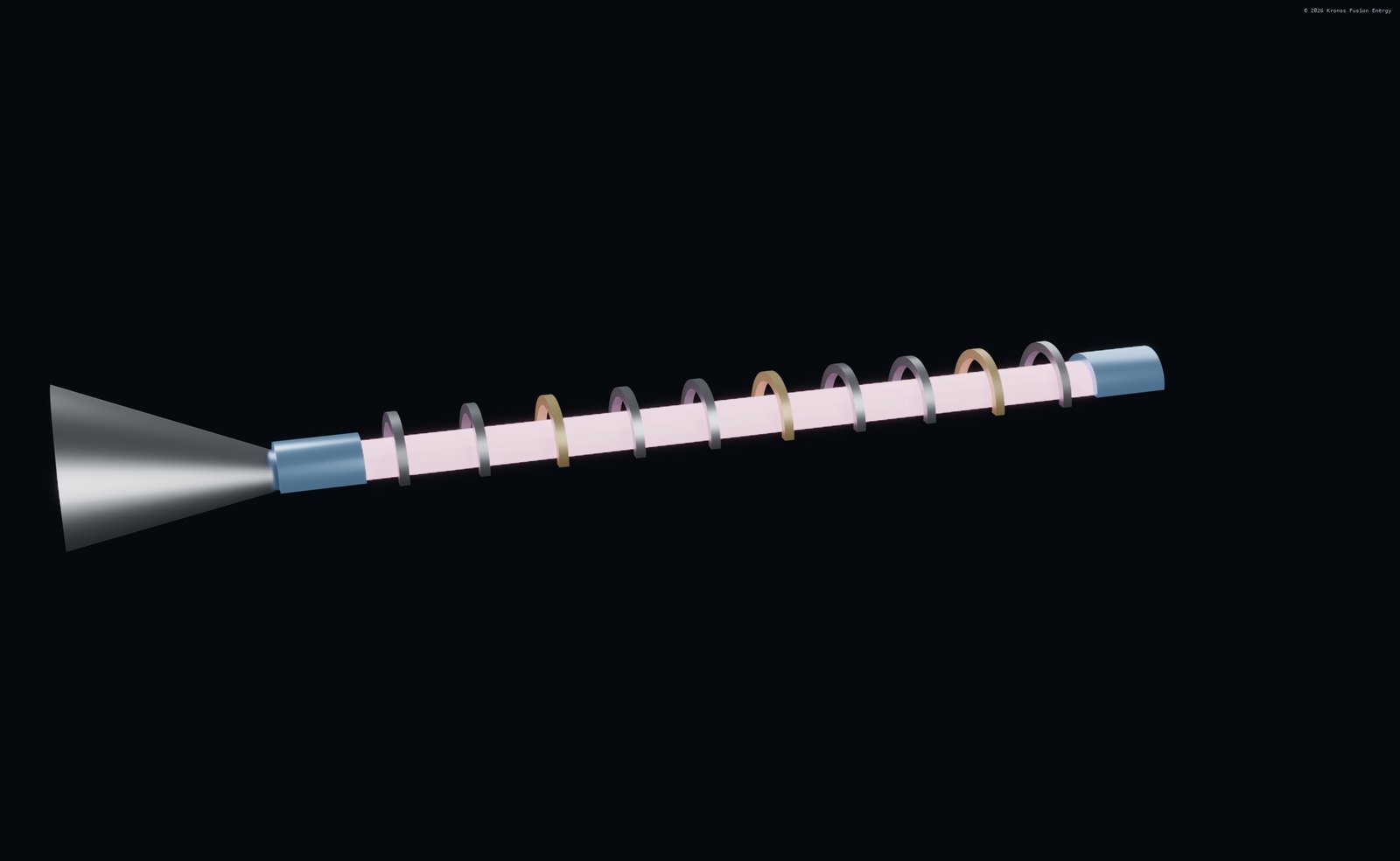
The Direct Converter
A periodic or venetian-blind collector array sorts charged particles by energy and decelerates them against staged voltages for efficient capture.
Sorting particles by energy
A direct converter must decelerate a spread of particle energies efficiently. Two classic geometries do this. A periodic (Venetian-blind) collector uses angled slats at graded potentials, so particles are captured on the electrode whose voltage best matches their energy. A gridded converter uses a sequence of transparent grids at rising potential, each reflecting lower-energy particles and passing the fastest to the deepest, highest-voltage stage.
Matching each particle to a collector near its own energy is what makes the conversion efficient: energy dumped as heat at a mismatched electrode is lost. The design must handle a broad energy spectrum — 3.6 MeV alphas and 14.7 MeV protons from the primary reaction, plus a thermal spread — across a large collector area to keep power density and secondary emission manageable.
Engineering constraints
Real converters contend with secondary electrons knocked off the electrodes, space-charge limits on how much current a gap can carry, and the sheer area needed at reactor power. These are demanding but conventional high-voltage engineering problems, not open physics gates like the plug.
The area required scales with the power to be converted and the space-charge limit of each gap, so a reactor-scale converter is physically large — a hall of electrodes rather than a compact unit. That size is a known engineering burden, and it interacts with the expander geometry that delivers and spreads the particle stream, but it does not carry the open-physics uncertainty that the plug does.
- Venetian-blind or gridded geometries
- Match particle energy to collector voltage
- Must span MeV-scale product energies
- Limited by secondaries, space charge, area