The Honest Gates, Together
Four physics gates define the burner's design stage: plug coil overstress, an unprecedented plug regime, a helium-3 shortfall, and availability short of Tier III.
The four gates, in one place
The burner's physics is promising and its gates are real. We state all four at full strength, because honest gates are what make the promise credible. None of them is an economic claim; each is a physics-and-engineering fact about a machine that is an engineering program, not yet built.
| Gate | Statement | Consequence |
|---|---|---|
| Plug coil | Overstressed ~3–3.9× at the design bore | Infeasible as specified |
| Plug regime | 166–830× beyond any device | Cannot be post-dicted today |
| He-3 supply | ~400× domestic supply per unit | Needs breeder-bred + lunar He-3 |
| Availability | 0.86–0.995 vs Tier III 0.99982 | 30–100× short; not a sole source |
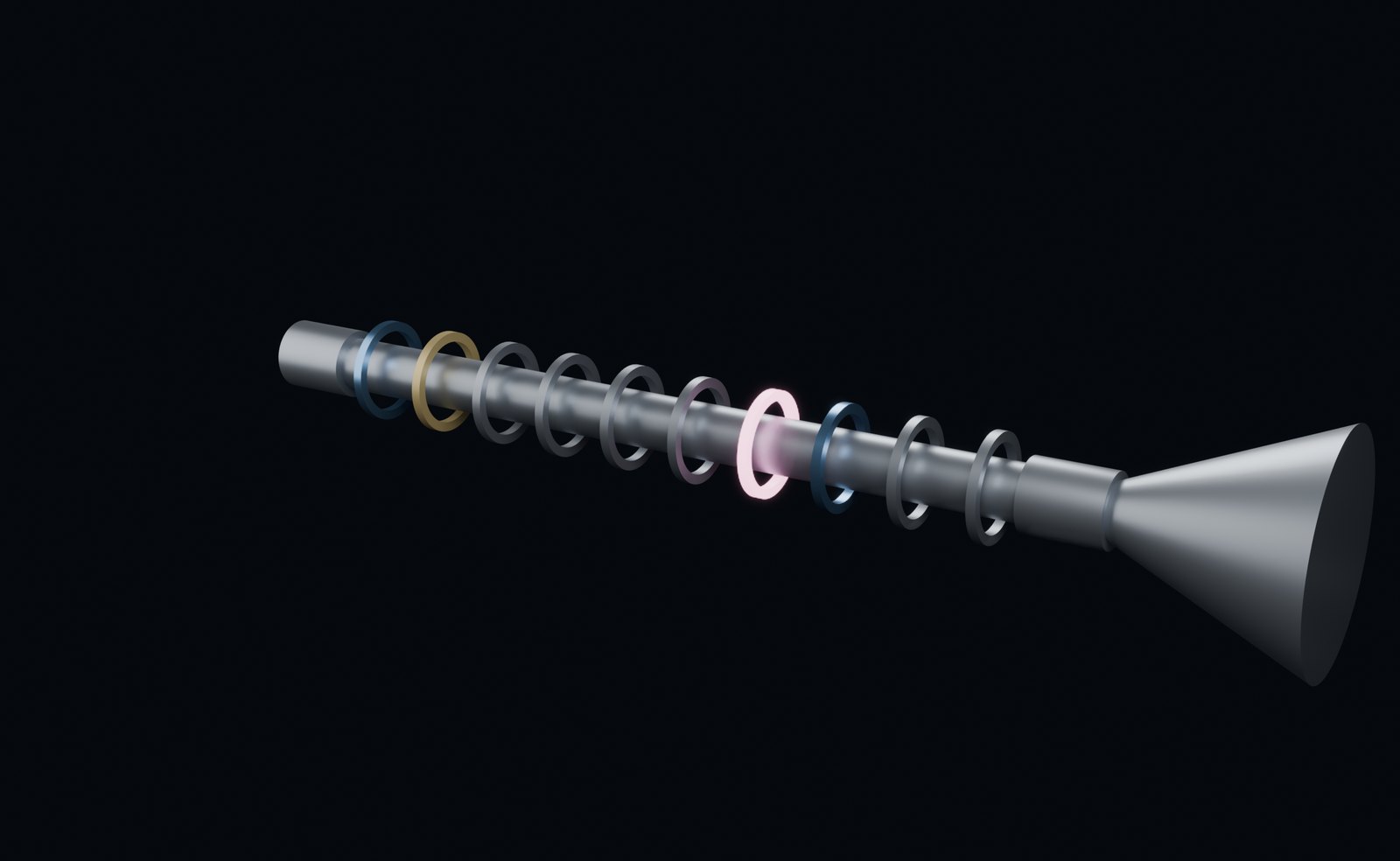
Two of the four — coil overstress and the plug regime — live in the end plug, the heart of the tandem mirror, and are coupled: the field that the plug needs is the field that breaks the coil, and the regime that field enables has never been tested. The other two are systemic: the fuel the machine burns does not exist at scale, and its uptime, as modelled, trails the most demanding standard.
Why they are shown, not hidden
A design that hides its gates cannot be trusted on anything else. By stating the 3–3.9×, 166–830×, ~400×, and 30–100× figures exactly, we make clear what must be solved before the burner is more than a study — and why the program builds the breeder first and stages the burner through a test machine (~2032) toward a commercial design (~2036).
Presented together, the gates also show a path: two are magnet-and-plasma problems concentrated in the end plug that a staged experimental program can attack directly, one is a fuel-supply problem the breeder is built to solve, and one is a reliability problem that improves with maturity and pairing. None is waved away, and none is presented as already solved — which is the whole point of stating them.
- Plug coil overstress: ~3–3.9×
- Plug regime: 166–830× beyond devices
- He-3 demand: ~400× domestic supply
- Availability: 0.86–0.995 vs 0.99982