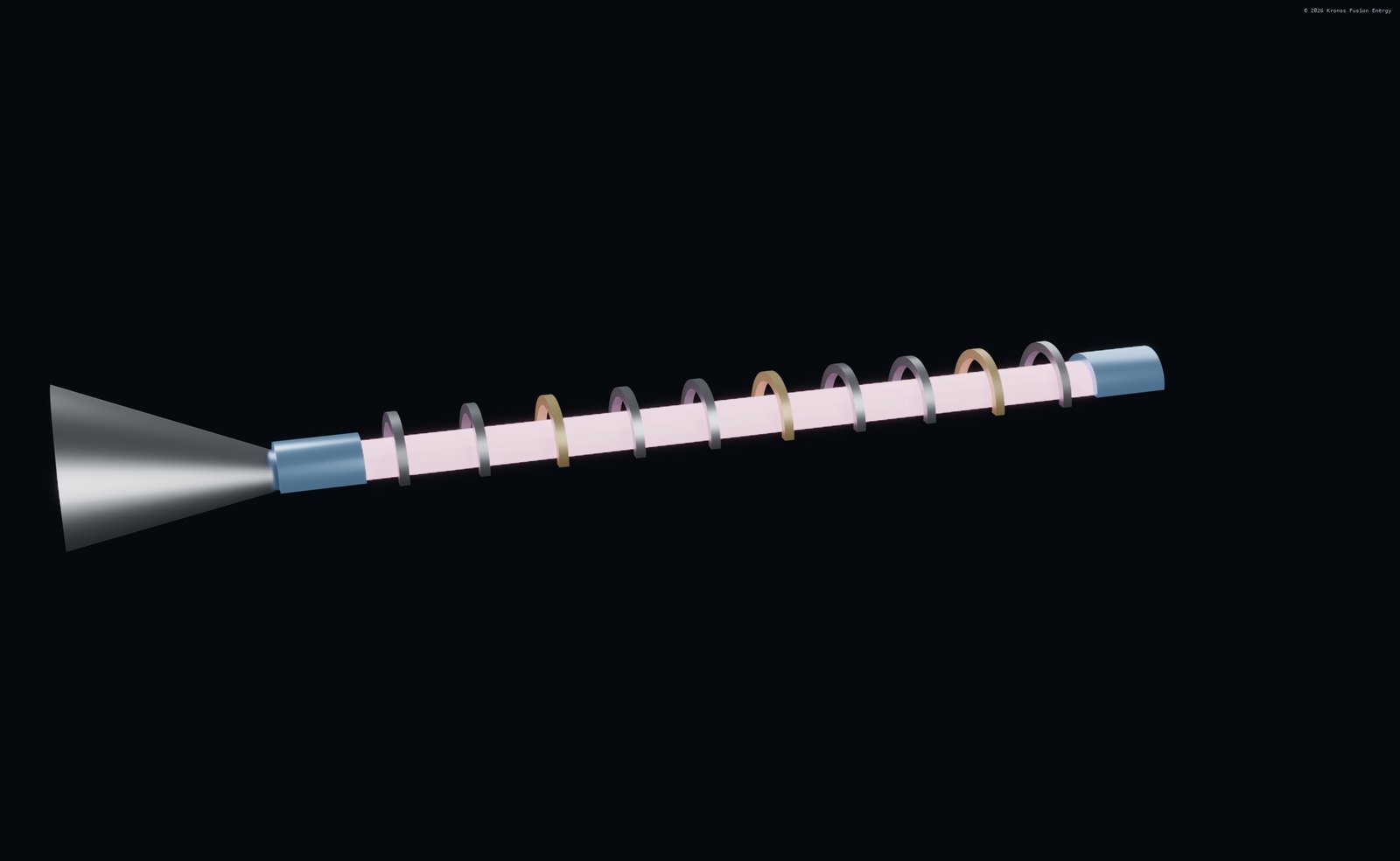
Steady-State Burn
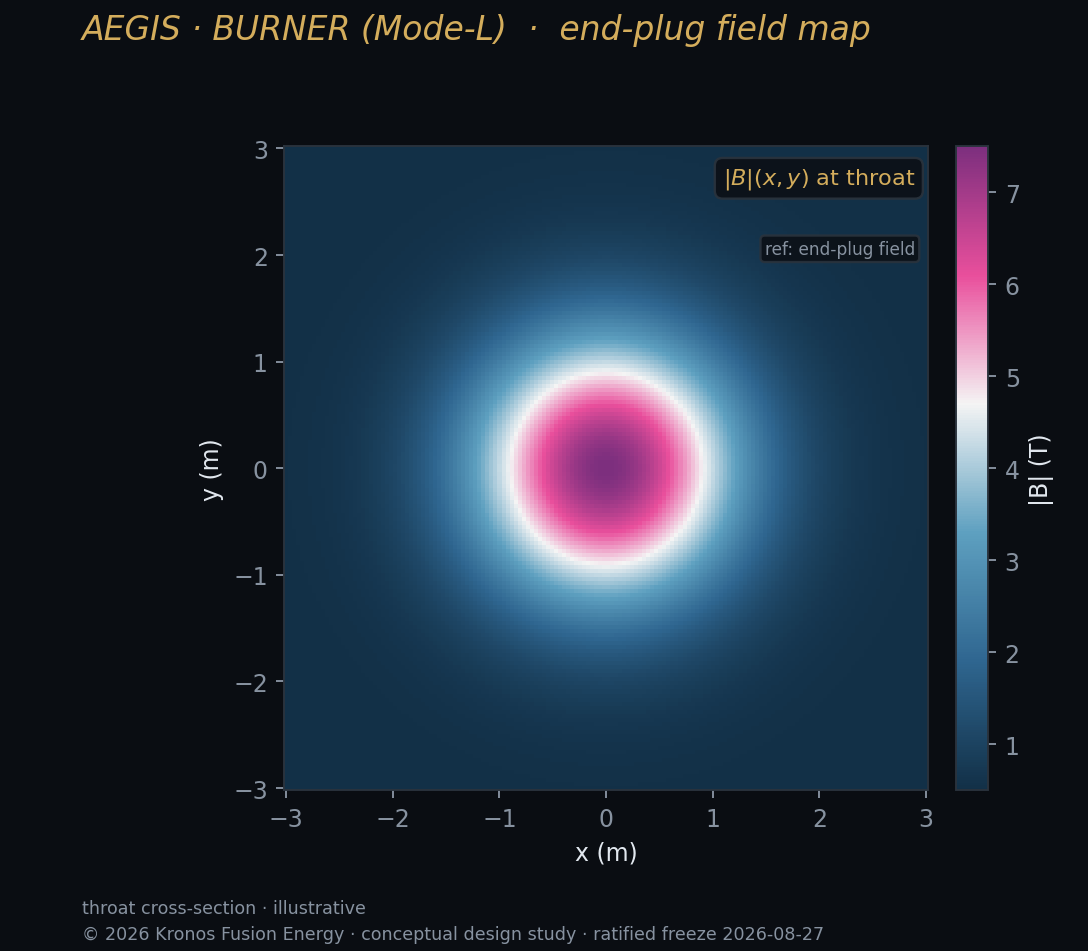
Once established, the burner runs continuously: fuel in, ash out, power out, with the plug potential and fields held steady against losses.
Unlike a pulsed machine, the burner is designed to run steady-state. Once the plug potential is established and the central cell is burning, the machine holds that state continuously: deuterium and helium-3 are fed in, helium-4 ash and spent gas are pumped out, and the charged fusion products stream to the DEC as power. Heating replaces end and radiation losses to keep the plasma at temperature.
Steady operation is a balance. Fueling matches burn-up; pumping matches ash production; heating matches losses; the plug plasma is continuously sustained to hold the potential. The control system trims all of these to keep the operating point fixed. A steady-state generator is what makes the burner a base-power machine rather than a pulsed experiment.
What must stay balanced
- Fueling rate against fuel burn-up
- Ash pumping against helium-4 production
- Heating power against end and radiation losses
- Plug sustainment against plug-plasma decay
- Exhaust conditions against the DEC's design window
- Impurity influx against radiation losses
Impurity control is part of the balance: high-Z impurities sputtered from walls or electrodes radiate strongly and cool the plasma, so the edge and first-wall condition feed back into whether the burn holds. A steady burn is thus a balance not only of fuel and heat but of cleanliness, watched continuously by the control system.
The reliability question
Steady-state is the goal; sustaining it without interruption is the availability gate. The machine can run continuously in principle, but faults — a quench, a plug-potential loss, a pump failure — break the steady state and take time to recover. The projected 0.86–0.995 availability reflects how often that balance is expected to be interrupted, honestly short of a 0.99982 Tier III target.
All figures are design and validation values for a machine not yet built.