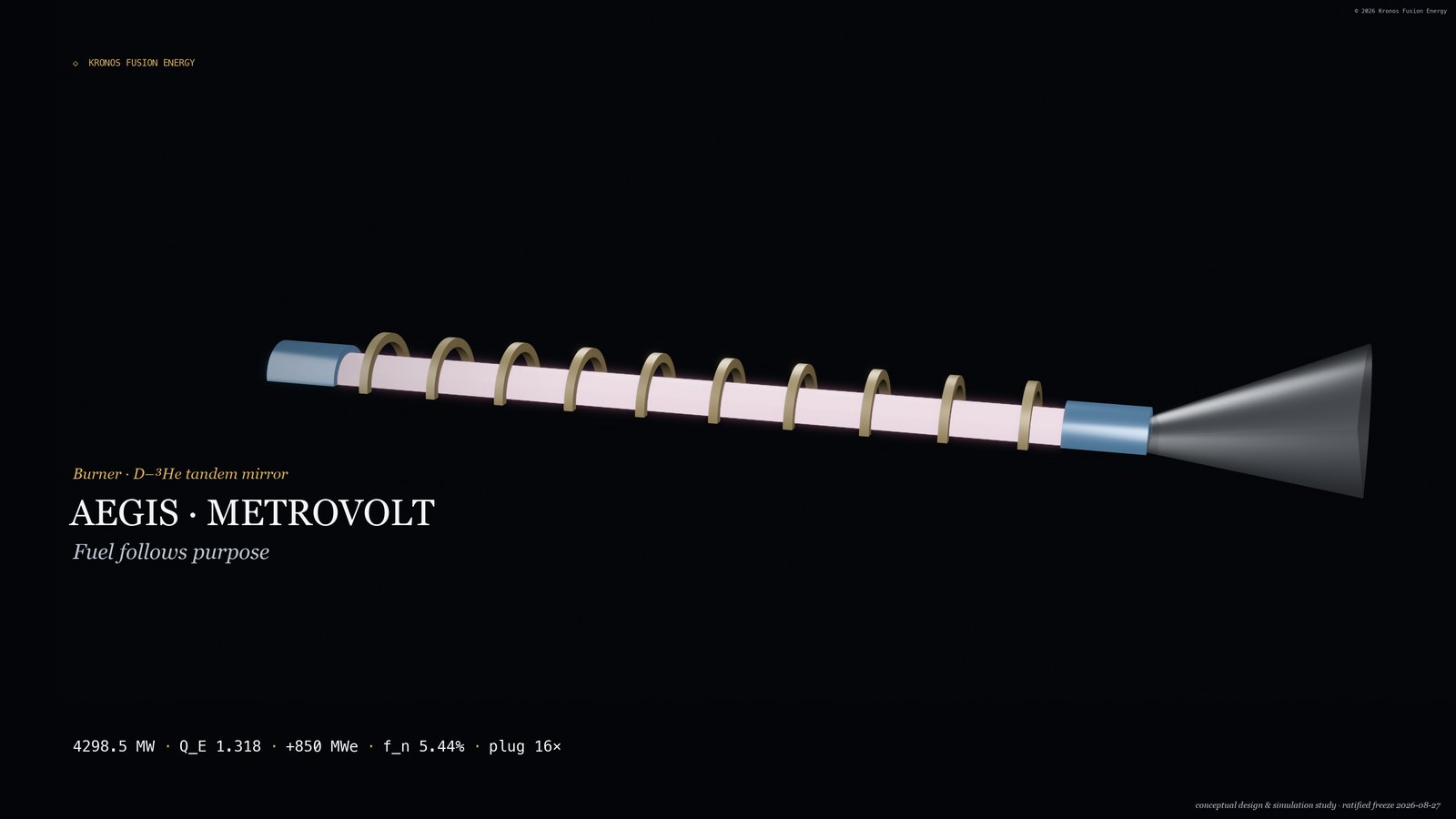
End-Loss Physics
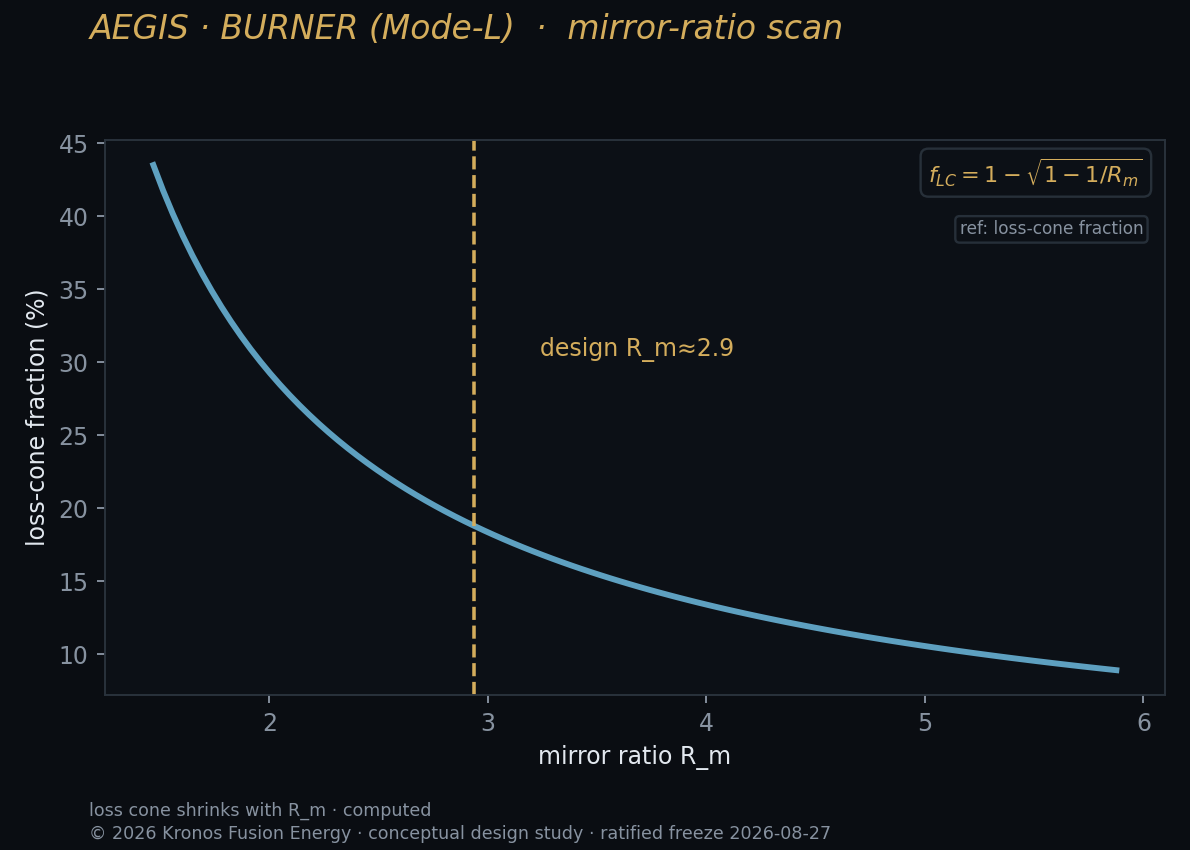
End loss is the axial escape of particles through the mirror; in the burner it is not waste but the power stream fed to direct conversion.
Every open magnetic machine loses particles out its ends. Collisions continually scatter ions and electrons into the loss cone, from which they stream along the axis and out through the mirror. In a closed torus this channel does not exist; in a mirror it is intrinsic. The rate of end loss, set by the mirror ratio and the plug potential, is a primary determinant of how well the machine confines.
The tandem-mirror design suppresses ion end loss with the ambipolar potential, so the fuel ions are held far longer than a simple mirror would allow. What still escapes — including the charged fusion products, the 14.7 MeV protons and 3.6 MeV helium-4 nuclei — carries real power out the ends. The burner is built to capture that power rather than dump it.
Two kinds of end flux
- Scattered fuel ions — minimized by the plug potential
- Fusion products — deliberately allowed out to the DEC
- Electrons — flow to balance charge and set the ambipolar potential
- Helium-4 ash — exhausted axially to keep the burn clean
Why open geometry pays off here
The same open ends that make confinement hard make the exhaust ideal for direct conversion: it is axial, magnetized, and dominated by charged particles. A tokamak must extract fusion power as heat through a wall; the burner routes most of it as directed ion kinetic energy straight into a converter. End-loss physics, usually a mirror's weakness, is what enables the burner's steam-free power path.
All figures are design and validation values for an unbuilt machine.