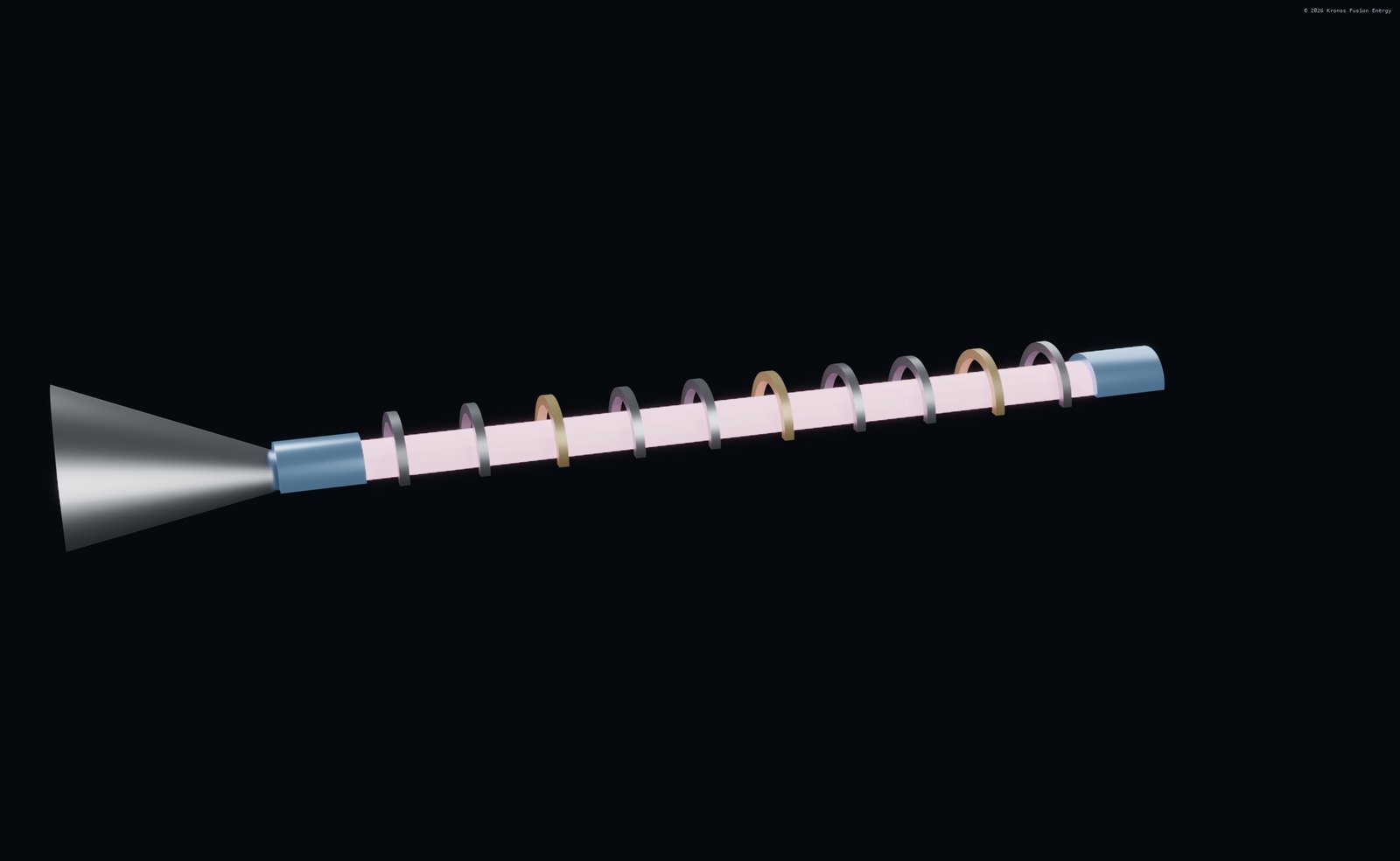
Plug Field Strength 26.49 T
The plug coils are specified at 26.49 T, the field needed to confine the plug plasma that builds the tandem barrier.
The 26.49 T plug field is set by the physics it must serve, not chosen for its own sake. To build an ambipolar potential tall enough to reflect central-cell ions near 90 keV, the plug plasma must be dense and well confined, and that requires a very high mirror field. The 26.49 T figure is the design point that closes the confinement chain in simulation.
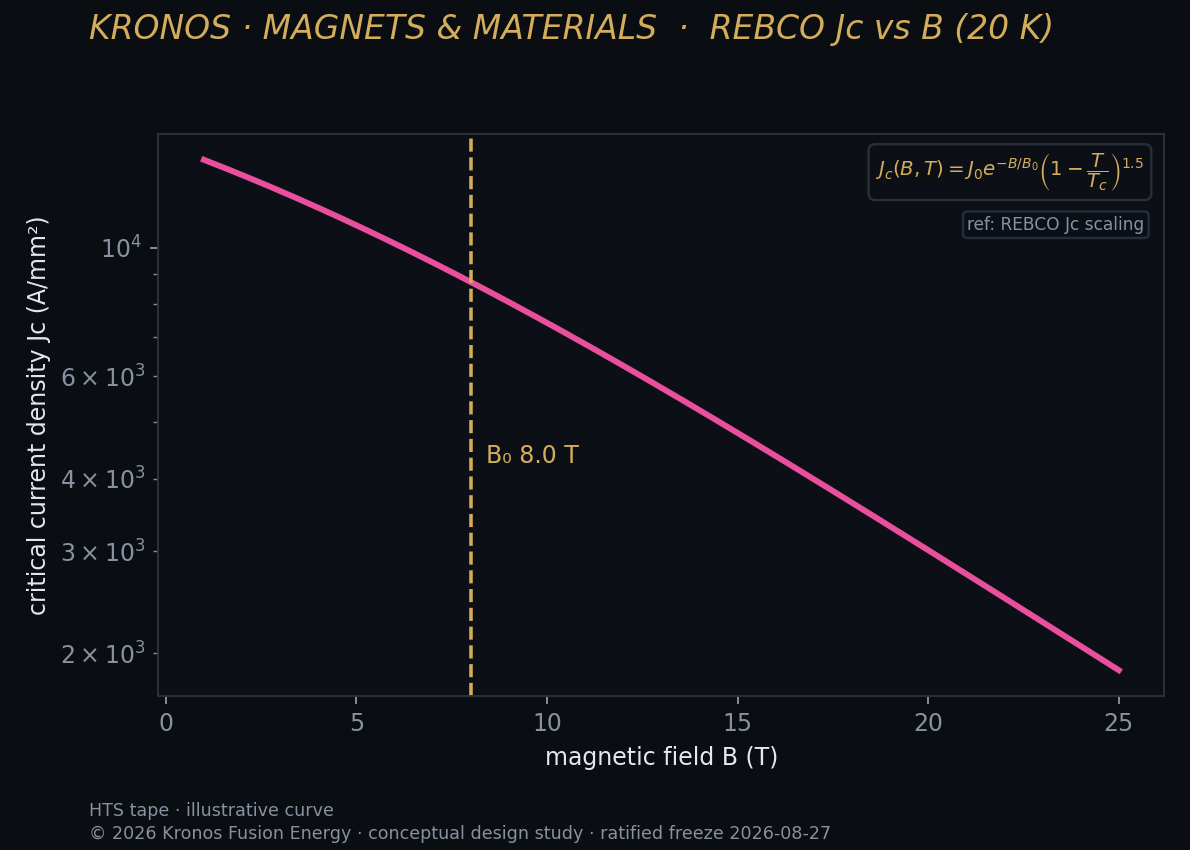
For scale, 26.49 T is well above the field of a large superconducting research magnet and above the peak field of the breeder (Hyperion), which reaches 16.84 T. Sustaining it steady-state over a plasma-relevant bore, at both ends, is the central engineering demand of the burner.
Why so high
- Confines a dense plug plasma in a small volume
- Sets the mirror ratio at the plug end
- Enables an ambipolar potential above central-cell ion energy
- Allows the central cell to run at lower field and larger volume
- Applies symmetrically at both machine ends
The cost of the field
Magnetic pressure scales with the square of the field, so going from the 17 T throat to the 26.49 T plug more than doubles the mechanical load the coil structure must carry. This is the direct source of the plug-coil stress gate: as specified, the structure to hold 26.49 T over the plug bore is overstressed by roughly 3–3.9x. The field level is physically motivated; the structure to hold it is the unsolved part.
All values are design and validation figures for a machine not yet built.