Plasma Heating
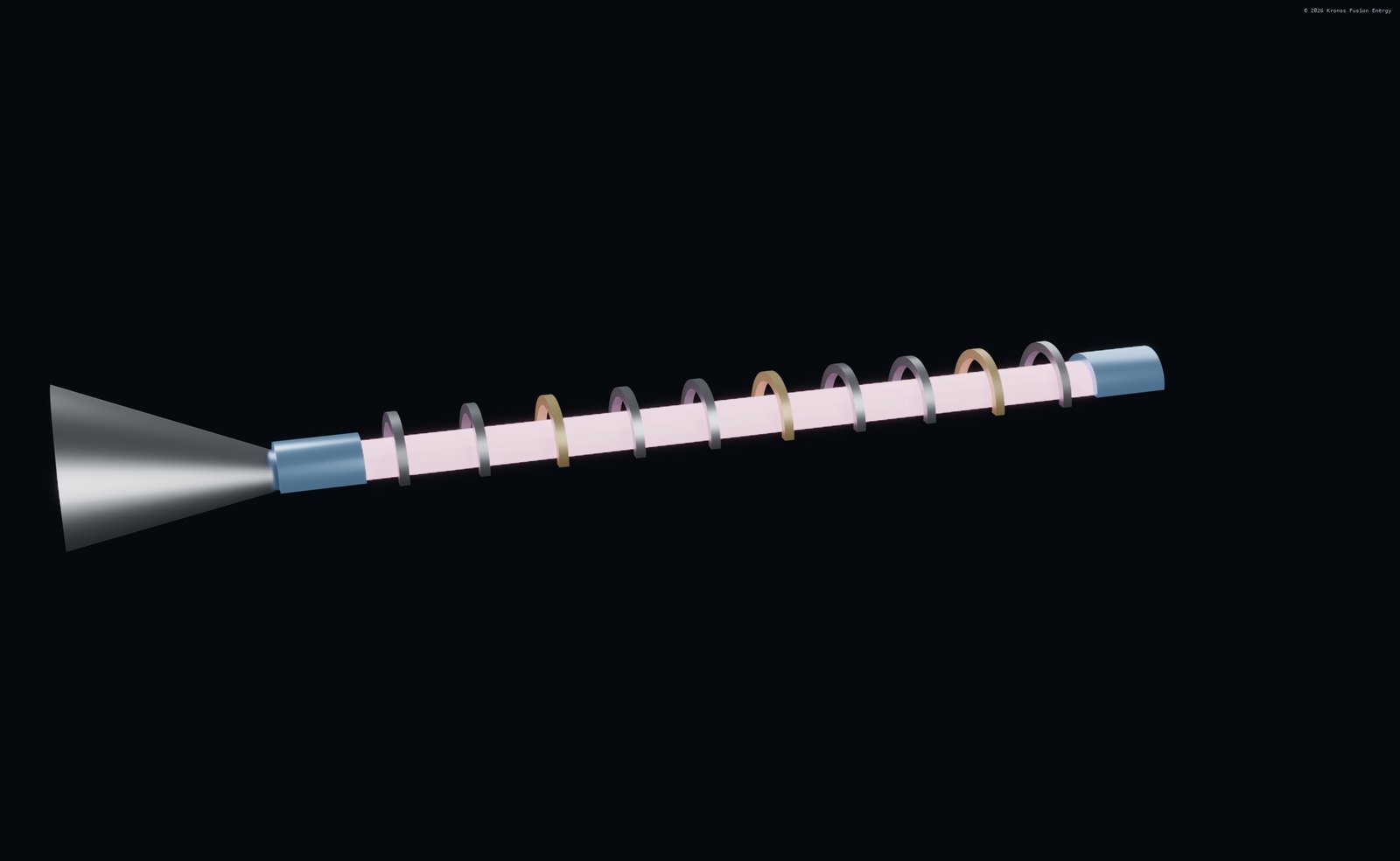
The central cell and plugs are heated to burn conditions by neutral-beam and radio-frequency systems that also help sustain the plug potential.
D–³He needs ion energies near 90 keV to burn, far above what ohmic or compressional heating alone can reach. The burner heats its plasma with a combination of neutral-beam injection and radio-frequency systems. Heating is not only about reaching temperature: in a tandem mirror it also shapes the plug plasma that builds the confining potential.
Because the machine is steady-state, the heating systems run continuously to replace end losses and radiated power, and to keep the plug potential above central-cell ion energy. The heating power must be delivered through ports in the vacuum vessel without spoiling the field geometry or the vacuum.
Heating functions
- Bring the central-cell ions to D–³He burn energy near 90 keV
- Sustain the dense, hot plug plasma at each end
- Replace continuous end and radiation losses in steady state
- Provide control authority over the plasma profile
- Support plasma initiation during startup
- Balance power between the central cell and the two plugs
Heating power is a large internal load on the machine, drawn from the same power path the DEC feeds, so the net output is what remains after heating and the other house loads are served. The heating fraction is therefore a direct term in the machine overall power balance.
Architecture notes
Neutral beams deposit energy by injecting fast neutral atoms that ionize inside the plasma and slow down, transferring energy to the bulk ions. RF systems couple energy to the plasma at resonant frequencies. The two are complementary: beams are good at building fast-ion populations and fueling; RF is good at targeted, wall-clean heating. The plug and central-cell heating requirements differ, so the systems are sized and aimed separately for each.
All figures are design and validation values for an unbuilt machine.