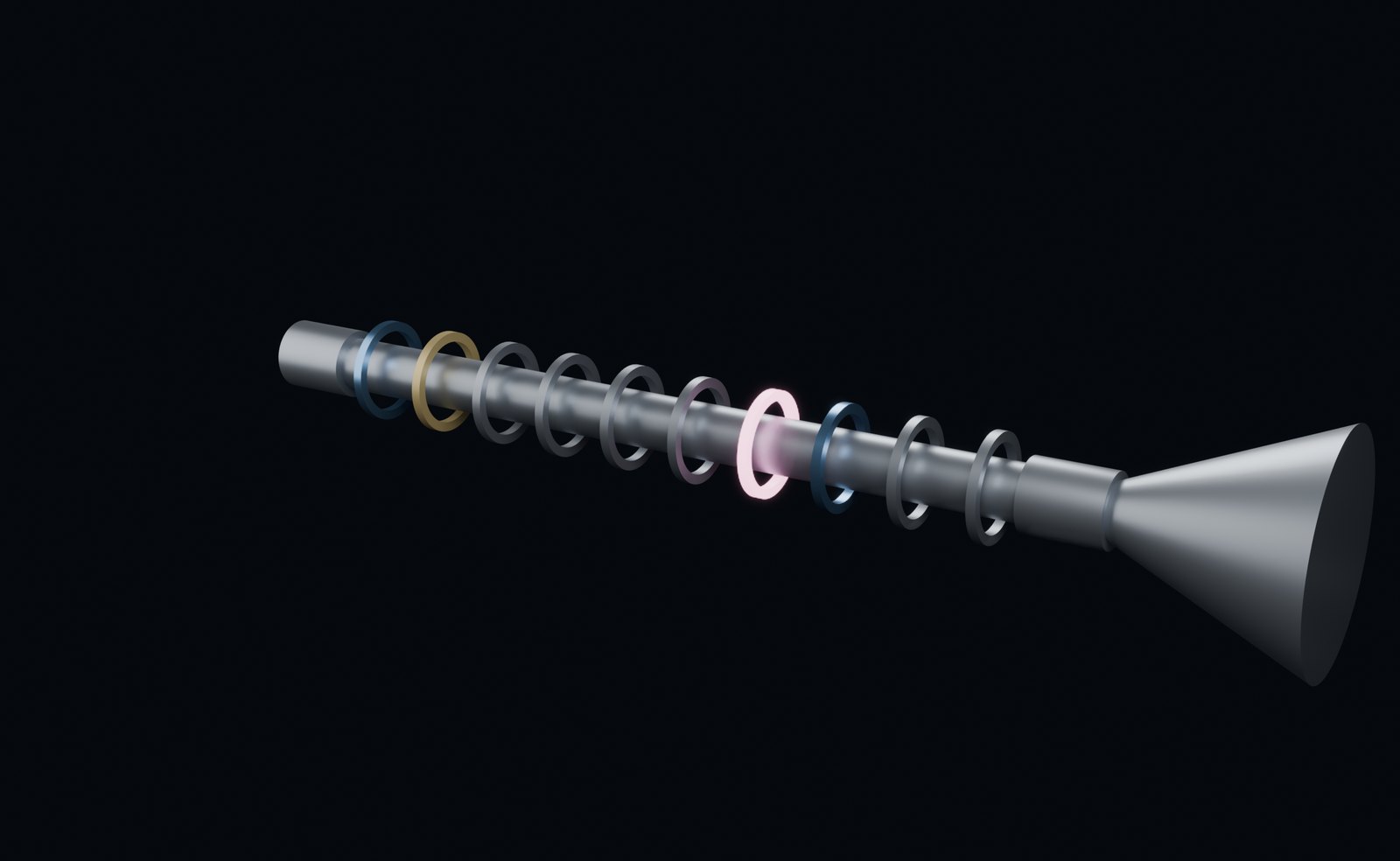
Central Cell
The central cell is the long, lower-field section where the D–³He plasma burns; it holds most of the plasma volume and produces most of the fusion power.
The central cell is the working volume of the burner (Aegis / MetroVolt). It is a straight, solenoidal section between the two throats where the deuterium–helium-3 plasma is confined and burns. Most of the plasma volume, and therefore most of the fusion power, lives here. The plugs and throats exist to hold this plasma; the central cell is what pays for them.
Because the tandem plugs supply the confining potential, the central cell can run at a comparatively modest field — on the order of the 8 T on-axis equivalent used for the machine — over a long axial length. That combination of moderate field and large volume is what makes an open machine a plausible steady-state generator rather than a pulsed device.
What the central cell must do
- Hold the burning D–³He plasma at roughly 90 keV ion energy
- Present enough length and density for a useful fusion rate
- Accept fuel and heating without spoiling confinement
- Exhaust helium-4 ash and spent fuel toward the ends
- Keep the neutron-producing side reactions to the 5.44% fraction
Burn conditions
The central-cell plasma runs hot — near 90 keV — because the D–³He reaction rate peaks at high ion temperature, far above D–T. The dominant reaction produces charged products (a proton and a helium-4) that stay magnetized and carry their energy to the ends, which is why direct conversion is possible. A minority of deuterium–deuterium side reactions produces the 5.44% neutron fraction; the machine is low-neutron, not aneutronic.
All values are design and validation figures for a machine not yet built.