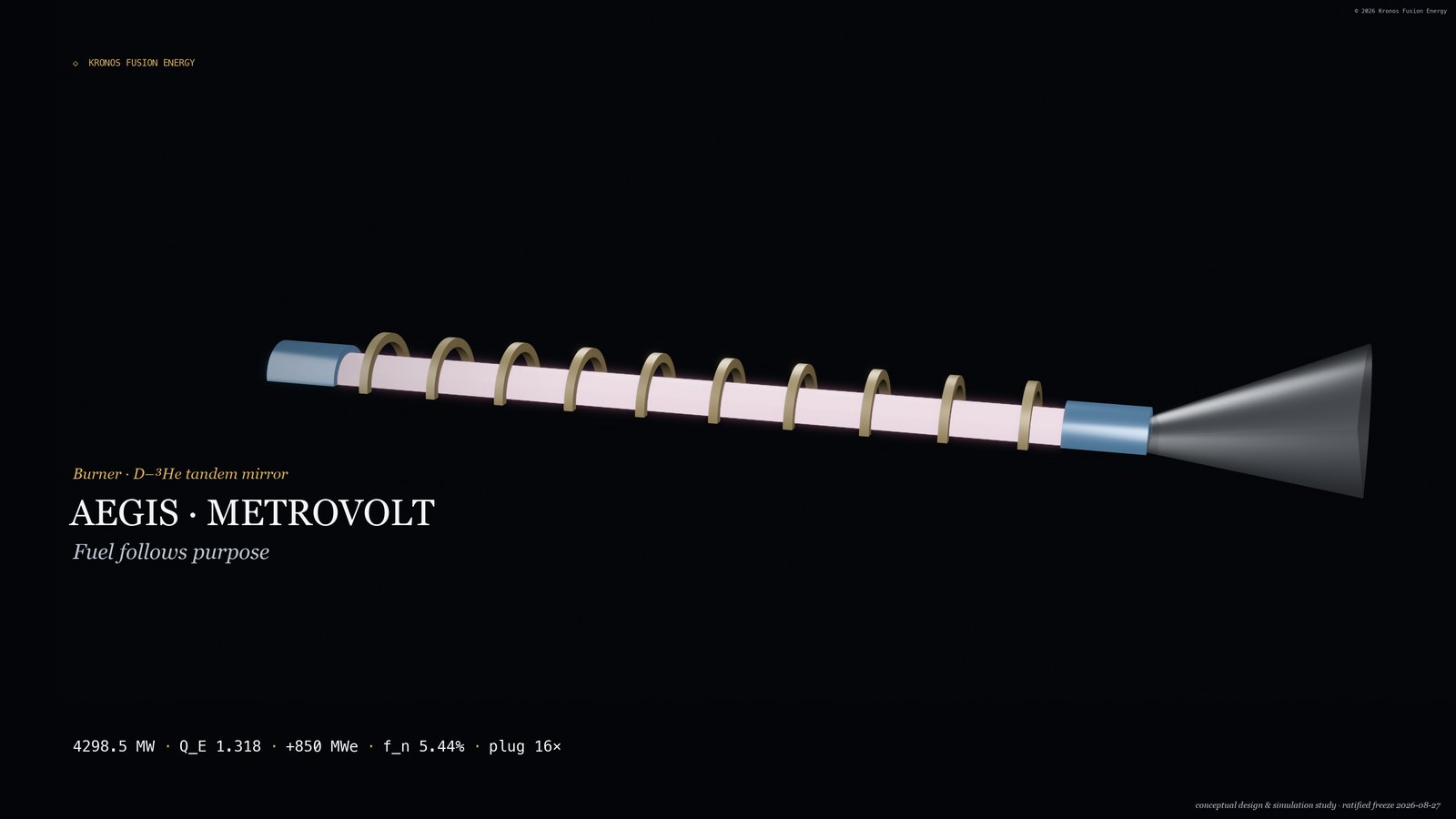
DEC Grid Electrodes
High-voltage grids and electrodes form the decelerating field and collect ion charge; they must hold voltage and shed neutron and secondary-electron heat.
The working surfaces of the DEC are its grids and collector electrodes. Grids are held at rising potentials to build the decelerating field; collectors capture the ions that have slowed to that stage's energy. Both must handle high voltages in vacuum near a plasma exhaust, and both must survive the incident particle and heat flux without arcing or eroding.
Electrode engineering is dominated by three demands: standing off the stage voltage without breakdown, transmitting the ion beam through grids with minimal interception, and rejecting the heat that does land — from intercepted ions, secondary electrons, and the neutron fraction that deposits in nearby structure. Secondary-electron emission in particular can rob efficiency if not suppressed.
Electrode requirements
- Hold high stage voltages in vacuum without breakdown
- High geometric transparency so grids intercept few ions
- Suppress secondary-electron emission that reduces net current
- Reject heat from interception and the 5.44% neutron fraction
- Resist sputtering and erosion over the maintenance interval
- Dissipate the local heat load without warping the grid geometry
Grid geometry is a precision requirement as well as a thermal one: if a heated grid warps, its transparency and field shape change, which shifts where ions are collected and lowers efficiency. The electrodes are therefore designed to hold shape under load, not merely to survive it.
Coupling to reliability
Because the electrodes stand in the exhaust stream, their lifetime and failure modes feed directly into the machine's availability. Grid erosion, coating degradation, and voltage-holding faults are the kind of wear that the availability gate accounts for. The electrode set is designed for inspection and replacement, and its condition is watched continuously in operation.
All figures are design and validation values for an unbuilt machine.