Footprint & Envelope
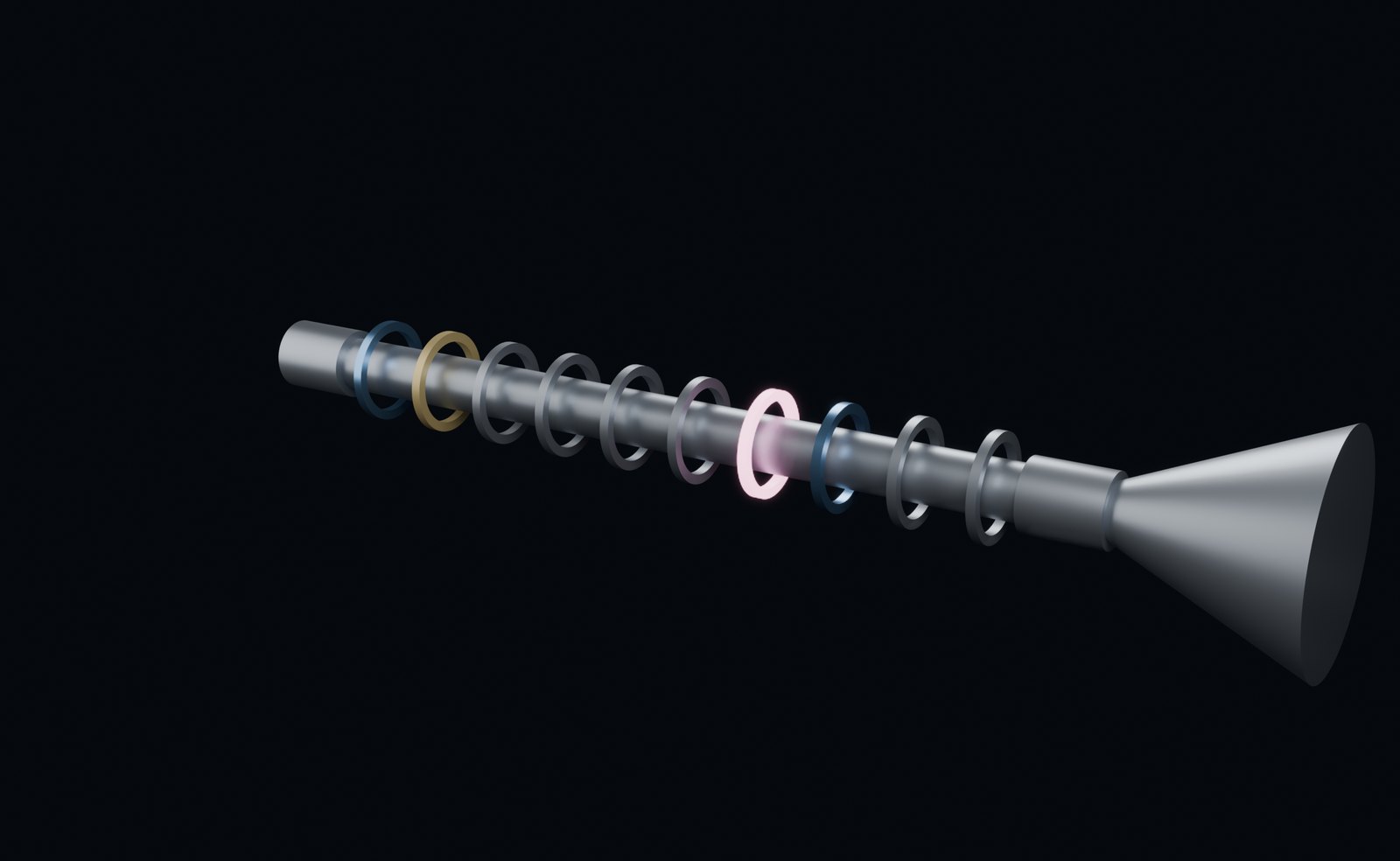
The burner is a long, straight machine; its footprint is dominated by the axial length of plugs, cell, expanders, and DEC plus shielding around them.
The burner's shape follows its physics: it is a straight line. The envelope is set by the axial length — plug, throat, central cell, throat, plug, then expander and DEC at each end — plus the shielding wrapped around the whole assembly and the space for cryoplant, heating, pumping, and power conditioning alongside. It is a long, narrow machine rather than a tall or wide one.
For the Aegis fixed-installation housing, footprint matters because the machine has to fit a prepared site and be delivered there in modules. The linear geometry helps: modules are arranged in line, and the axis defines the assembly sequence. But the expander and DEC tanks at each end, and the shielding, add length and mass that the siting plan must accommodate.
What sets the envelope
- Central-cell length needed for the burn volume
- Plug, throat, and expander sections at each end
- Shielding thickness around the whole assembly
- Balance-of-plant skids: cryoplant, heating, pumping, conditioning
- Access and maintenance clearances
Modularity within the envelope
The straight axis is what makes the machine modular: each section can be a factory-built, transportable unit set in line on site. The envelope is therefore not just a size but a layout — a sequence of modules plus their support skids and shielding. This is what lets the fixed-installation housing be planned as a siting layout rather than a bespoke build. No cost or economic figures attach to this; it is a physical layout description.
All figures are design and validation values for a machine not yet built.