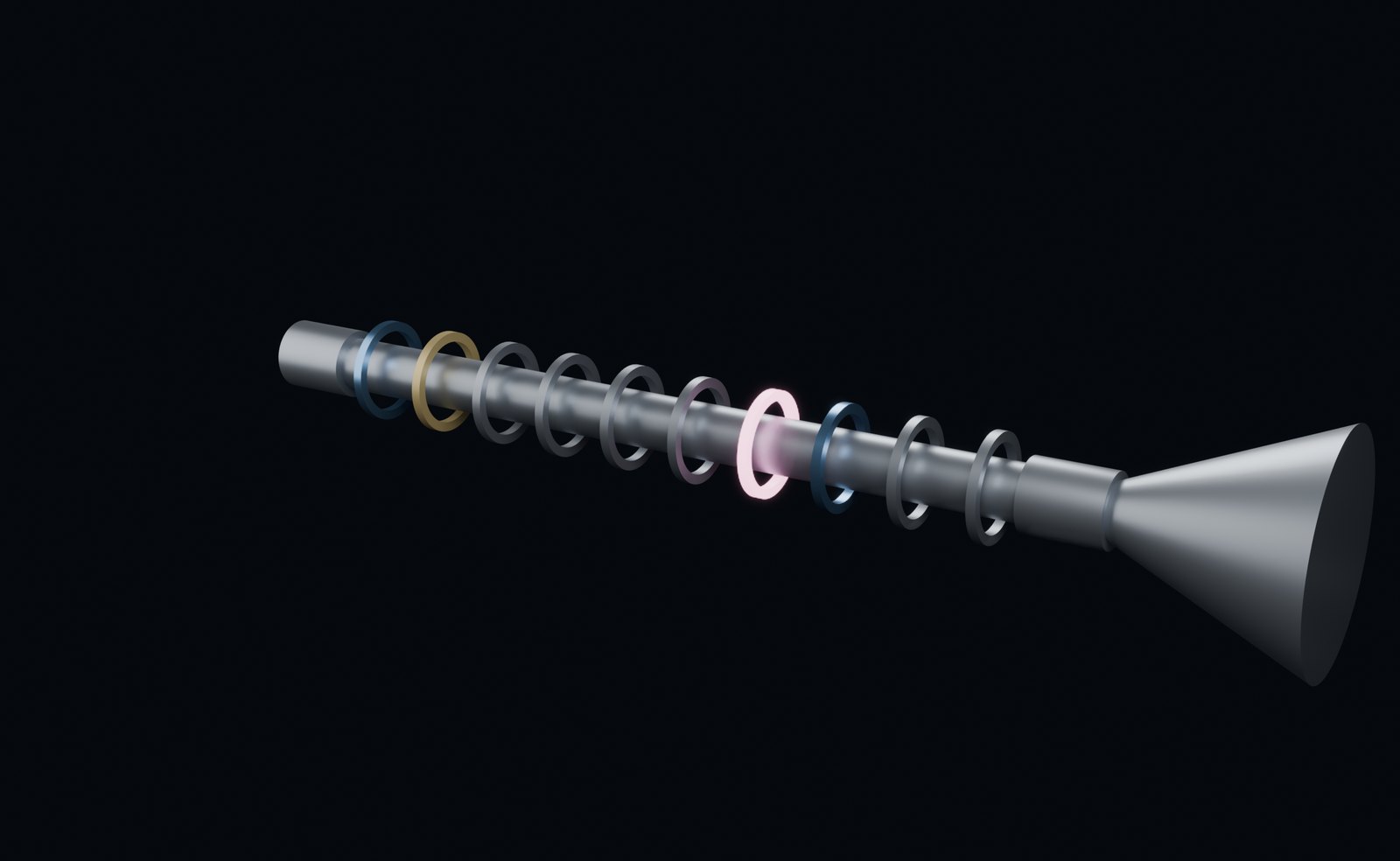
High-Field Plug Architecture
Each end plug is a compact, very-high-field magnet and plasma that builds the electrostatic barrier confining the central cell.
The plugs are the defining hardware of a tandem mirror. Each end of the machine carries a plug: a small, dense plasma held in a very strong magnetic field whose purpose is to raise a local electrostatic potential. That potential, not magnetic reflection alone, is what keeps central-cell ions from streaming out the loss cone.
In the burner (Aegis / MetroVolt) the plug field is 26.49 T — among the highest steady fields any fusion concept asks for. The plug plasma is heated and fueled independently of the central cell so its potential can be tuned. The 17 T throat sits between the plug and the central cell, defining the mirror the plug potential sits atop.
What the plug must achieve
- Reach and hold 26.49 T over the plug bore
- Sustain a dense plug plasma to build the ambipolar potential
- Set a potential peak higher than the central-cell ion energy
- Do this steady-state at both ends symmetrically
- Survive the mechanical load of that field on its own structure
Two honest gates live here
The plug is where the burner's physics is least proven. The coil stress to hold 26.49 T over the design bore runs roughly 3–3.9x the feasible structural limit as specified, so the plug is infeasible exactly as drawn. Separately, the plug plasma regime is 166–830x beyond any device operated to date, so its behavior cannot be post-dicted from existing experiments. Both are design and validation findings and are detailed on their own gate pages.