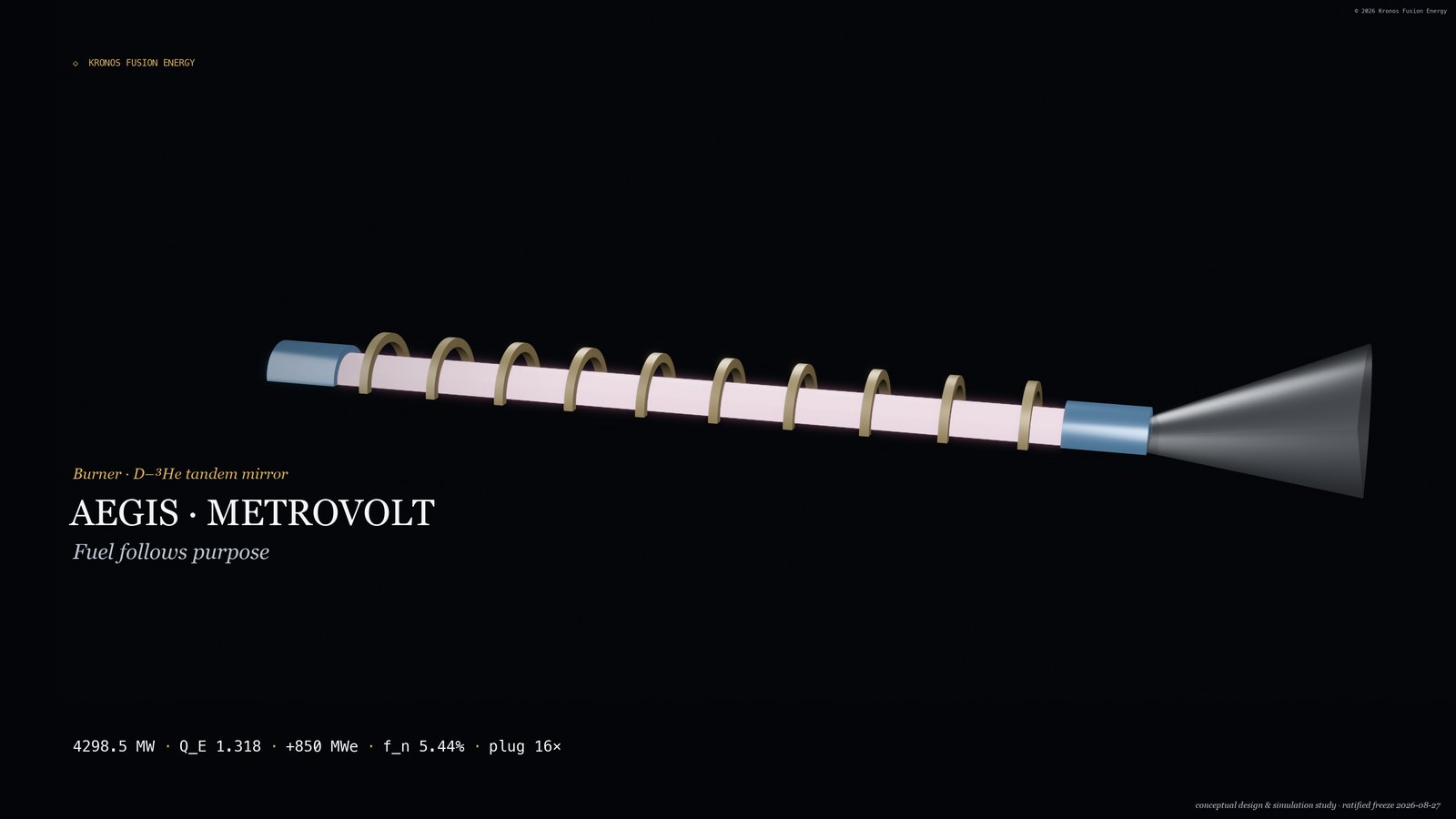
Machine Architecture Overview
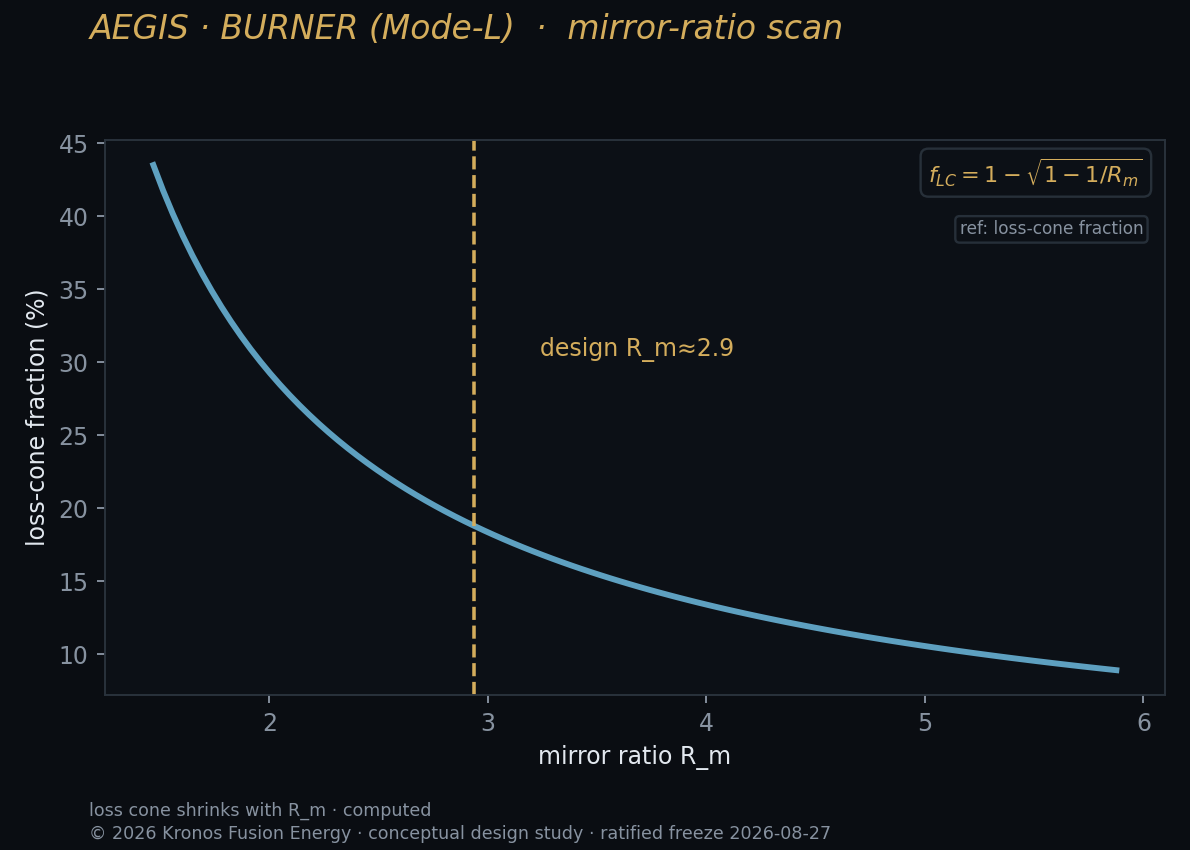
Aegis is the Kronos burner (Aegis / MetroVolt) in a fixed-installation housing: a D–³He tandem-mirror generator with direct energy conversion.
The burner (Aegis / MetroVolt) is a linear, open-ended magnetic confinement machine rather than a closed torus. Fusion fuel is confined along a straight axis by a magnetic mirror at each end, and charged particles that leak past the mirrors are captured by a direct-energy-conversion (DEC) train instead of a steam cycle. Aegis is the fixed-defense-installation housing of that machine; it shares its core physics exactly with the MetroVolt data-center housing.
The machine has five architectural regions arranged along one axis: two high-field plugs at 26.49 T, the magnetic throats at 17 T that define the mirror, the central cell where the D–³He plasma burns, the expander regions where the exhaust plasma fans out, and the DEC collectors that turn escaping ion energy directly into electricity.
Why an open geometry
A linear machine trades the closed-field confinement quality of a tokamak for mechanical simplicity, steady-state operation, and an exhaust that is naturally aimed at a converter. There are no disruptions in the tokamak sense, and the axis can be opened at either end for the DEC. The cost is end losses: particles stream out of the mirror, and the plug fields must be extreme to hold the central-cell plasma against that loss.
Design and Validation status
Every parameter here is a design and validation figure. The burner has not been built. A test burner is targeted around 2032 and a commercial-class unit around 2036. The architecture is honest about its open physics gates — plug coil stress, plug operating regime, He-3 fuel supply, and availability — which are stated plainly on their own pages.
- Plugs at 26.49 T set the mirror that confines the central cell
- Central cell burns D–³He at roughly 90 keV, neutron fraction 5.44%
- DEC replaces the thermal cycle for the escaping charged-particle power
- Linear axis is steady-state and opens directly onto the converters