Magnetic Mirror Confinement
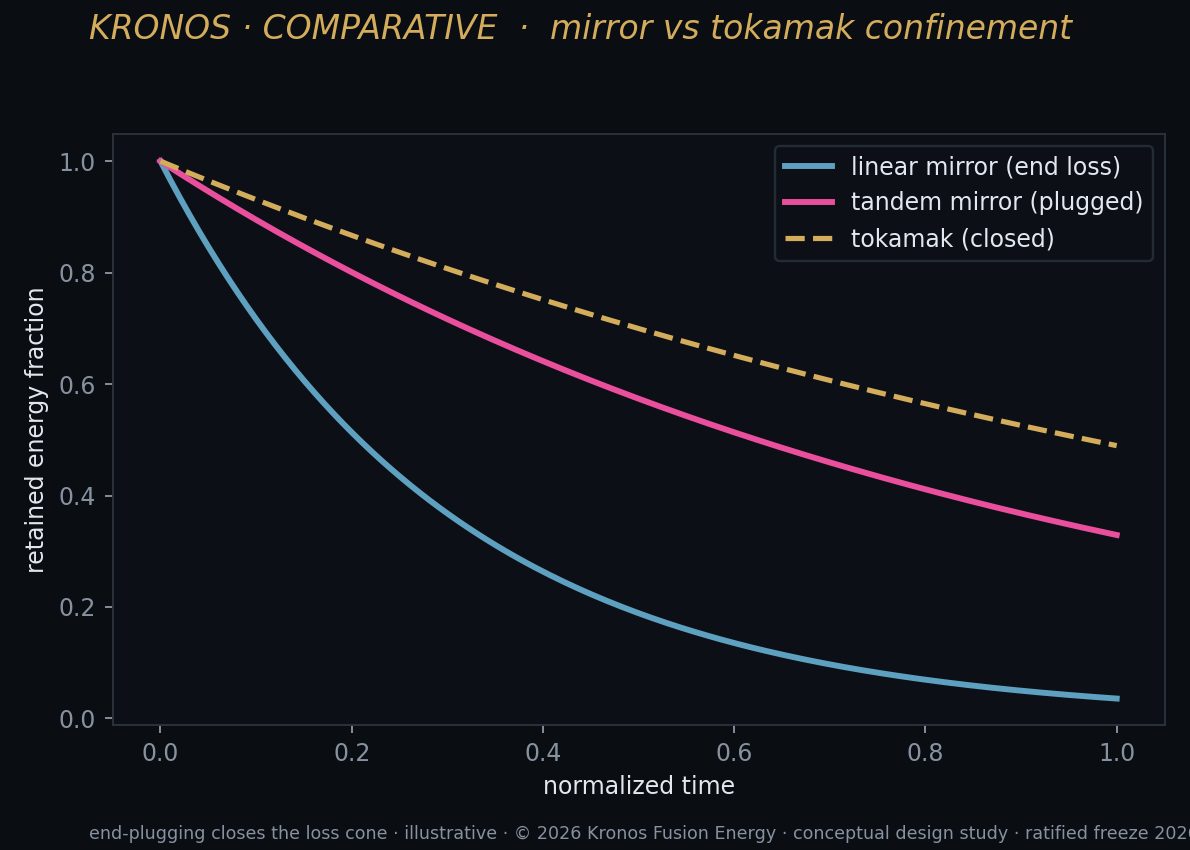
A magnetic mirror reflects charged particles from regions of high field; the mirror ratio and loss cone set how well an open machine holds its plasma.
Charged particles spiral around magnetic field lines. As a particle moves into stronger field its perpendicular velocity grows at the expense of its parallel velocity, conserving the magnetic moment. If the field rises enough, the parallel velocity reaches zero and the particle is reflected — a magnetic mirror. The ratio of peak field to central field, the mirror ratio, sets which particles are trapped.
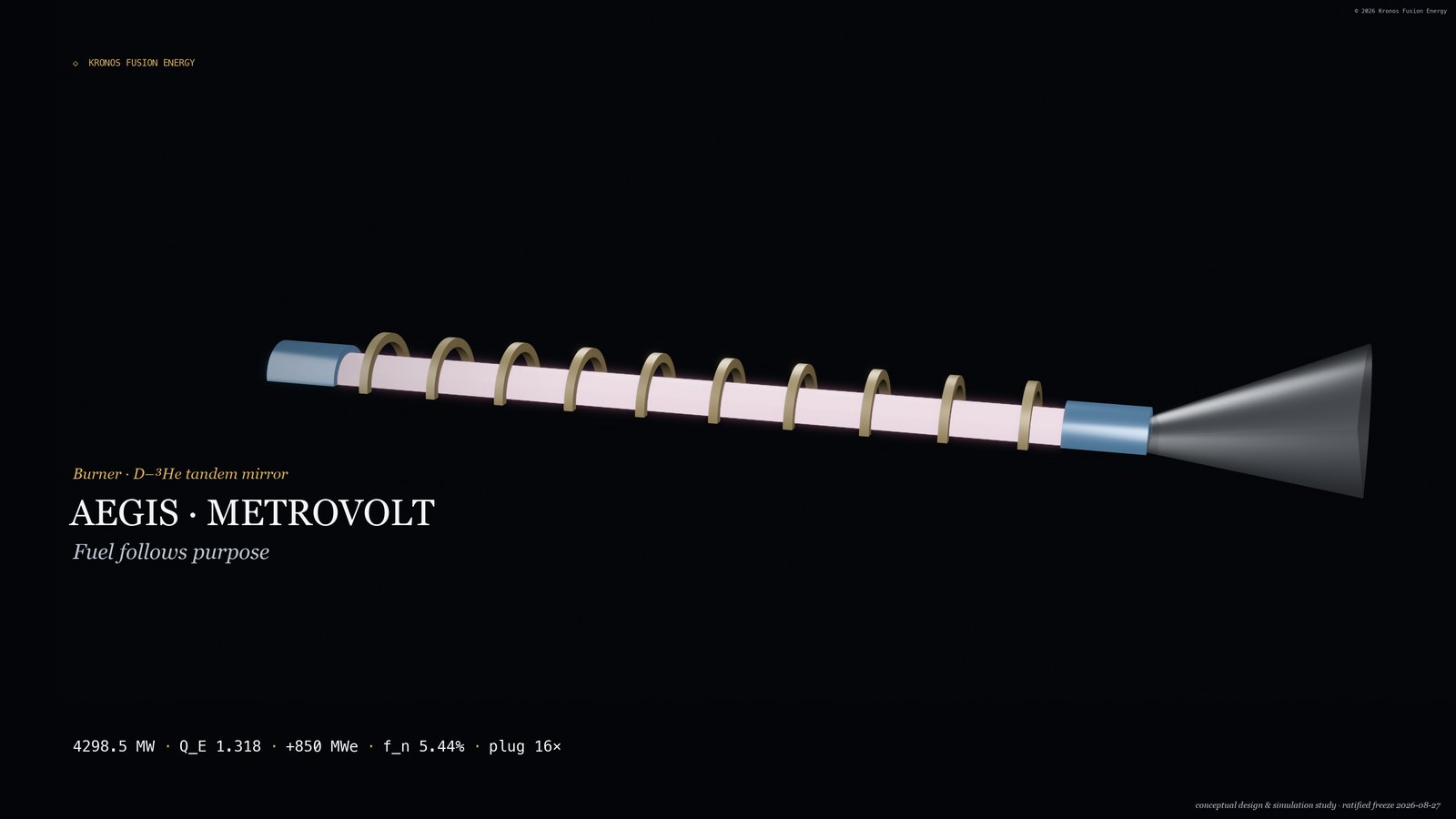
Particles whose velocity vector lies within the loss cone — too aligned with the axis — are not reflected and stream out the ends. This loss is intrinsic to open geometry. In the burner the throat field of 17 T against the central-cell field defines the base mirror ratio, and the 26.49 T plugs add the electrostatic plugging that a purely magnetic mirror cannot provide.
Loss cone and end loss
- Mirror ratio R = B_peak / B_cell sets the trapped-particle fraction
- Particles inside the loss cone escape along the axis
- Scattering continually refills the loss cone, driving steady end loss
- Electrostatic plugging from the tandem plugs suppresses ion end loss
- Escaping charged-particle power is not wasted — it is fed to the DEC
Why the burner accepts end loss
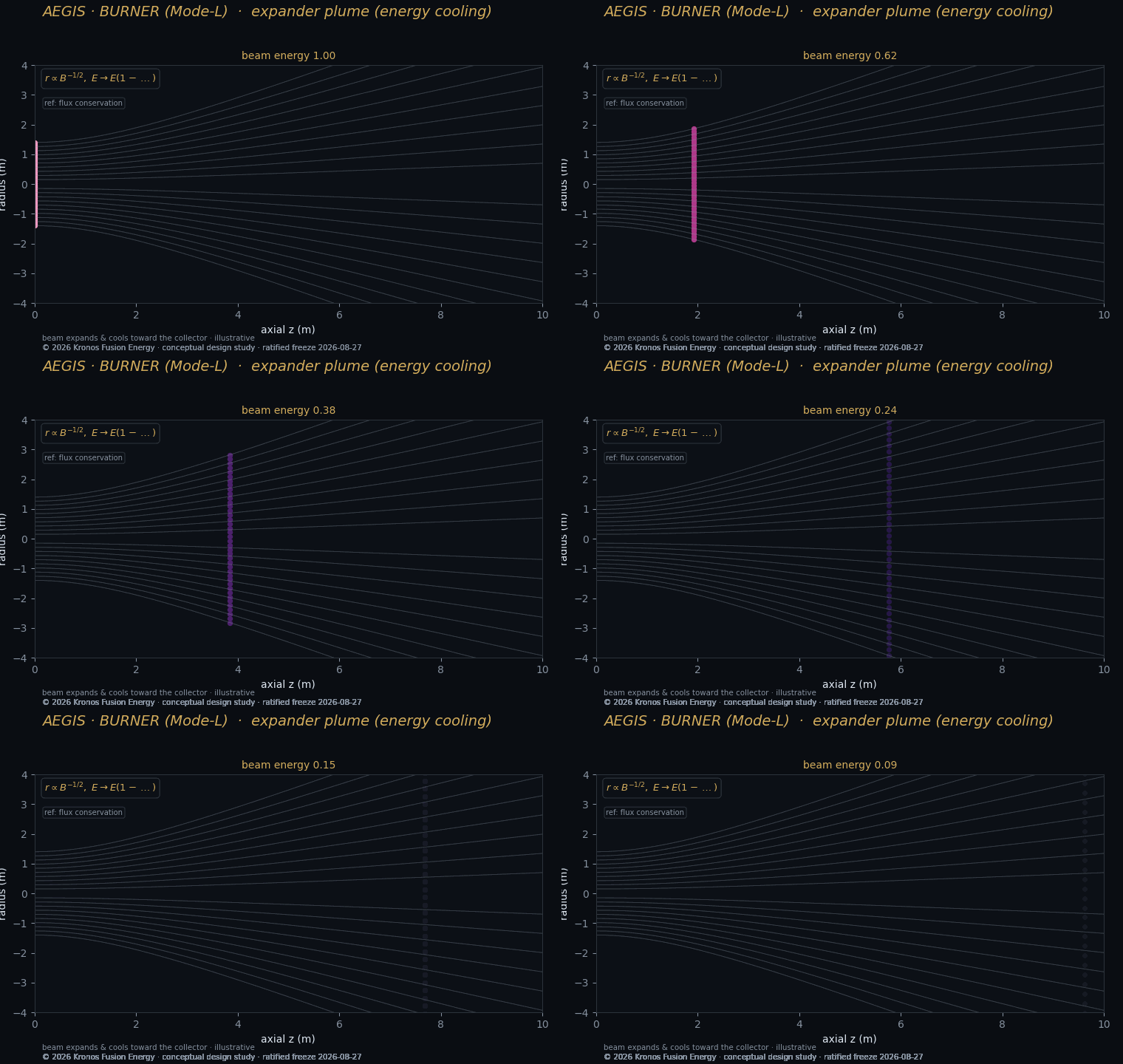
End loss is a liability in a mirror power reactor only if the escaping energy is thrown away. The burner turns it into the primary power path: ions that stream out the ends are decelerated in the DEC and their kinetic energy is collected as direct current. The open geometry that makes confinement hard also makes the exhaust clean, axial, and convertible.
All figures are design and validation values for an unbuilt machine.