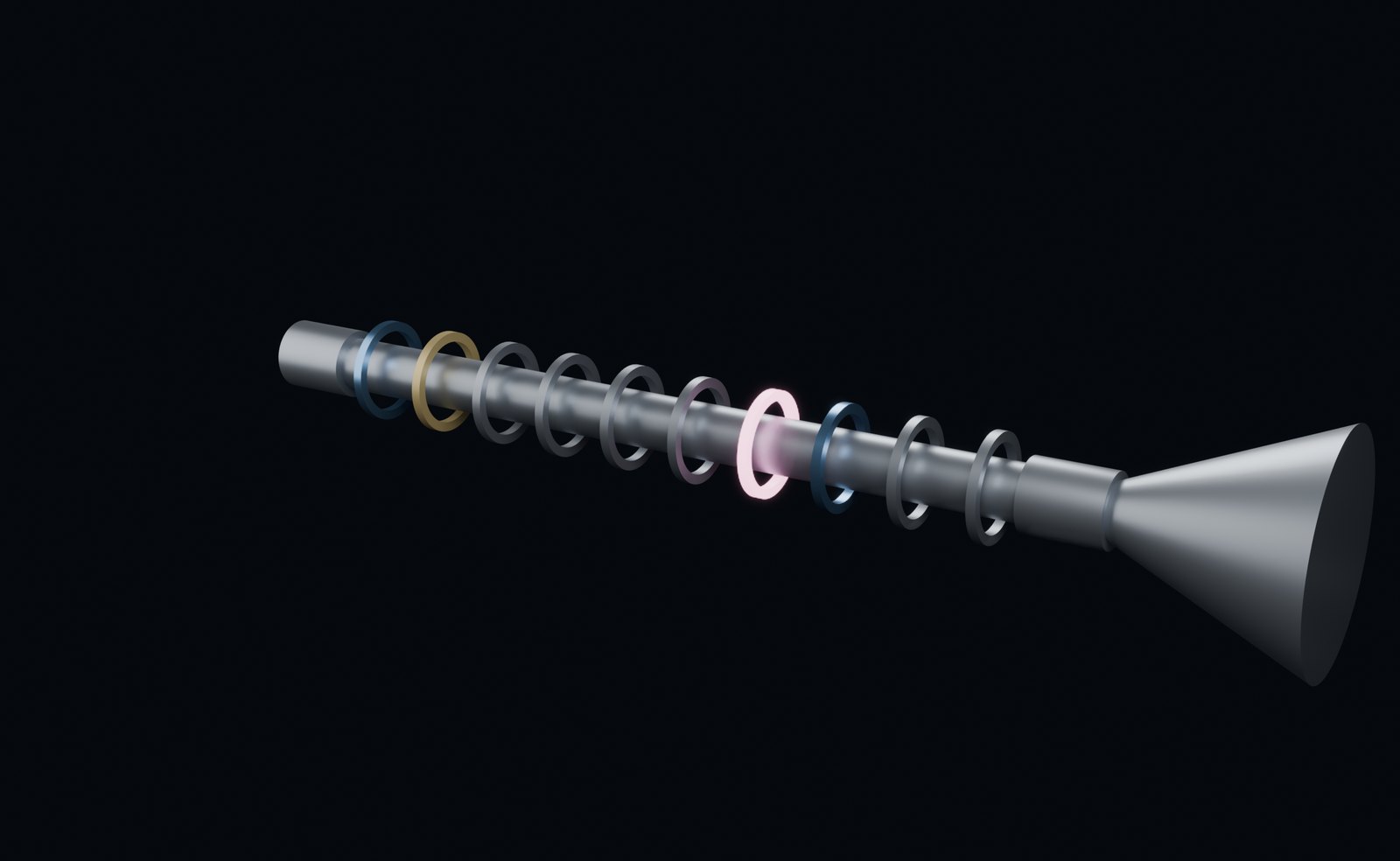
Direct Energy Conversion Train
The DEC train decelerates escaping fusion-product ions in staged electric fields and collects their kinetic energy as direct current — no steam cycle.
Direct energy conversion (DEC) is the reason the burner uses D–³He and an open geometry. The dominant fusion products are charged — a 14.7 MeV proton and a 3.6 MeV helium-4 — and they leave the machine along the axis as a magnetized ion stream. Rather than stopping them in a wall to make heat and then running a thermal cycle, the DEC decelerates them against an electric field and collects their charge directly as current.
The train sits beyond the expander at each end. Incoming ions pass through grids or electrodes held at rising potentials; each ion climbs the potential hill, converting kinetic energy to electrical potential energy, and is collected at the electrode matched to its energy. Because the conversion is electrostatic, it sidesteps the thermodynamic ceiling of a heat engine.
Why direct conversion
- Most D–³He power is carried by charged particles, not neutrons
- Charged particles can be decelerated and collected electrically
- No boiler, turbine, or condenser in the primary power path
- Steady-state axial exhaust suits electrode collection
- Efficiency is not bounded by a thermal-cycle limit
Honest scope
The DEC does not capture everything. The 5.44% of power carried by neutrons cannot be converted this way and appears as heat in the shielding, which is managed separately. The efficiency of the collector, the electrode voltage handling, and the ion-energy spread from the expander are engineering problems addressed on the DEC efficiency and electrode pages. All figures are design and validation values for an unbuilt machine.