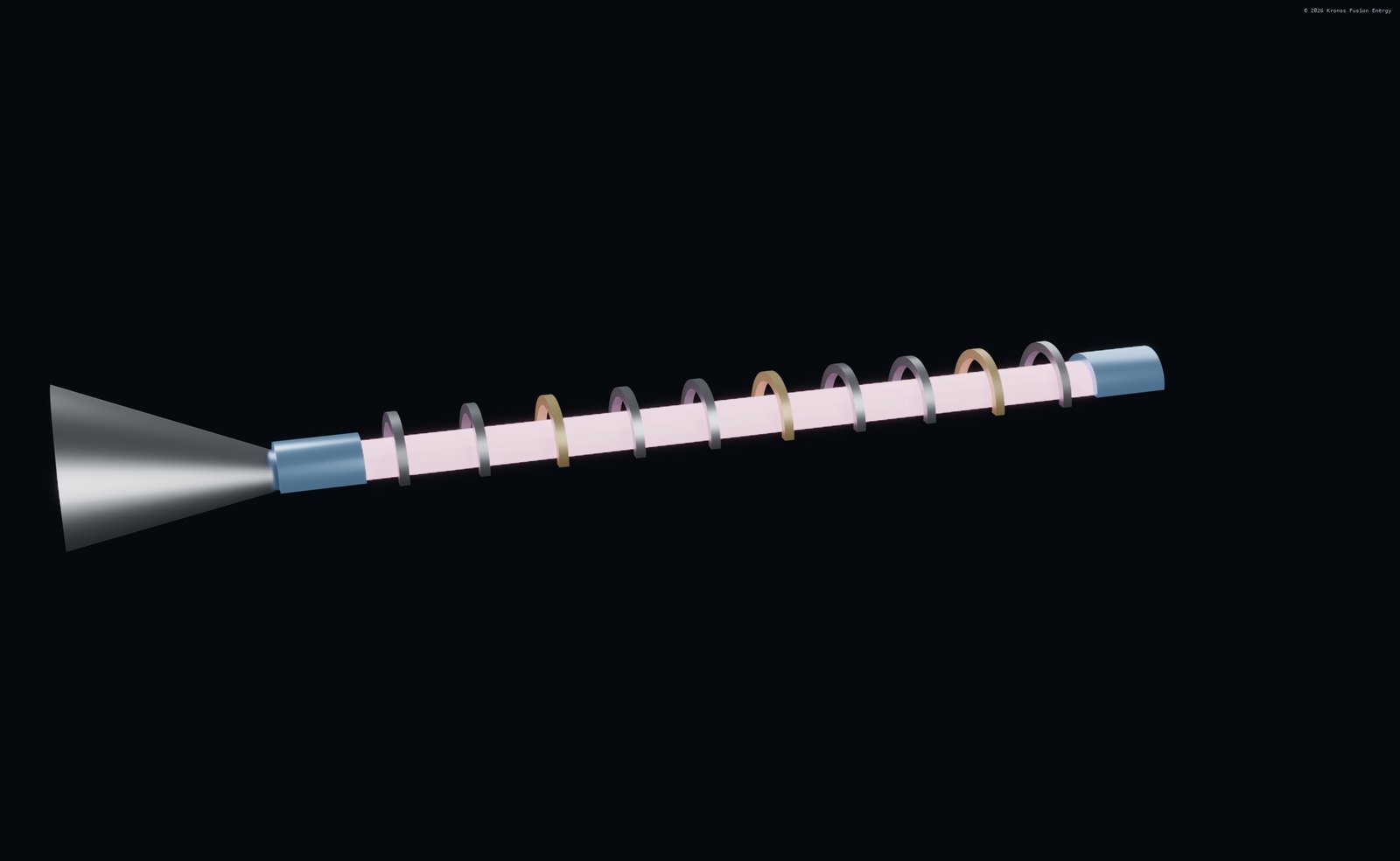
Central-Cell Plasma Conditions
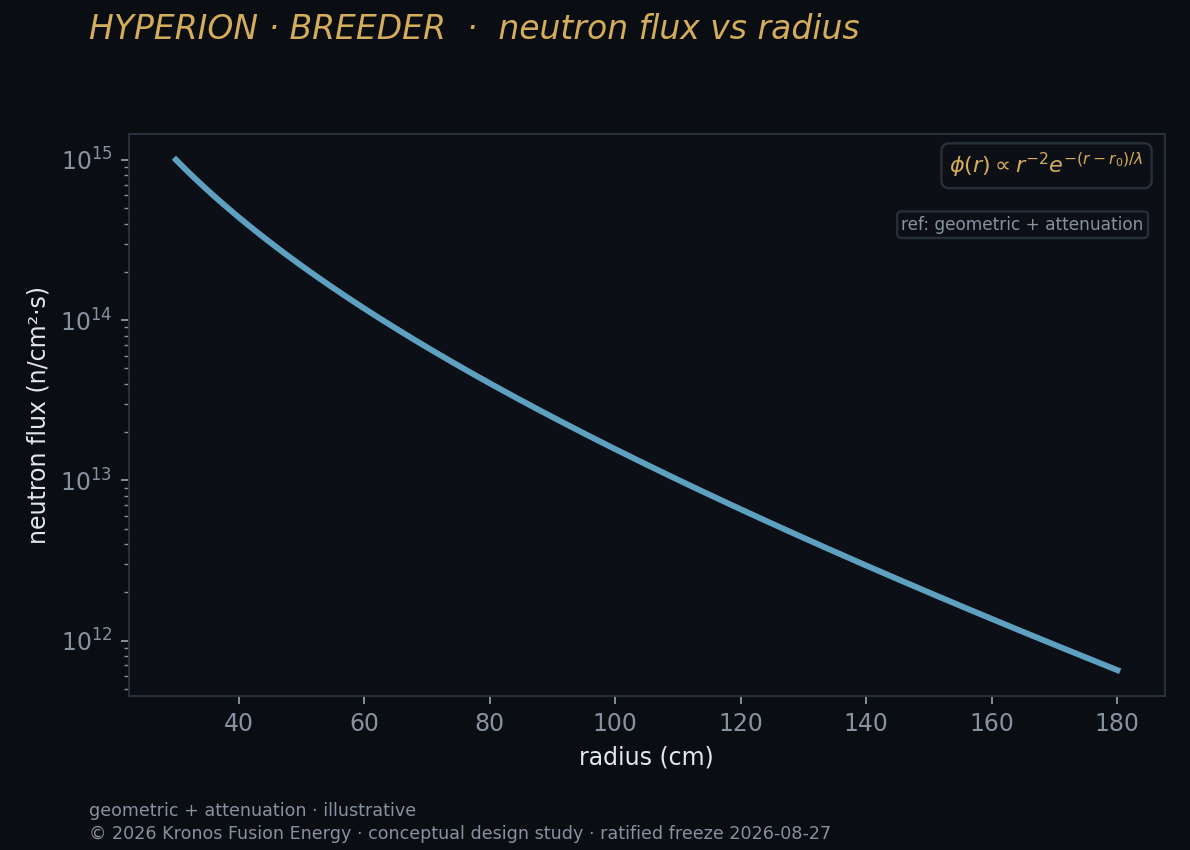
The central-cell plasma runs near 90 keV so the D–³He reaction rate is high; its density and temperature set the fusion power and the 5.44% neutron fraction.
D–³He fuses efficiently only at ion energies well above those used for D–T. The central-cell plasma is therefore held near 90 keV, where the reaction cross-section is favorable. At that temperature the plasma is fully ionized deuterium and helium-3 with helium-4 ash and a small deuterium–deuterium side-reaction population.
The reaction of interest, D + ³He, releases a 14.7 MeV proton and a 3.6 MeV helium-4 nucleus — both charged, both magnetized, both steered toward the ends and the DEC. Because the primary channel is charged, most of the fusion power leaves as directed particle kinetic energy rather than as neutrons or bulk heat.
The neutron fraction
D–³He is low-neutron, not aneutronic. Deuterium–deuterium side reactions in the hot plasma produce neutrons and tritium, and the tritium can burn with deuterium to add more. In the burner design point this totals a neutron fraction of 5.44% of fusion power. That fraction sets the shielding and first-wall requirements and is stated honestly rather than rounded to zero.
Parameters at a glance
- Ion energy near 90 keV for D–³He reactivity
- Primary products: 14.7 MeV proton + 3.6 MeV helium-4 (both charged)
- Neutron fraction 5.44% from D–D and secondary D–T
- Helium-4 ash must be exhausted to sustain the burn
- Steady-state operation along the open axis
- Reaction rate scales with density squared and with temperature
The density is bounded by pressure balance against the field and by the ambipolar potential the plugs can hold; too high a central-cell pressure would overwhelm the barrier. The operating point balances fusion rate against confinement and against the D–D neutron rate, which climbs with both deuterium fraction and temperature. Every number here is a design and validation value for a machine that has not been built.