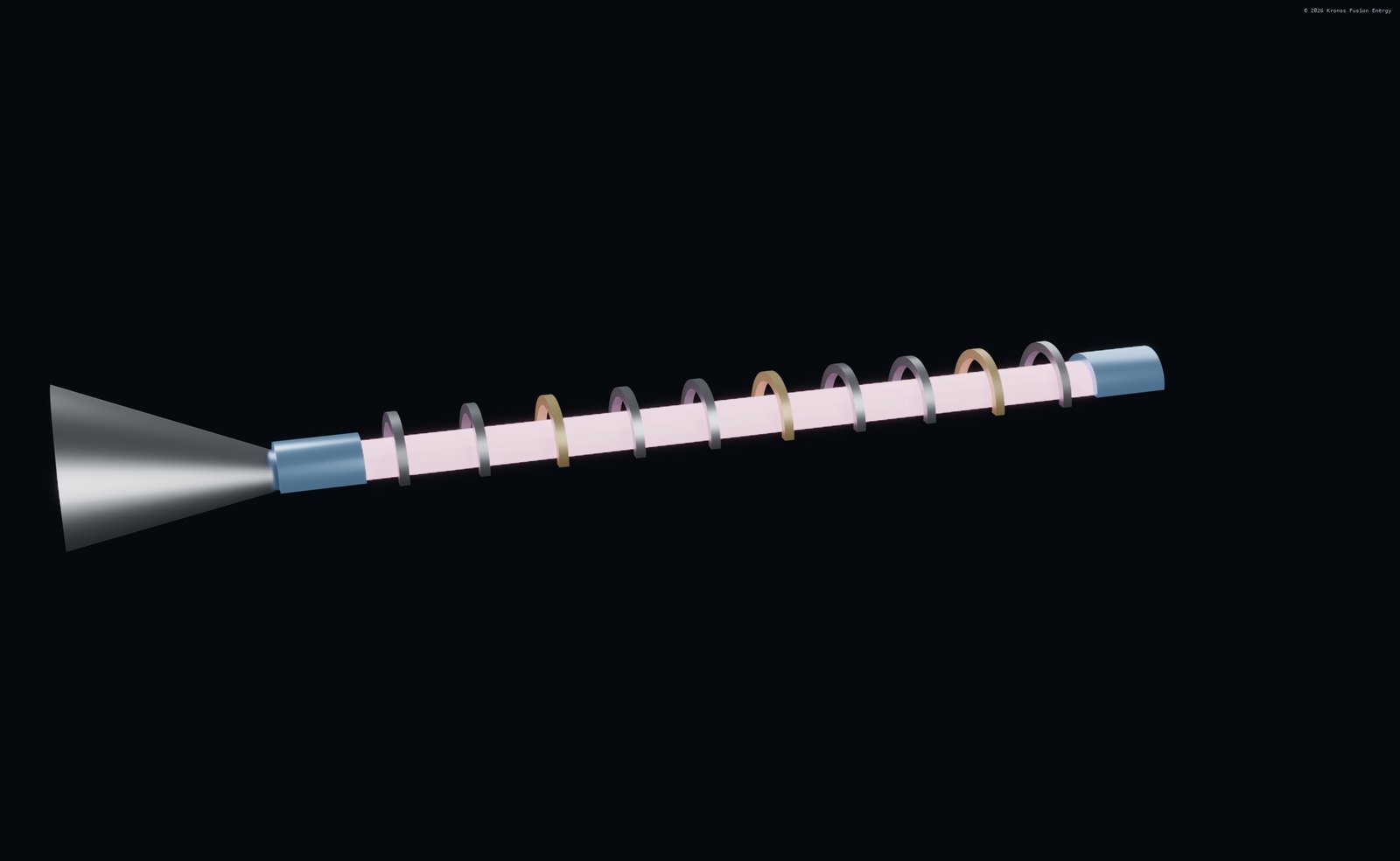
Tritium Yield from Hyperion
The breeder's ~4 kg/yr-class tritium output is both a product in its own right and the reservoir from which the burner's helium-3 is drawn.
Tritium as reservoir and product
Hyperion's headline output is tritium — a design-point yield in the ~4 kg/yr class, produced when 14 MeV fusion neutrons breed tritium in a lithium-bearing blanket. Tritium is directly useful: it is a valuable isotope for the breeder line on its own terms. But for the burner it plays a second role, as the reservoir that decays into helium-3.
The held-versus-decayed decision
Because tritium is both a saleable product and the precursor to helium-3, every unit of bred tritium poses a choice: use or sell it now as tritium, or hold it and let it become helium-3 for the burner. This split is an inventory decision set by fleet demand, and it is reversible in planning — tritium held for decay simply becomes helium-3 at the fixed half-life rate. The two product lines share one source stream.
- ~4 kg/yr-class tritium bred in a lithium blanket by 14 MeV neutrons
- Tritium is a direct product and the helium-3 precursor
- Held vs decayed split set by fleet demand
- Breeding ratio (1.1 / 1.5 / 1.8) scales the yield
Understanding the tritium yield is therefore prerequisite to understanding helium-3 supply: helium-3 can never exceed what the tritium reservoir provides, and the reservoir's size is set here.