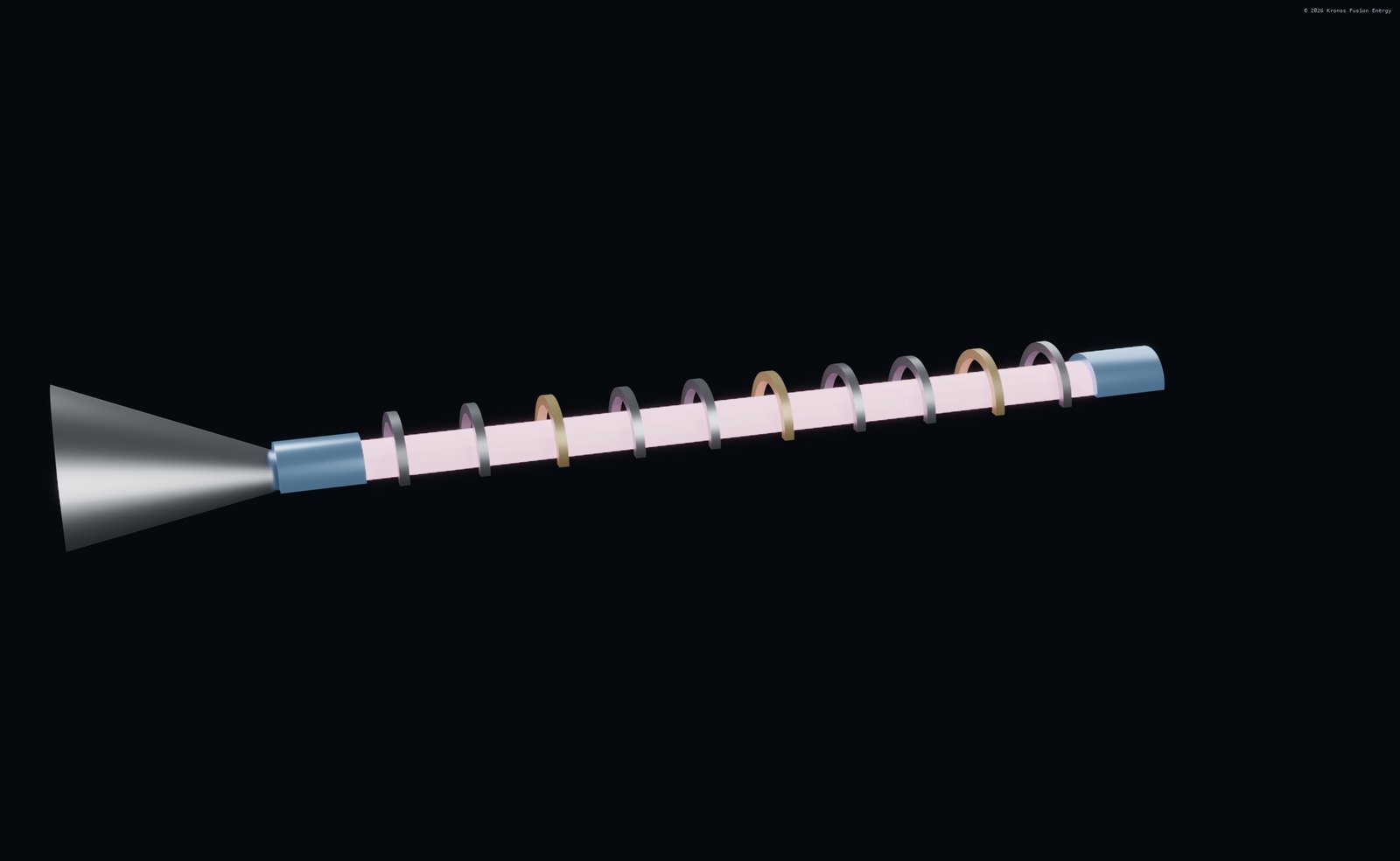
The Fuel Injection System
Fuel enters the central cell as gas or frozen pellets, replacing what the plasma burns and controlling density and the deuterium–helium-3 ratio in real time.
Feeding the central cell
A burning plasma consumes fuel and must be continuously refuelled. In the tandem mirror the reacting plasma lives in the central cell, so that is where fuel is delivered. Two methods are used together: gas puffing, which admits neutral gas at the plasma edge, and pellet injection, which fires small frozen pellets deep into the plasma where the density is highest. Gas puffing is fast and fine; pellets place fuel where edge fuelling cannot reach.
Control, not just supply
Injection is a control system, not merely a feed pipe. By adjusting the rate and location of gas and pellets, operators set the plasma density and hold the deuterium-to-helium-3 ratio at its target. Because the two fuels burn at different rates and helium-3 is the scarce one, precise, well-metered injection is directly tied to fuel economy: over-feeding helium-3 wastes a bred resource, under-feeding it cools the burn.
- Gas puffing: fast edge fuelling and fine density trim
- Pellet injection: deep fuelling where edge gas cannot reach
- Injection sets both density and the D:3He ratio
- Metering helium-3 precisely is a fuel-economy requirement
The injection system is instrumented and closed-loop, tied to the density and composition diagnostics so the fuel mix stays on target through the burn. It is one of the main places the burner's control brain touches the fuel supply.