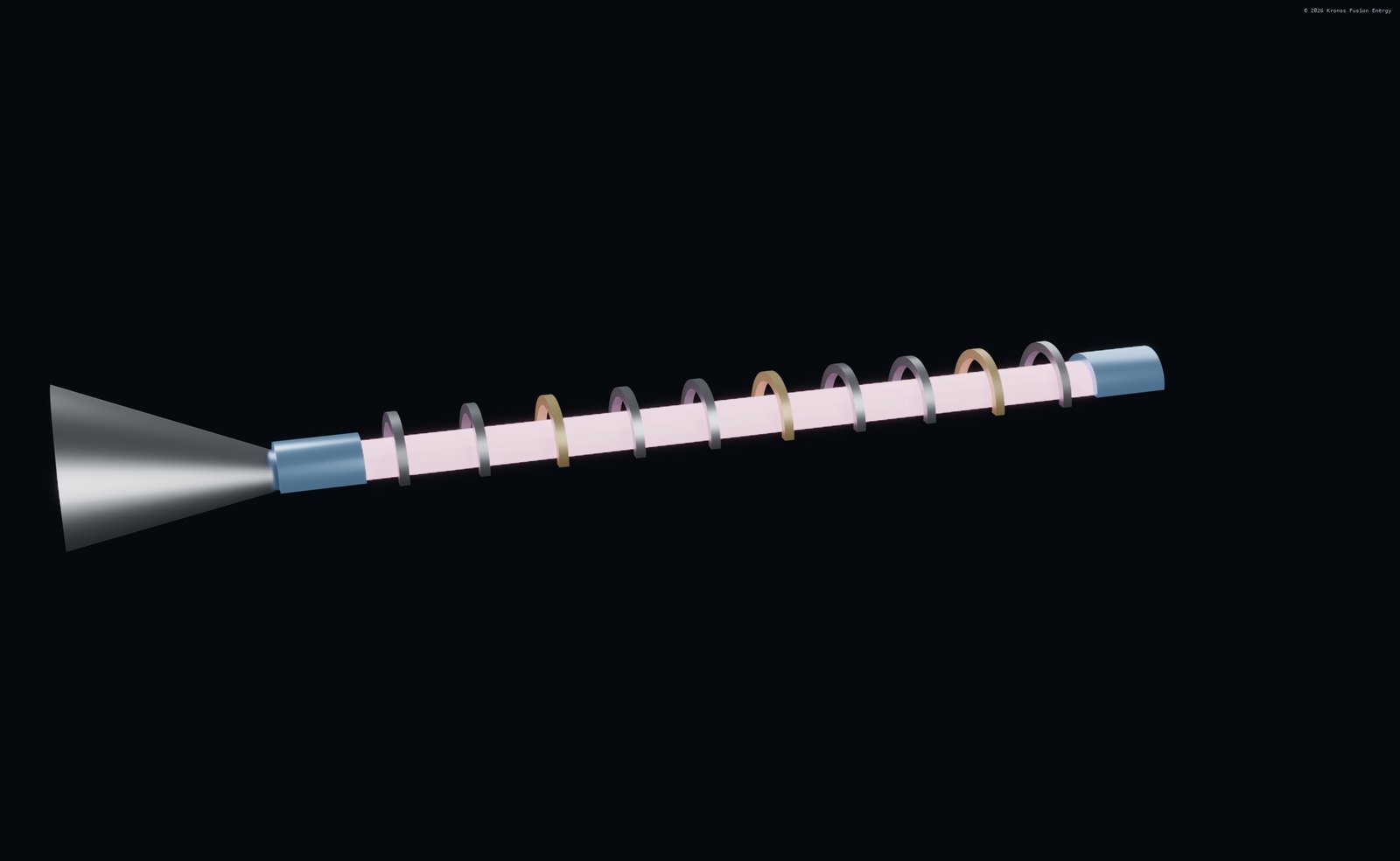
D–D Side Reactions
Deuterium reacting with itself is the main source of neutrons in the burner; understanding these side channels explains the 5.44% neutron fraction.
Deuterium cannot ignore itself
Even in a fuel optimized for the clean D–3He channel, deuterium nuclei collide with each other. The D–D reaction has two branches of nearly equal probability: D + D → T + p, and D + D → 3He + n (2.45 MeV neutron). The first branch produces tritium, which then reacts with deuterium (D + T → 4He + n) to release a 14.1 MeV neutron. These are the channels that keep the burner from being perfectly aneutronic.
From channels to the 5.44% number
Adding up the neutron-producing channels — the D–D branch that makes a neutron directly, plus the D–T reaction fed by the tritium from the other branch — against the total fusion power gives the neutron fraction. At the Aegis design point this sums to 5.44%. It is a computed consequence of the fuel mix and plasma conditions, not a target set independently. Change the mix or the temperature and the fraction moves.
- D–D branch A: D + D → T + p
- D–D branch B: D + D → 3He + n (2.45 MeV)
- Follow-on: D + T → 4He + n (14.1 MeV)
- Sum of neutron channels / total power = 5.44%
One useful by-product: branch A and branch B both make useful fuel — tritium and helium-3 — inside the burner itself. This does not close the fuel cycle (the amounts are small and the burn consumes far more helium-3 than it makes), but it is a real, if minor, internal contribution.