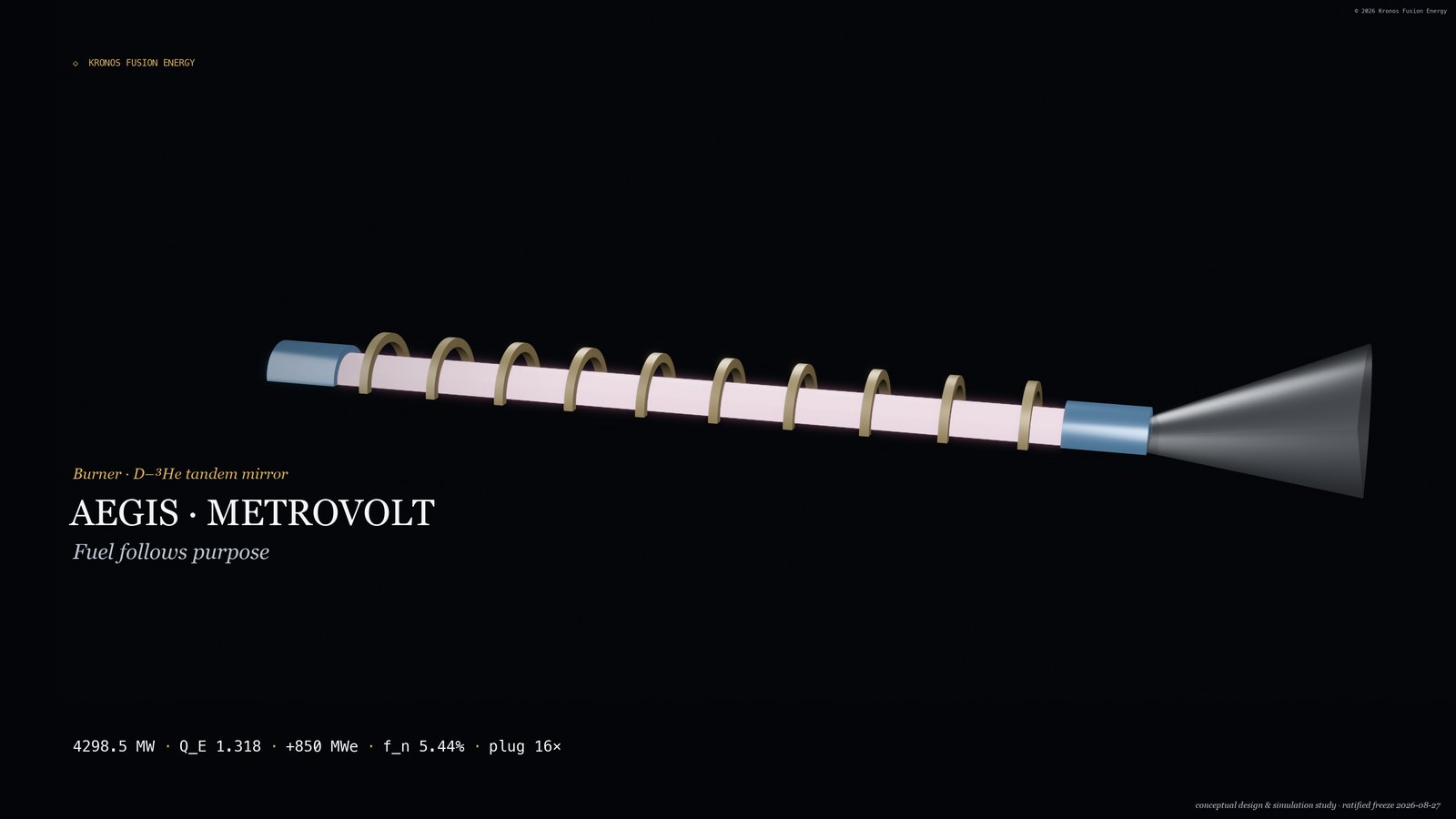
Open Gate: He-3 Demand Outruns Terrestrial Supply
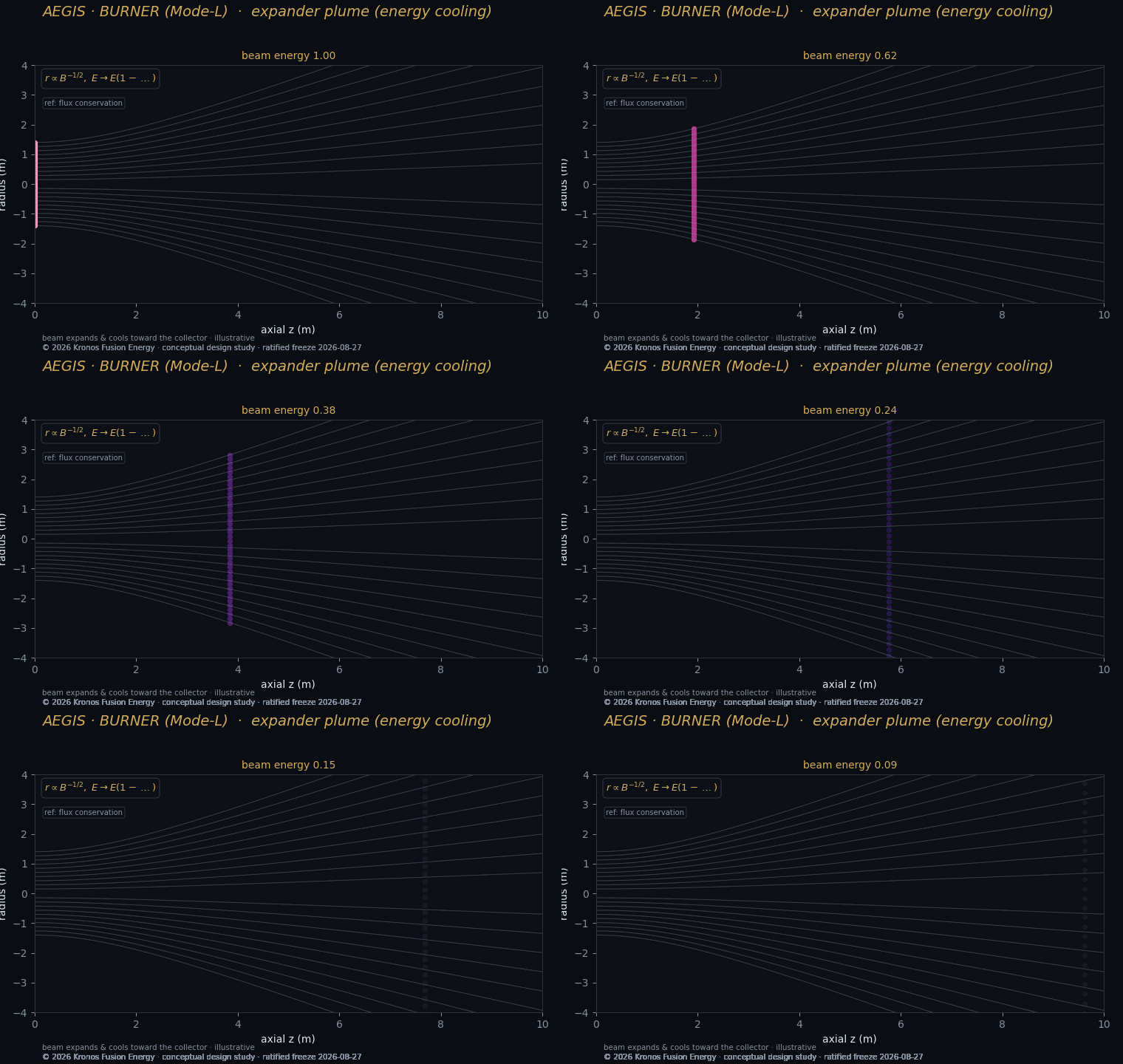
A single commercial D–³He unit would need on the order of 400× the entire domestic helium-3 supply per year — terrestrial He-3 cannot fuel the burner.
What the numbers say
The burner fuses deuterium with helium-3. Domestic He-3 comes almost entirely from the decay of stored tritium and totals only a few thousand liters per year — a supply so tight it triggered a well-documented national shortage after 2008. Our design study finds that one commercial-scale D–³He unit would consume on the order of ~400× that entire domestic supply per year. Terrestrial He-3 cannot fuel even one commercial burner, let alone a fleet.
Why this is a feature of the Kronos plan, not a surprise
This gate is exactly why Kronos builds the breeder (Hyperion) first. The breeder produces roughly 1.97 kg/yr of helium-3 (plus a ~4 kg/yr tritium class and 14 MeV neutrons) — a purpose-built He-3 source rather than a scavenged one. The longer-horizon answer is the lunar He-3 flywheel. The burner is openly gated on a fuel supply that does not yet exist at terrestrial scale; the breeder is how that supply begins to exist.
| Helium-3 flow | Order of magnitude |
|---|---|
| Domestic supply (tritium-decay) | few thousand L / yr |
| One commercial burner's demand | ≈400× domestic supply |
| Breeder (Hyperion) He-3 output | ≈1.97 kg / yr |
Honest status
Design and Validation framing. No claim is made that a terrestrial He-3 economy exists today. The supply path — bred He-3 now, lunar He-3 later — is a program, not a line item that is already filled.
Sources. U.S. helium-3 supply and the post-2008 shortage are documented by the DOE Isotope Program and GAO (GAO-11-472). Burner fuel demand and breeder He-3 output are from the Kronos design study (DOI 10.5281/zenodo.21746479).