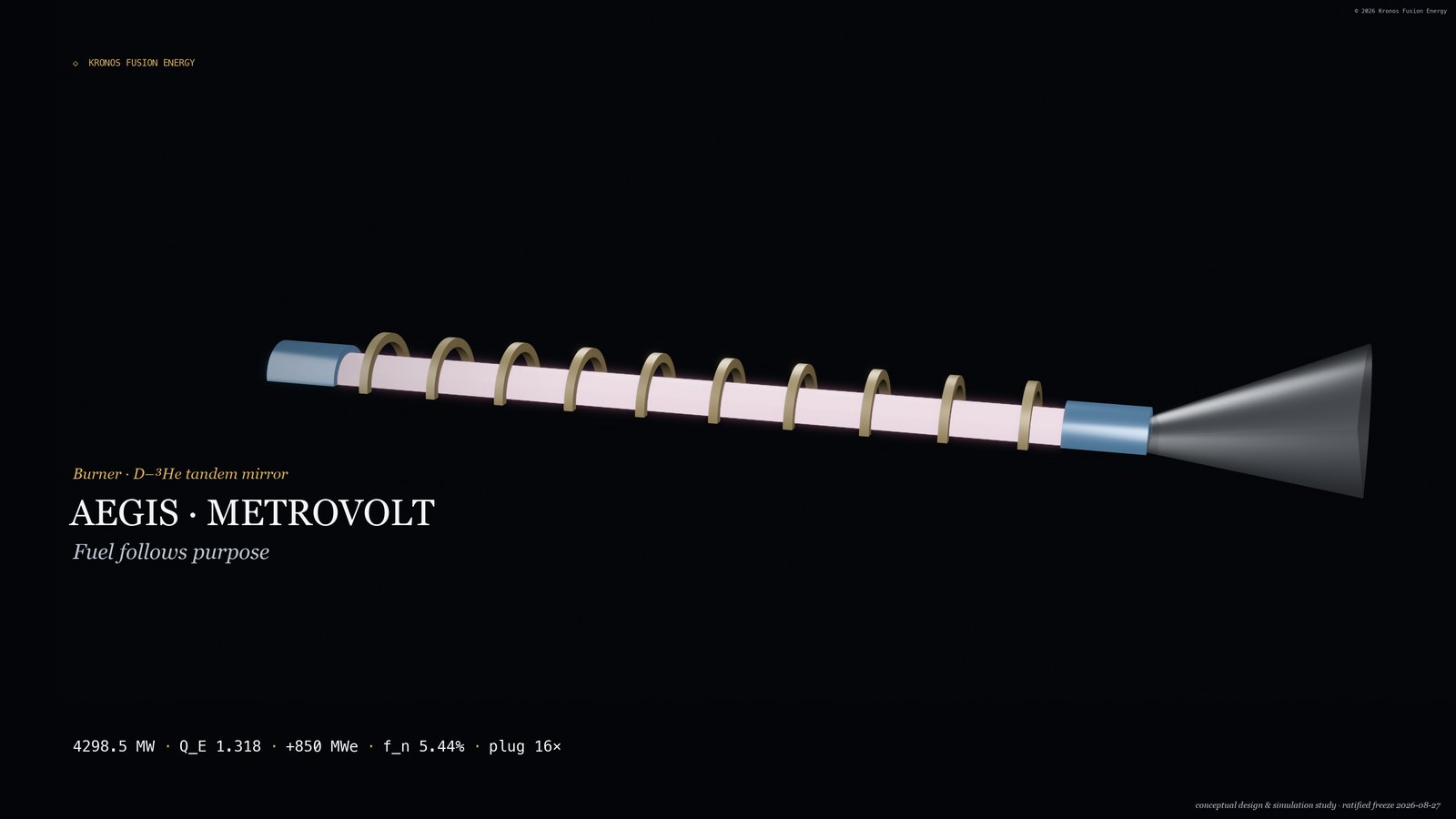
The D–3He Fuel Cycle
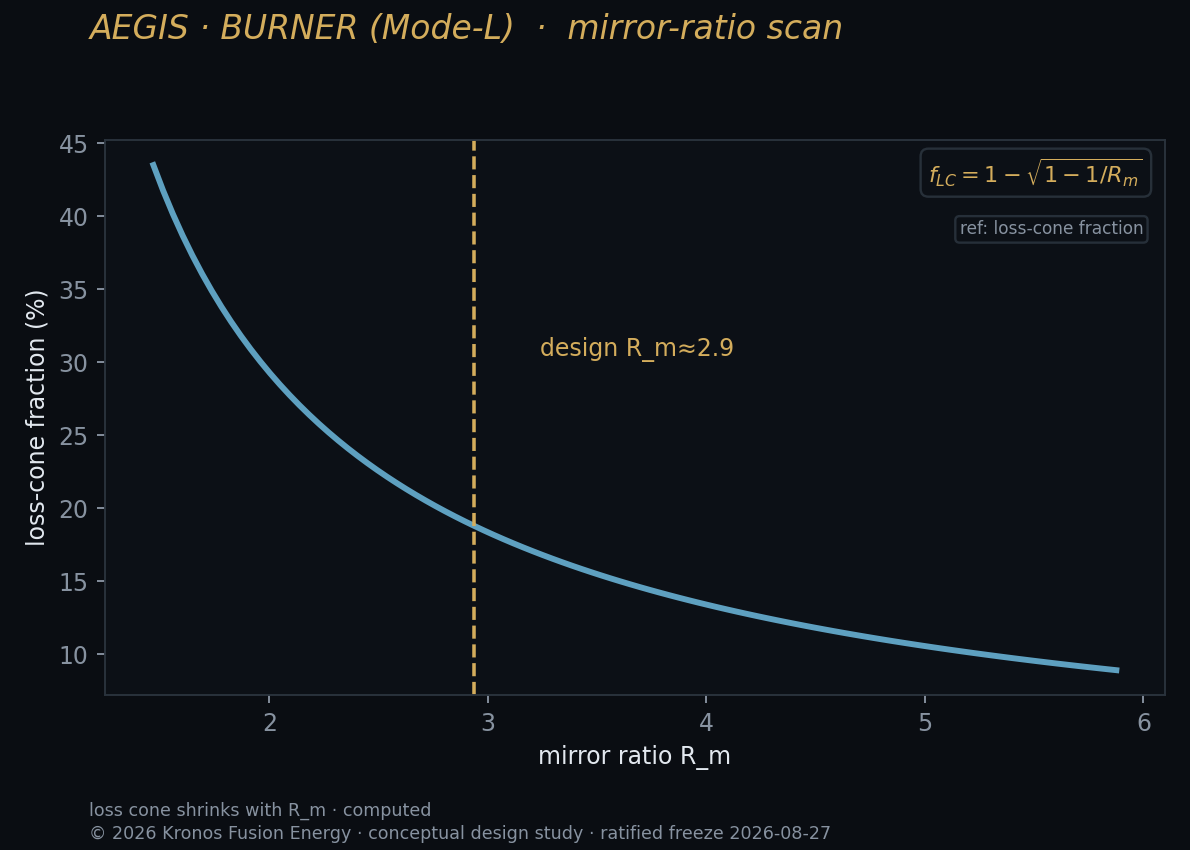
The deuterium–helium-3 reaction releases 18.3 MeV almost entirely as charged particles, which is what makes direct energy conversion and low neutron output possible.
The primary reaction
The reaction Aegis is built around is D + 3He → 4He (3.6 MeV) + p (14.7 MeV). Both products are charged: an alpha particle and a proton. Because charged particles are confined and steered by magnetic and electric fields, their energy can be recovered by direct energy conversion rather than only as heat. This is the physical basis for the burner's efficiency and low-signature operation.
Why it is not perfectly aneutronic
A pure D–3He plasma still contains deuterium, and deuterium reacts with itself. The D–D side reactions produce tritium and helium-3, and one D–D branch and the subsequent D–T reaction release neutrons. In the Aegis design point this shows up as a neutron fraction of 5.44% of total fusion power — low, but not zero. The fuel cycle and shielding are designed around this honest number, not around an idealized aneutronic claim.
- Primary: D + 3He → 4He + p (charged, 18.3 MeV)
- Side: D + D → T + p and D + D → 3He + n
- Follow-on: D + T → 4He + n (14.1 MeV)
- Net neutron fraction at the design point: 5.44%
The consequence for supply is important: the burner consumes helium-3 and deuterium and returns helium-4 ash. It does not breed its own fuel. Every kilogram of helium-3 must come from outside the machine — which is exactly the role the breeder fills.