How a Breeder Fleet Feeds a Burner Fleet
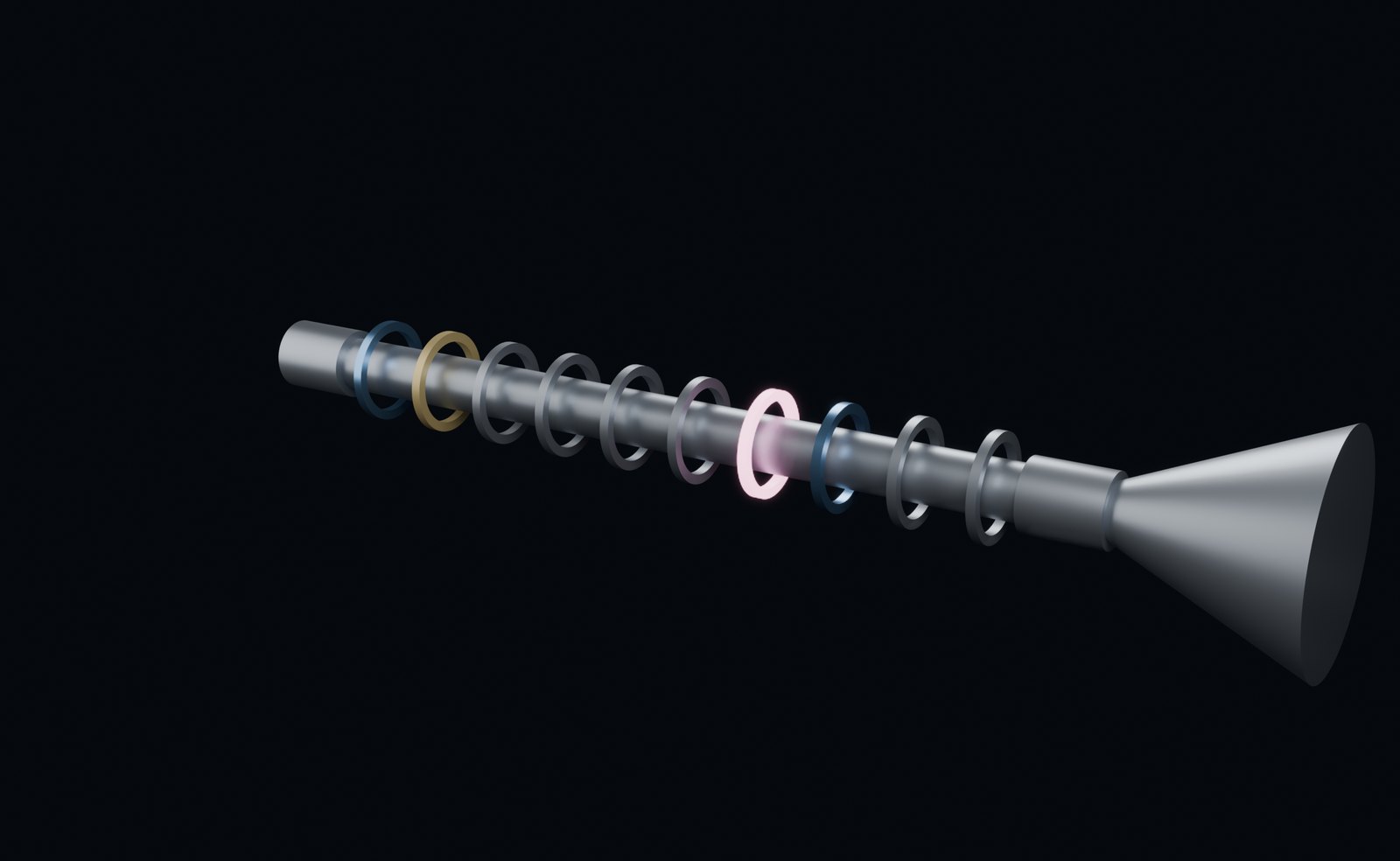
At scale, a fleet of breeders acts as a fuel foundry: each unit's helium-3 output supports a matched number of burners, sequenced breeder-first.
The foundry model
Scaled up, the two-machine system becomes a fleet relationship. A group of breeders functions as a fuel foundry, each producing helium-3 in the ~1.97 kg/yr class at its design point. That output, matched against the net steady-state demand and startup charges of the burners, determines how many burners the foundry can sustain. Growing the burner fleet requires growing the breeder fleet ahead of it, on the same breeder-first logic that governs the single-machine case.
Sequencing and matching
Two rules govern the fleet. Sequencing: breeders come online first so a helium-3 reserve exists before burners need charging — construction from Q2 2027, first tritium ~2030, first test burner ~2032. Matching: the number of burners is bounded by breeder production, the breeding-ratio lever (1.1 / 1.5 / 1.8), recovery efficiency, and how much bred tritium is held for decay versus used directly. Lunar helium-3 could later raise the ceiling, but the near-term fleet is sized on terrestrial breeding alone.
- Breeders act as a fuel foundry, each ~1.97 kg/yr class helium-3
- Burner count bounded by breeder output and recovery efficiency
- Breeder-first sequencing builds a reserve ahead of demand
- Breeding-ratio lever scales how many burners a foundry feeds
This foundry model is the fleet-scale expression of the breeder–burner link: the same physics, planned across many machines, with the breeder always built ahead as the source of the burner's fuel.