Exhaust and Ash Removal
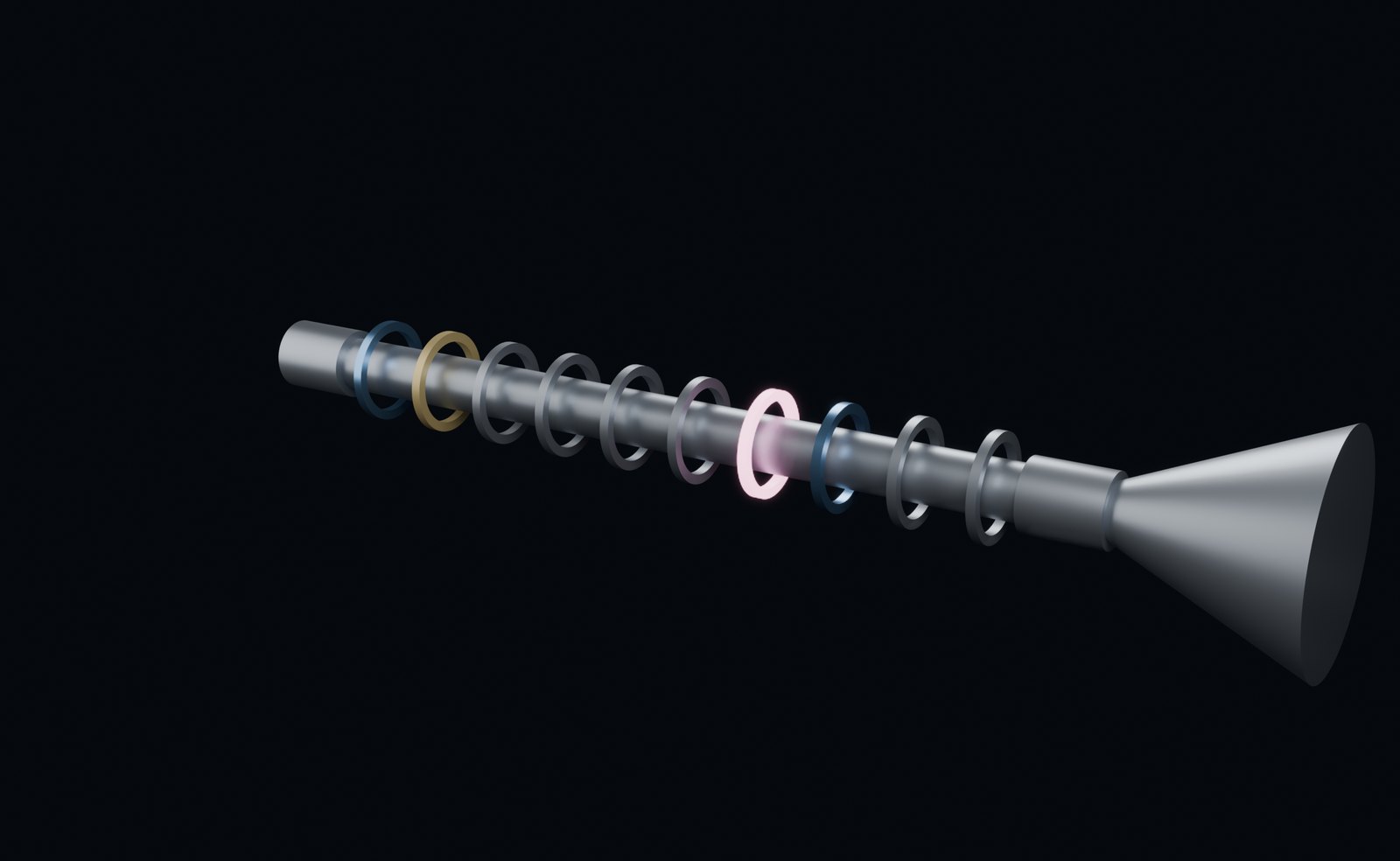
The burner's exhaust carries helium-4 ash and unburned fuel out through the mirror ends; processing it removes ash and returns fuel to the loop.
Where the exhaust goes
In a tandem mirror, particles that are not confined stream out along the field lines through the end regions. This end loss, often a problem to be minimized, doubles as the exhaust path: helium-4 ash produced by the burn, along with unburned helium-3 and deuterium, leaves the central cell toward the expanders and end cells. The exhaust is collected there rather than at a divertor as in a tokamak.
Processing the stream
The collected exhaust is pumped, cooled, and sent to fuel processing. There, helium-4 ash is separated from the valuable helium-3 and deuterium, impurities are removed, and the recovered fuel is returned to store. The helium-4 ash — inert and harmless — is the burner's main routine waste stream, and it is vented or collected without special radiological handling.
- Exhaust exits along field lines through the mirror ends
- Carries helium-4 ash plus unburned helium-3 and deuterium
- Processing separates ash from recoverable fuel
- Helium-4 ash is inert — the main routine waste stream
Because the exhaust path is also where charged particles are directed for direct energy conversion, exhaust handling and power conversion share the same end-region hardware — a point where the fuel cycle and the power cycle physically meet.