No Tritium Fuel in the Burner
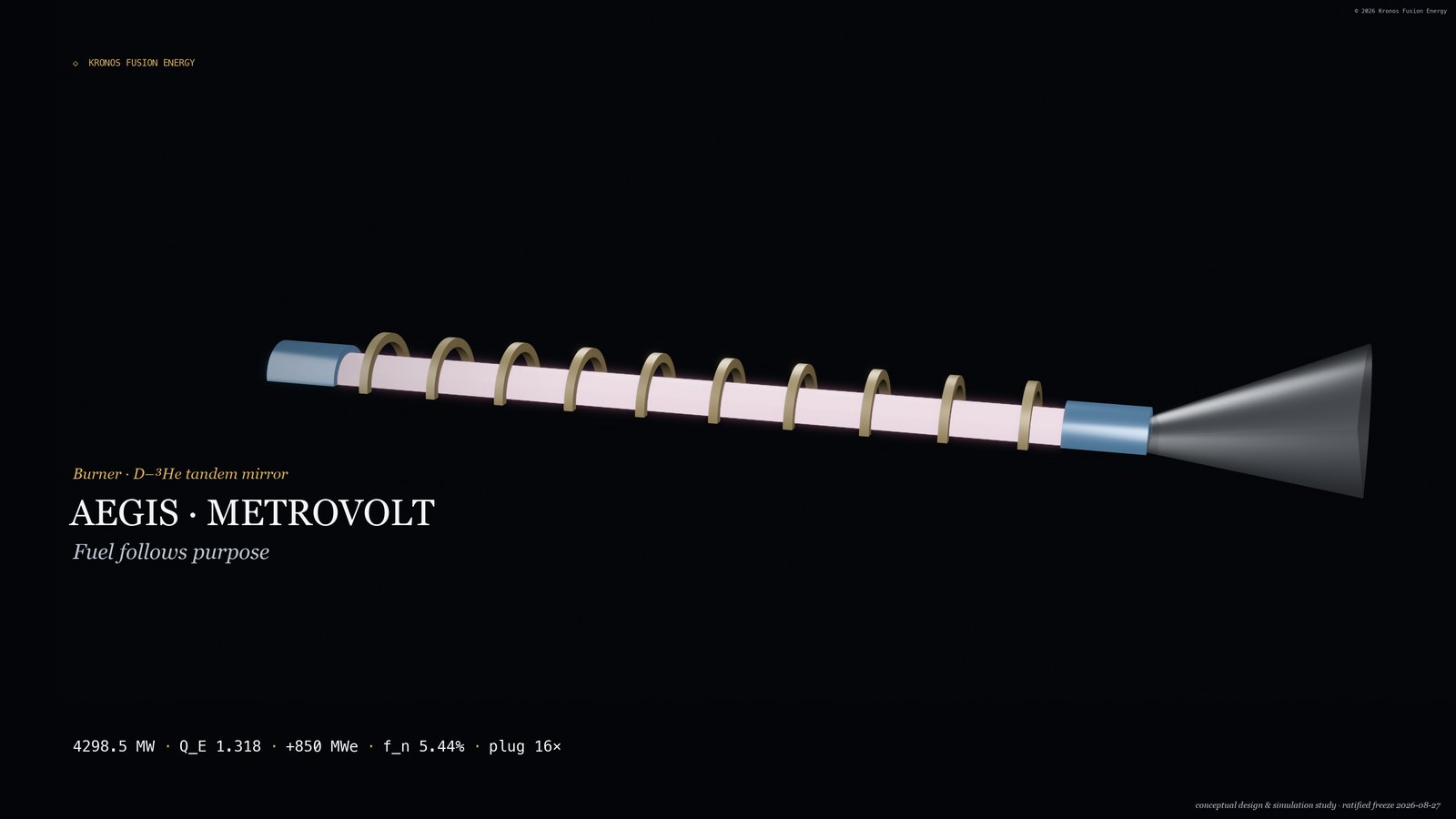
Aegis does not use tritium as a primary fuel; it burns deuterium and helium-3, which keeps its on-site radiological inventory small.
A common misreading
Because tritium is central to the fuel story — it is what helium-3 is made from — it is easy to assume the burner runs on tritium. It does not. Aegis burns deuterium and helium-3. Tritium's role is upstream, at the breeder, as the precursor that decays into the helium-3 the burner uses. A fielded burner is not fuelled with tritium and does not need a tritium supply on site.
Why this matters for siting
Keeping tritium off the burner site is one reason Aegis suits fixed installations. Tritium is the fuel loop's one mobile radioactive species, demanding layered containment and detritiation wherever it lives. By confining that burden to the breeder and shipping only helium-3 — an inert, stable, non-radioactive gas — the burner carries a far smaller radiological footprint. A trace of tritium is generated internally by D–D side reactions, but this is a small in-machine quantity, not a fuel input.
- Burner fuel is deuterium and helium-3, not tritium
- Tritium's role is upstream, at the breeder
- Helium-3 shipped to site is inert and non-radioactive
- Only a trace of tritium arises internally, not as fuel
This separation of duties — radiological work at the breeder, clean fuel at the burner — is a deliberate feature of the two-machine system, and a large part of why the burner can be described as low-signature.