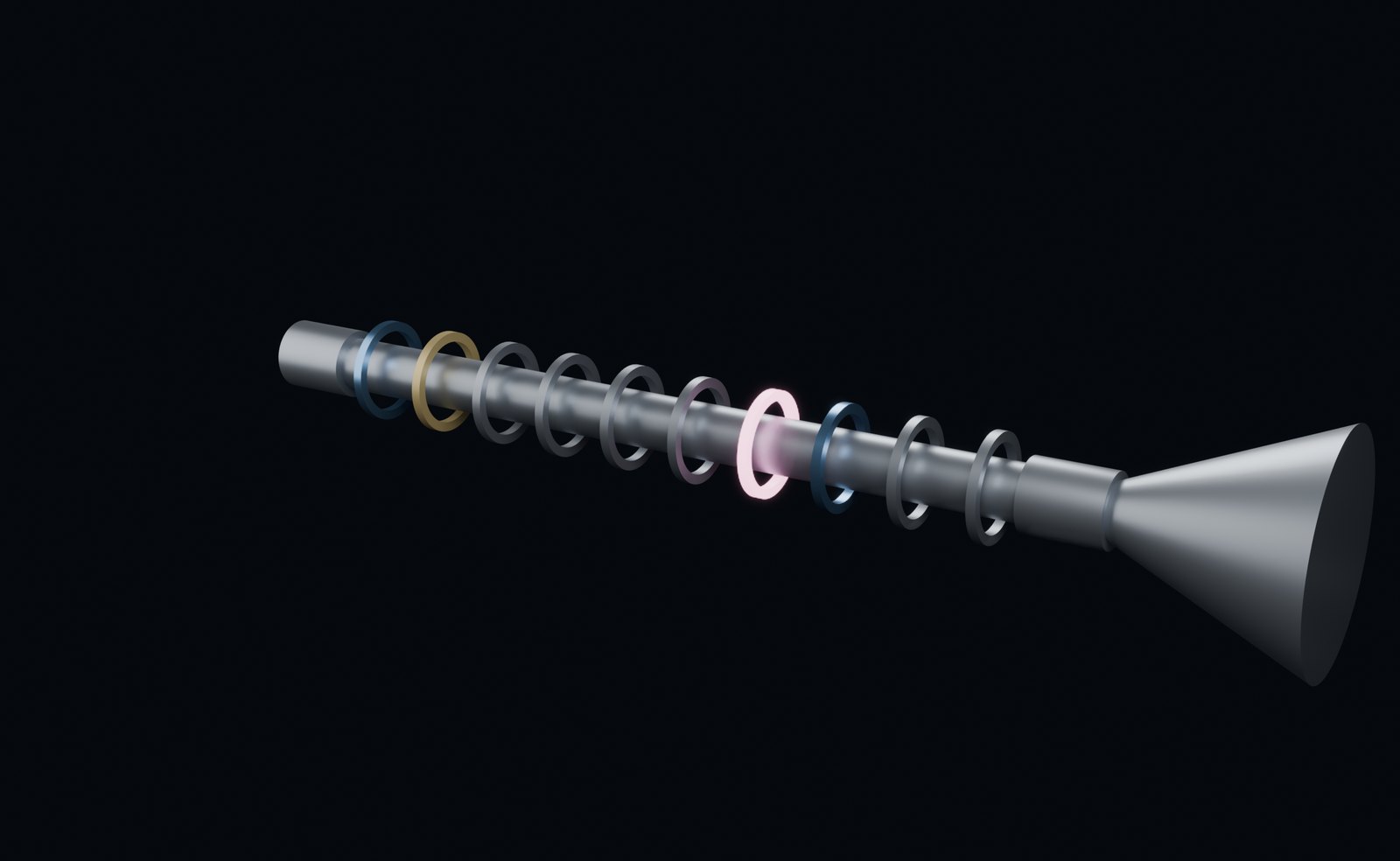
The Proton Product and Direct Conversion
The 14.7 MeV proton from the primary reaction is a charged particle whose energy can be captured directly, linking the fuel choice to the burner's power path.
The reaction that pays off at the ends
The primary D–3He reaction sends most of its 18.3 MeV into a fast proton (14.7 MeV) and an alpha (3.6 MeV). Both are charged, and this is the crux of the fuel choice: charged products can be guided by magnetic and electric fields and their kinetic energy recovered by direct energy conversion, rather than only being turned into heat and then into electricity through a thermal cycle.
Why this is a fuel-supply topic
Direct conversion is usually filed under the power system, but it belongs to the fuel story too: it is the reason the burner tolerates the high cost of using helium-3. A fuel whose energy comes out as charged particles justifies the effort of breeding and handling a scarce isotope, because it converts to electricity more directly than a neutron-dominated fuel could. The fuel choice and the conversion method are two sides of the same design decision.
- Primary products are charged: proton (14.7 MeV) and alpha (3.6 MeV)
- Charged particles enable direct energy conversion
- This justifies the cost of using scarce helium-3
- Fuel choice and conversion method are one decision
The small neutron fraction (5.44%) is the part of the energy that cannot be directly converted and instead appears as heat and activation — another reason keeping that fraction low is valued.