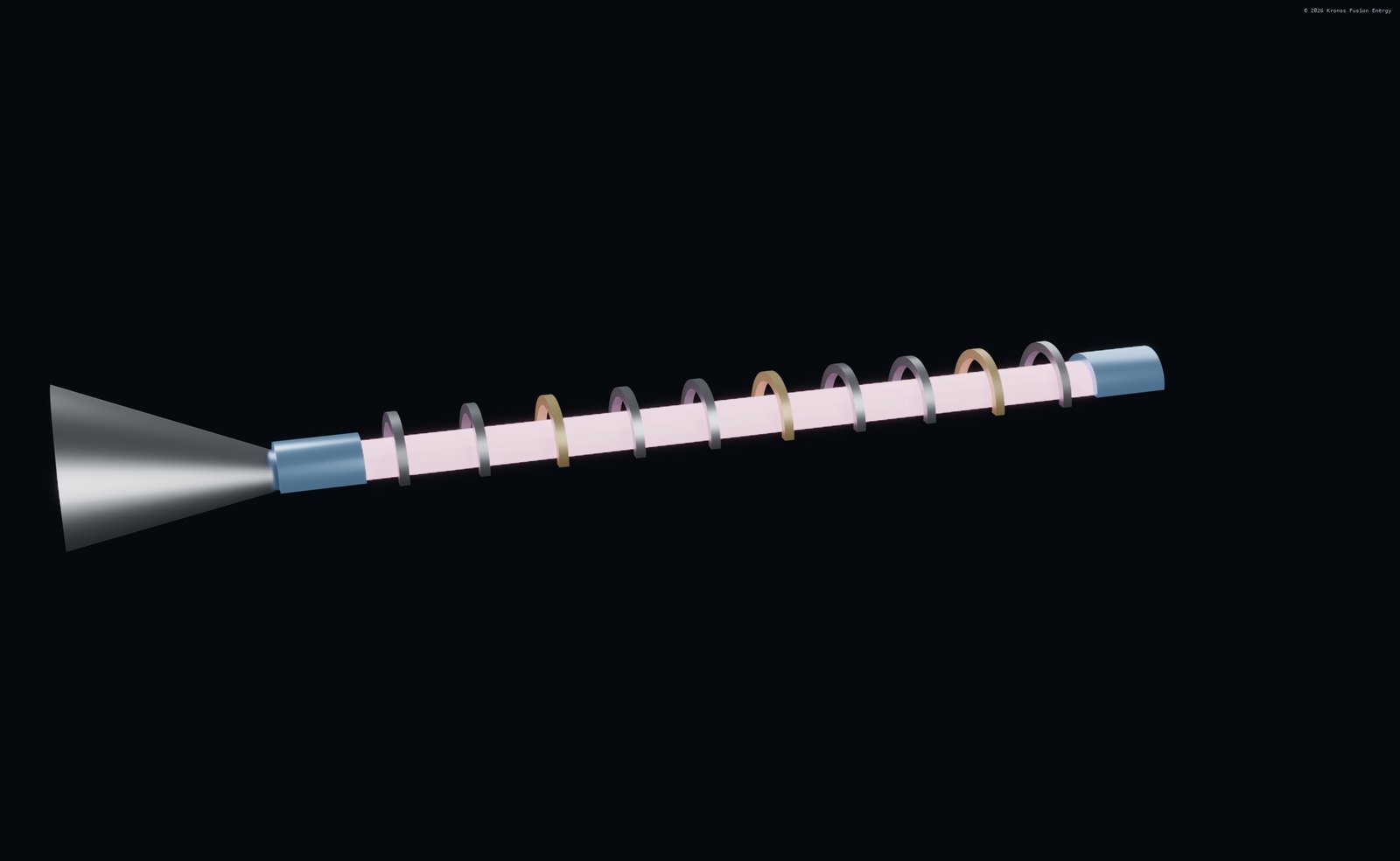
The Breeder–Burner Link
The breeder makes the helium-3 the burner needs; the burner gives the breeder's helium-3 a purpose — a deliberately coupled two-machine system.
Two machines, one system
Kronos does not treat the breeder (Hyperion) and the burner (Aegis / MetroVolt) as separate products that happen to share a company. They are engineered as a coupled system. The breeder is a source of tritium, helium-3, and 14 MeV neutrons; the burner is a consumer of helium-3 and a producer of firm electric power. Neither is complete without the other: a burner with no helium-3 source cannot be fielded at scale, and a breeder with no helium-3 customer under-uses one of its products.
Sequencing
The link also sets the build order. The breeder is built first because it makes the fuel: construction begins Q2 2027 and first-of-a-kind first tritium is expected around 2030. Helium-3 then accumulates by decay while the burner is still being perfected on paper and in simulation. The first test burner follows around 2032. By the time burners are fielded in numbers, a breeder fleet is intended to be running ahead of them as the fuel foundry.
- Breeder is the fuel source; burner is the fuel consumer
- Build order: breeder first, then test burner (~2032)
- Helium-3 reserve accumulates by decay during the gap
- Fleet planning couples breeder count to burner demand
This is why the burner's fuel supply is presented honestly as a design-stage story. The physics of the link is settled; the hardware is being built in the right order to make it real, and no step claims a net-gain result that has not been shown.