Readiness and Timeline at a Glance
The burner (Aegis) is an engineering program today; a test burner is targeted around 2032 and a commercial unit around 2036, gated on four honest physics items.
Where Aegis stands now
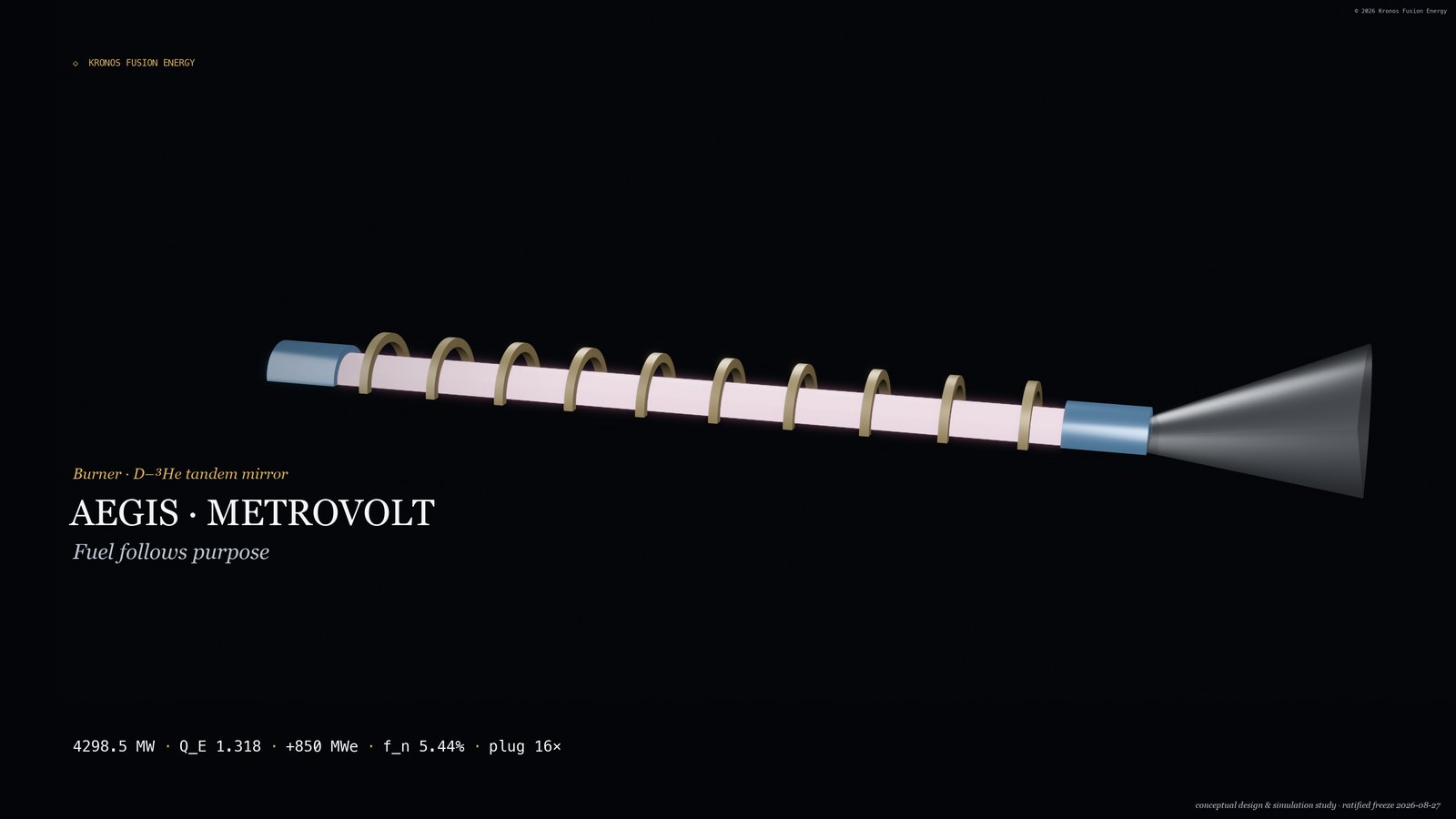
Aegis is not a built machine. It is an engineering program of a deuterium–helium-3 (D–3He) tandem-mirror generator: 26.49 T plug field, 17 T throat, a 5.44% neutron fraction, and direct energy conversion in place of a steam cycle. Every performance figure quoted across this site is a modelled result, not a demonstrated one.
The dependency that sets the clock
Aegis cannot be decoupled from the breeder (Hyperion). The breeder begins construction in Q2 2027 and targets first-of-a-kind (FOAK) first tritium around 2030; that tritium decays into the helium-3 the burner runs on. Only after the breeder is producing does a burner fuel supply exist at all. A test burner follows around 2032 and a commercial unit around 2036.
Four gates, stated plainly
We do not hide the open items. Four physics gates stand between the present design and a fielded machine: the plug coil is overstressed roughly 3–3.9x at the design bore; the plug plasma regime sits 166–830x beyond any operated device; a single commercial unit demands about 400x today's domestic helium-3 supply; and modelled availability of 0.86–0.995 is 30–100x short of hyperscale Tier III uptime (0.99982). These are physics facts, not marketing caveats.
Read this section as a status report, not a sales pitch. Aegis is a low-neutron D–³He generator, not aneutronic; its story is resilient sovereign power for a fixed defense installation, independent of the fuel-logistics tail. That story only holds if the four gates close in hardware, so the pages that follow spend more words on the open items than on the finished physics.
See the four burner gates and simulated vs demonstrated for how each is being addressed.