Closing the Plug-Stress Gate
The route from a 3-to-3.9x overstressed coil in simulation to a testable plug magnet: materials, current density, bore trades, and coupon testing.
Sequence of steps
Closing a structural gate is an engineering campaign, not a single fix. The plug-stress result (3–3.9x over allowable at the design bore) is attacked on several fronts at once, then validated in hardware coupons before any full coil is committed.
Levers available
- Higher-strength structural alloys with better fatigue behaviour
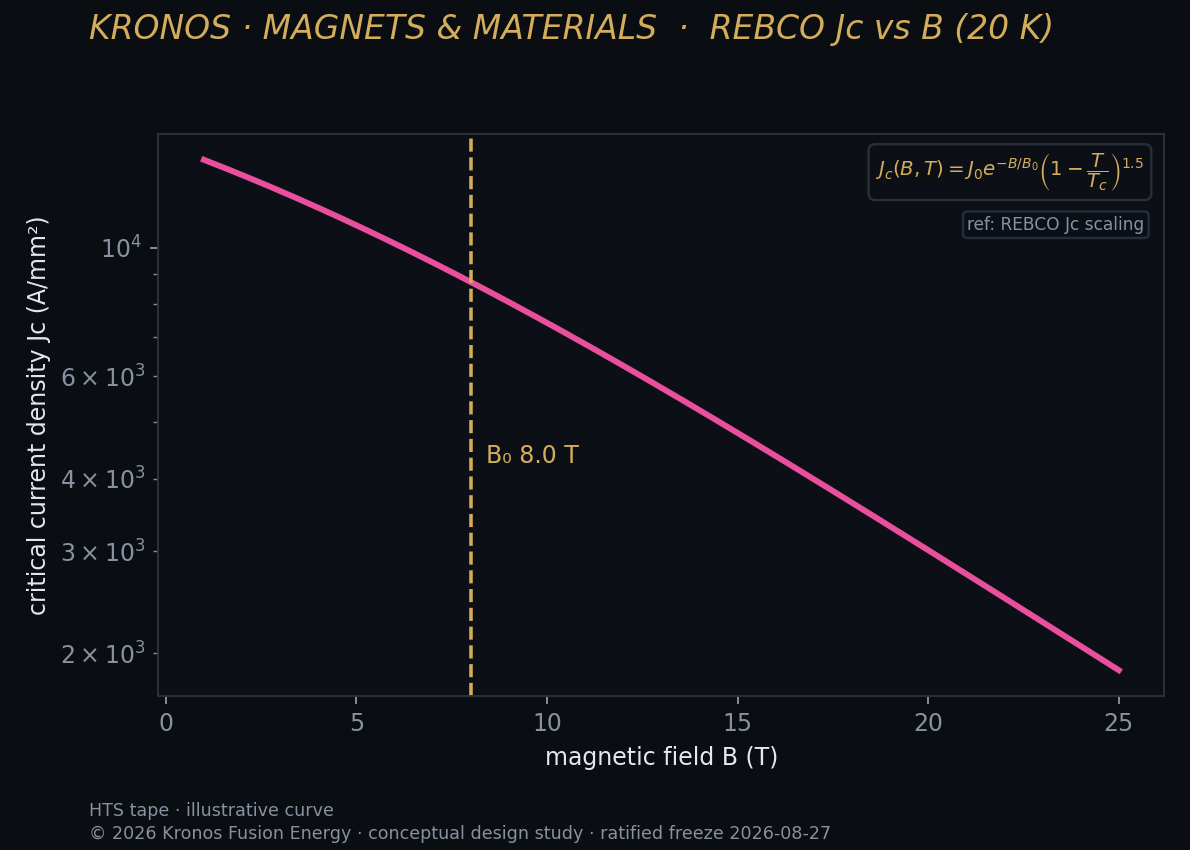
- REBCO high-temperature superconductor run at conservative current density for margin
- A bore/field trade that reduces peak stress while preserving central-cell confinement
- Improved support structure and pre-stress management
Validation gate
No lever counts until a coupon or sub-scale coil is tested to the modelled stress and field. That test is what converts the plug from a simulation result to a demonstrated component, and it precedes the test burner around 2032.
Each lever in this campaign trades one constraint for another — more structure raises mass and cooling load, lower current density raises conductor volume — so the program optimises them together rather than in isolation. The discipline is that no combination is believed until a coupon or coil section is tested to the modelled stress at field. Analysis proposes; the coupon disposes.
See magnet readiness and the prototype program.