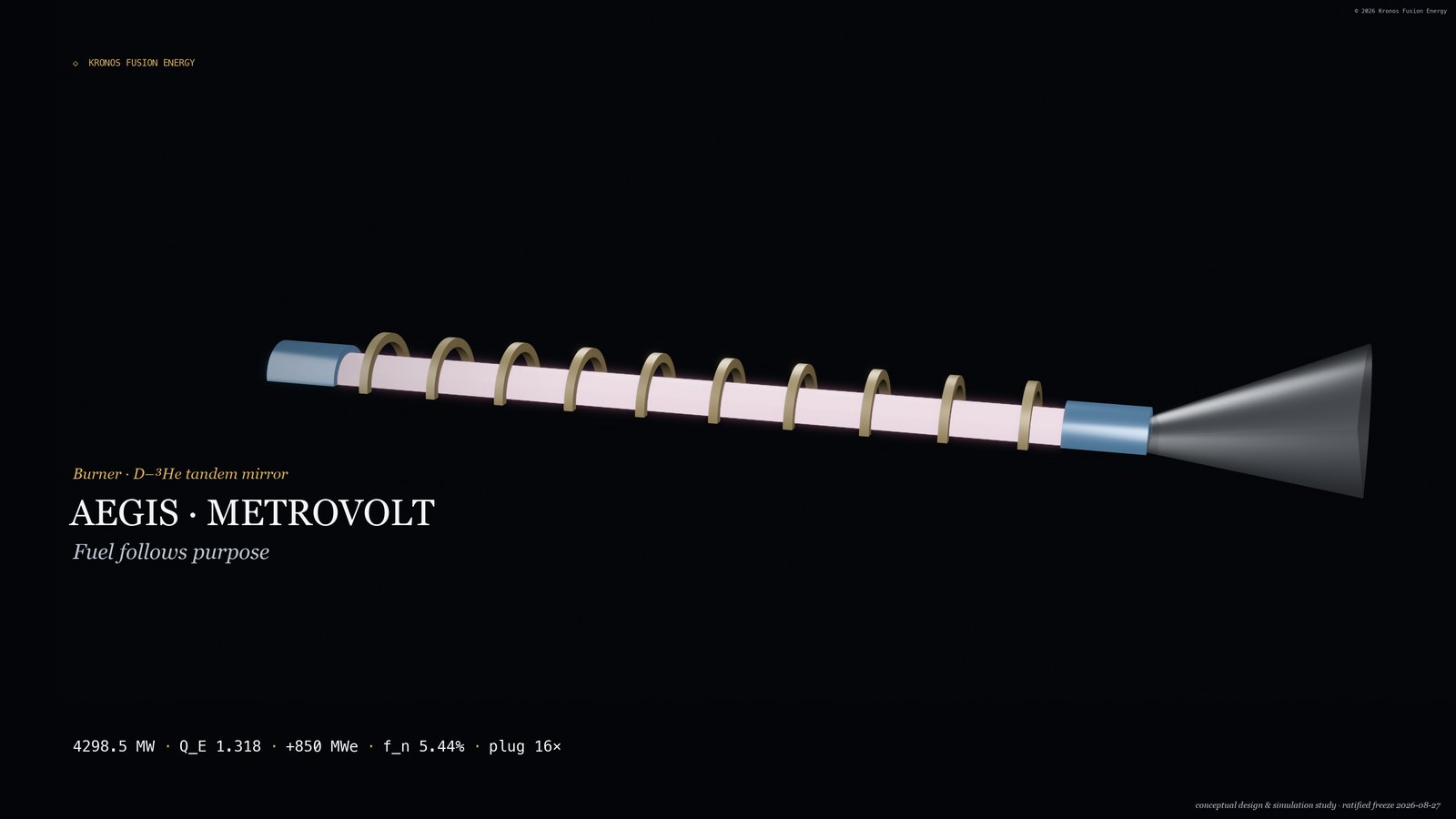
Installation Overview
Aegis is delivered as pre-tested modules and assembled on a prepared foundation, sequencing the machine, its shielding, and balance of plant.
Aegis is the Kronos burner (Aegis / MetroVolt) in a fixed-installation housing: a D-³He tandem-mirror generator. Installation is the ordered process of turning a prepared site into a commissioned machine. Because Aegis is at the design and validation stage, the sequence described here is the engineering plan the design is optimized against, not a record of a built unit.
The installation strategy is module-first. The high-field plug assemblies, the central-cell solenoid, the direct-energy-conversion (DEC) end, the cryoplant, and the power skids are factory-built, factory-tested, and shipped as transportable units. Site work is dominated by civil foundations, shielding placement, and inter-module connection rather than in-place fabrication.
Why module-first
A tandem mirror is a linear machine: high-field plugs at each end, a long central cell between them, and an expander tank feeding the direct converter. That linear geometry is friendly to modular assembly — each section has clean mechanical and cryogenic interfaces. Testing coils, vacuum integrity, and instrumentation before shipment removes the highest-risk work from the critical path on site.
What governs the schedule
- Foundation cure and survey tolerance before any coil is set
- Radiation-shielding placement, which is heavy and sequence-locked
- Cryogenic line routing and leak verification
- Alignment of the plug–cell–plug axis to specification
- Staged energization: vacuum, then cold, then first plasma
The neutron fraction of D-³He operation is low (5.44%), which reduces — but does not remove — shielding and activation constraints compared with a D-T machine. Installation planning treats the reactor hall as a controlled radiological area from first fuel.