Resilient Installation Power: The Aegis Case
Aegis is the Kronos burner sited at fixed defense installations to supply firm, sovereign power that does not depend on a fuel-logistics tail.
What Aegis is for
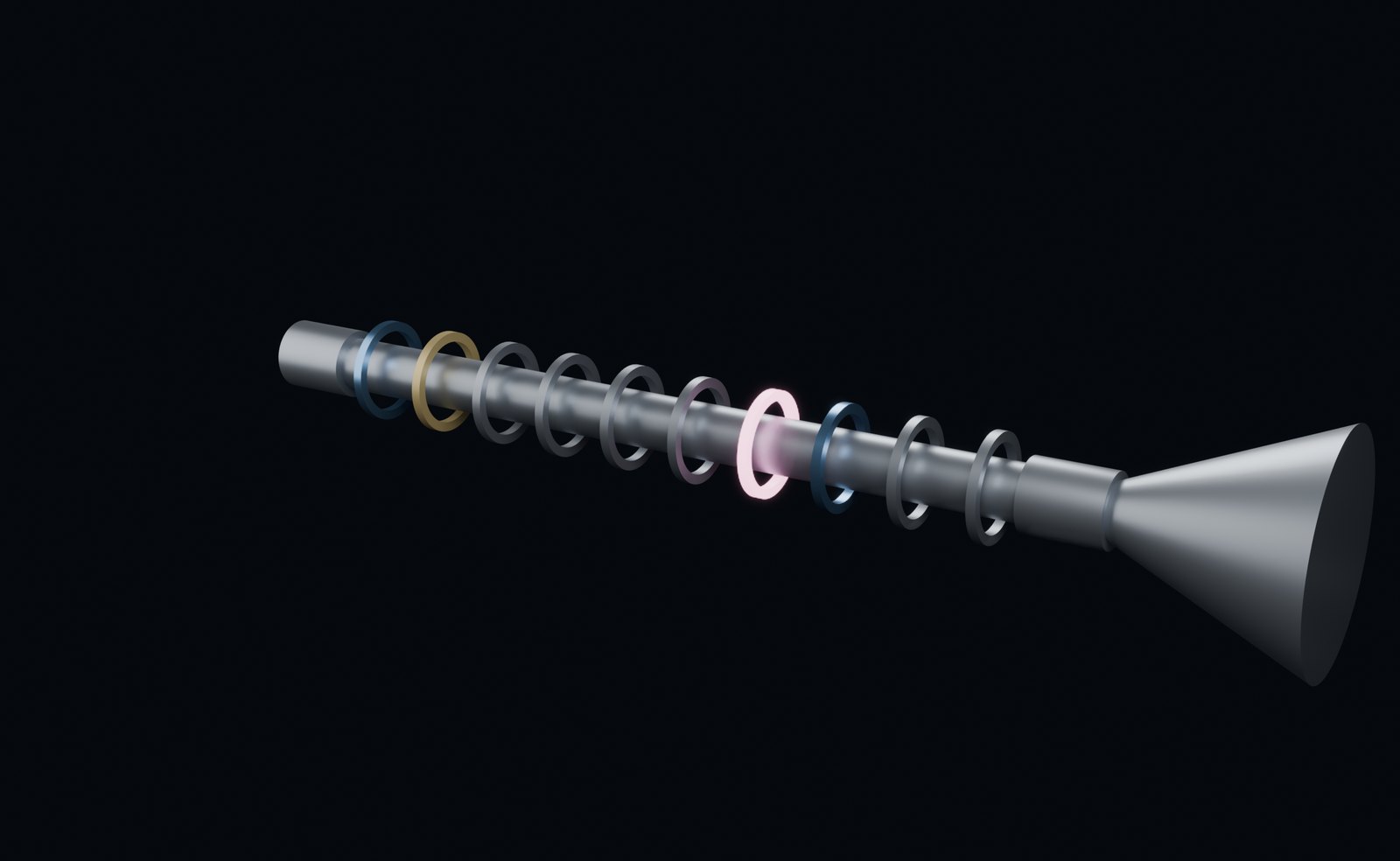
Aegis is the fixed-installation housing of the Kronos burner: a deuterium–helium-3 (D–3He) tandem-mirror generator. It is sited at bases and other fixed sites — never naval — to supply firm power that is rooted in place. The value proposition is continuity: a source of electricity whose availability does not rise and fall with the security of a supply road, a pipeline, or a fuel depot.
Three properties that matter
The design is organised around three installation-relevant properties. It is sovereign: once fuelled it carries years of energy on-site, so it removes the recurring convoy. It is low-signature: a low-neutron reaction (5.44% of fusion energy in neutrons) and direct energy conversion mean no combustion plume and no steam-cycle stack. It is islandable: it can hold an installation microgrid up on its own when the outside grid is gone.
- Sovereign fuelling: on-site inventory, no recurring resupply convoy
- Low-signature: 5.44% neutron fraction, direct conversion, no combustion
- Islandable: grid-forming operation for the installation microgrid
Stated honestly
Aegis is at the design and validation stage. The test burner is targeted for around 2032 and a commercial unit around 2036; there is no claim of hardware net gain before the breeder's first-of-a-kind milestone. The pages in this section describe the resilience concept and, in the same breath, the physics gates that constrain it — most importantly an estimated availability of 0.86–0.995, which is 30–100× short of a hyperscale Tier III target of 0.99982 and therefore requires redundancy rather than a single unit.
Read this section as an engineering argument, not a promise: it explains why fixed installations are a natural fit for the burner, and exactly where the honest limits are.