Grid-Forming Operation
Aegis output is conditioned to set its own voltage and frequency reference, the property that lets it anchor an islanded microgrid.
Forming the reference
A grid-forming source behaves as a controllable voltage source behind an impedance: it decides the instantaneous voltage magnitude and phase and lets load current follow. This is the opposite of a grid-following inverter, which measures an external reference and injects current in step with it. Only a grid-forming source can start and hold an island.
From direct conversion to a stiff bus
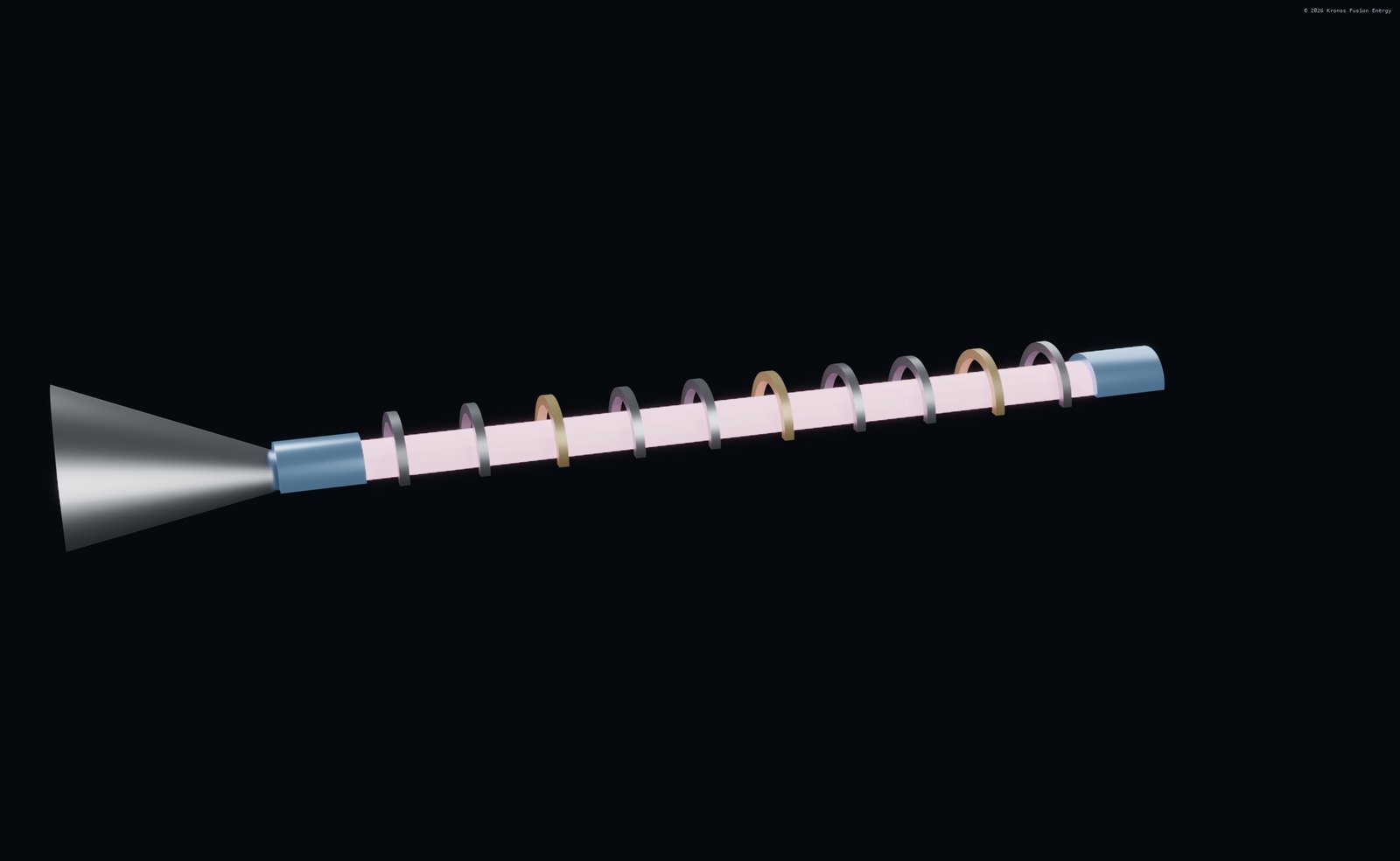
In the burner, escaping charged particles are decelerated across grid stages and collected as direct current. That DC is conditioned into AC by the output stage. Because the inverter is fed from a DC link rather than a synchronous machine, it can implement droop or virtual-synchronous control in firmware and present a programmable, stable reference to the installation bus.
- Voltage/frequency reference synthesised in the conditioning stage
- Droop control lets multiple units share load without a central master
- Virtual inertia can be emulated from the DC link and storage
Sharing load across units
When several Aegis units run in parallel on one island, droop control lets them divide load in proportion to rating without a communications link on the critical path — a resilience property, because the island survives loss of the controller network. A supervisory microgrid controller still coordinates dispatch, but the primary voltage/frequency behaviour is local.
Grid-forming capability is a control and power-electronics property, not a claim about the plasma. It is stated at the design stage and depends on the same conditioning train that any real deployment would validate on the test burner.