
The Precautionary Approach
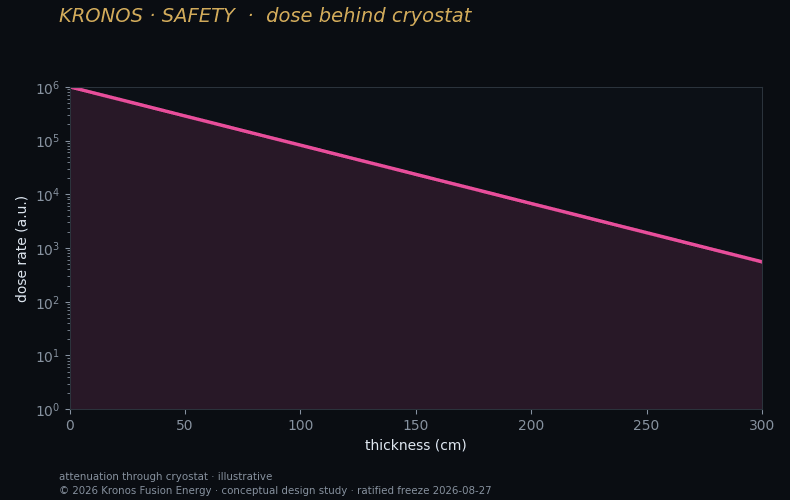
Where consequences could be serious and knowledge is incomplete, we design conservatively and test before we scale.
Caution scaled to stakes
The precautionary approach holds that when an action could cause serious harm and the science is incomplete, the burden is on demonstrating safety rather than on proving harm first. For an energy technology handling radioactive materials and high energy densities, this is not optional caution; it is the responsible default.
How it shapes our program
- Design and simulate exhaustively before building hardware
- Prove behavior at small scale before committing to fleets
- Choose conservative materials and margins where uncertainty is high
- Pre-register predictions so surprises are visible, not buried
Our staged timeline embodies this: breeder construction begins Q2 2027, a first-of-a-kind machine targets first tritium around 2030, and only-then-proven designs progress to next-of-a-kind and beyond. We make no hardware net-gain claim before the first-of-a-kind operates. Scaling follows demonstration, not hope.
The precautionary approach also disciplines our language. We do not describe unbuilt machines as if their environmental benefits were realized. See humility about what we don't know and designing digitally before building.
Applied poorly, precaution becomes an excuse for paralysis. We reject that reading. The point is not to avoid all action but to sequence it so that the largest, least reversible commitments come after the evidence that justifies them. Testing a first-of-a-kind machine before committing to a fleet is precaution and progress at once.