Aegis and Defense Installations, Honestly
Aegis is the burner in a housing for fixed defense installations — not naval — and it carries the same open gates.
What Aegis is, and is not
Aegis is the burner (a D-3He tandem-mirror generator) packaged for fixed defense installations. It is not a naval reactor, not a mobile system, and not a weapon. The use case is on-site firm power for critical facilities that need to keep operating when the wider grid is stressed or cut. Stating what it is not is as important as stating what it is.
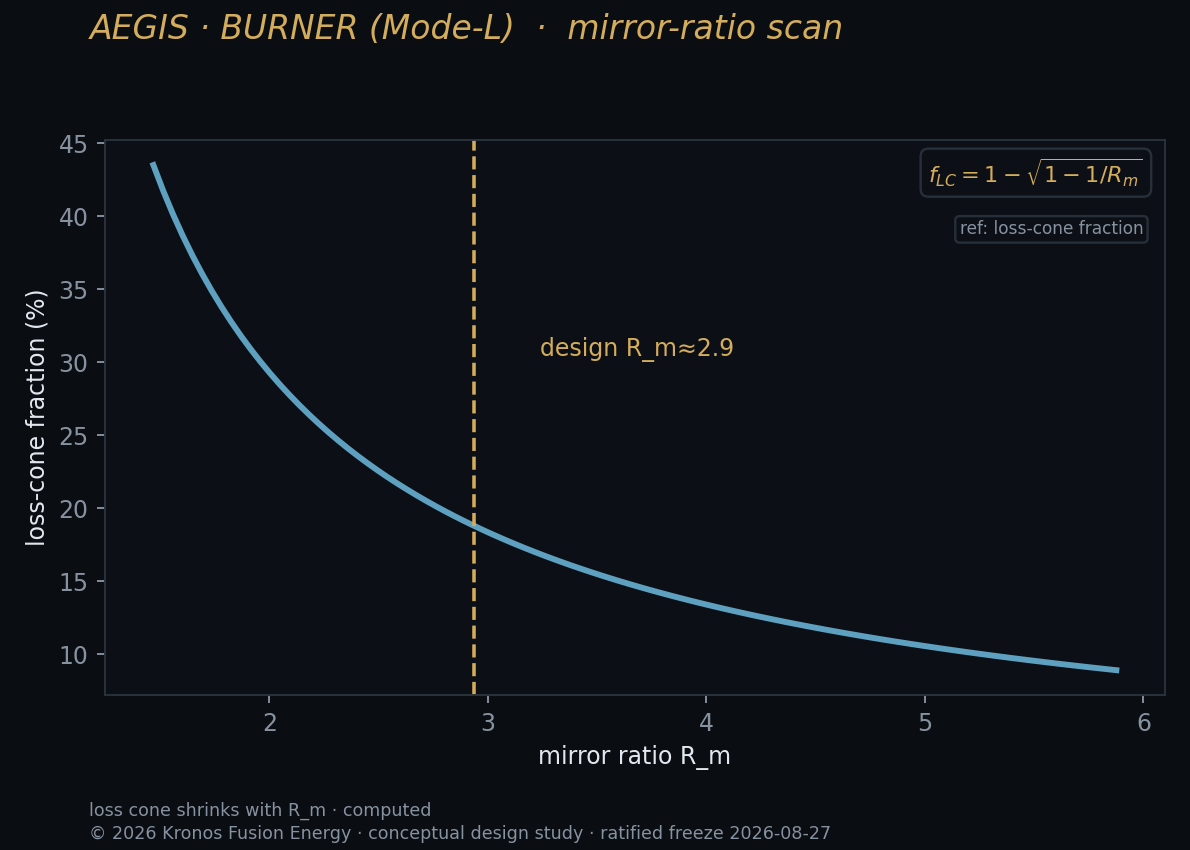
The appeal for defense siting is straightforward: firm power generated on-site improves resilience and reduces dependence on vulnerable transmission. The burner's low neutron fraction of 5.44% and direct energy conversion are relevant design properties for a compact installed generator. All of this is an engineering program.
The gates apply here too
- Plug coil overstressed ~3–3.9x at the design bore — infeasible as specified
- Plug regime 166–830x beyond any device — not post-dictable today
- He-3 demand ~400x domestic supply per unit — fuel gated
- Availability 0.86–0.995 — short of the highest reliability standards
A defense customer evaluating on-site power needs these facts, not a reassurance. Critical infrastructure is precisely where an overclaimed reliability figure would do the most harm. So we present the availability gate to defense users with the same candor as to data-center users.
The responsibility of the domain
Power for defense installations sits near questions of security and dual-use. We address those in responsibility and dual-use and note the non-weapon, energy-only intent of the program plainly. See also grid resilience and security.