TBR as a Design Lever
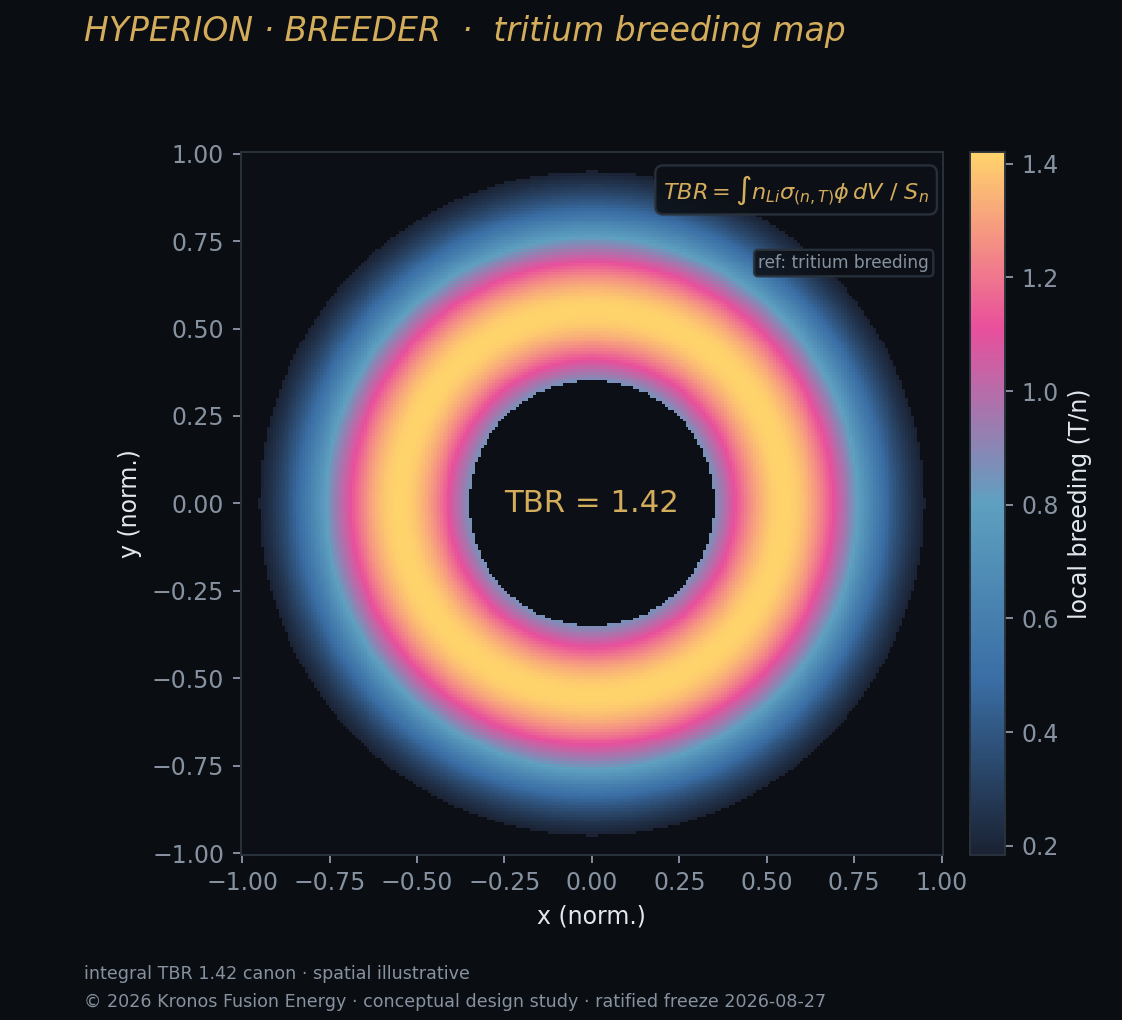
The tritium breeding ratio is studied across 1.1, 1.5, and 1.8 as a design variable, so readers see how self-sufficiency depends on it rather than one number.
What a breeding ratio is
The tritium breeding ratio (TBR) is the amount of tritium a machine breeds per unit it consumes. A TBR above one is the threshold for self-sufficiency, with margin needed to cover losses and to start up other units. Rather than assert a single value for Hyperion, Kronos studies TBR as a lever across three points — 1.1, 1.5, and 1.8 — and reports how the breeder's product and self-sufficiency picture changes across them.
Why sweep instead of state
- 1.1 is barely self-sufficient: little margin for losses or for seeding new machines.
- 1.5 provides working margin under favorable assumptions.
- 1.8 is an optimistic upper anchor used to bound the design space, not a promise.
- Presenting all three shows the reader the sensitivity, which a single number conceals.
The reconciliation it exposes
Sweeping the lever is what makes the open question legible: the gap between an idealized local breeding ratio and a realistic net ratio, once geometry and ports are included, is visible when the range is on the page. That gap is the breeder's central reconciliation; see the breeder open questions.
How the lever ties to the products
The breeder's product framing — a tritium class near 4 kg/yr, about 1.97 kg/yr of helium-3, and 14 MeV neutrons — sits on top of the breeding assumption. Because those products, especially helium-3, feed the burner and its fuel-supply gate, being honest about the breeding lever matters to the whole program. The lever values are frozen canon; see frozen-design discipline.
We publish TBR as a dial with its uncertainty shown, not as a single confident figure.