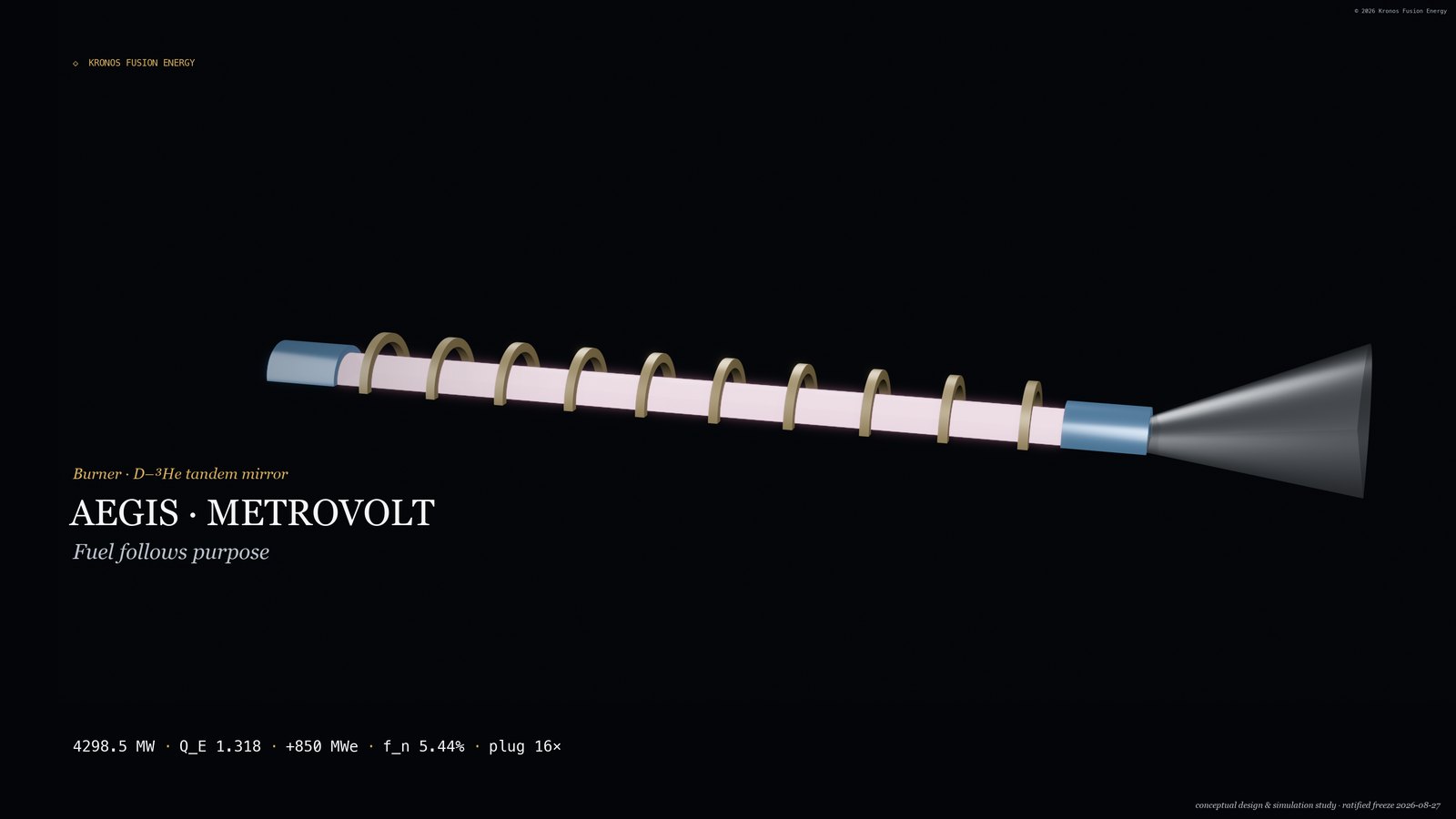
The Burner Paper
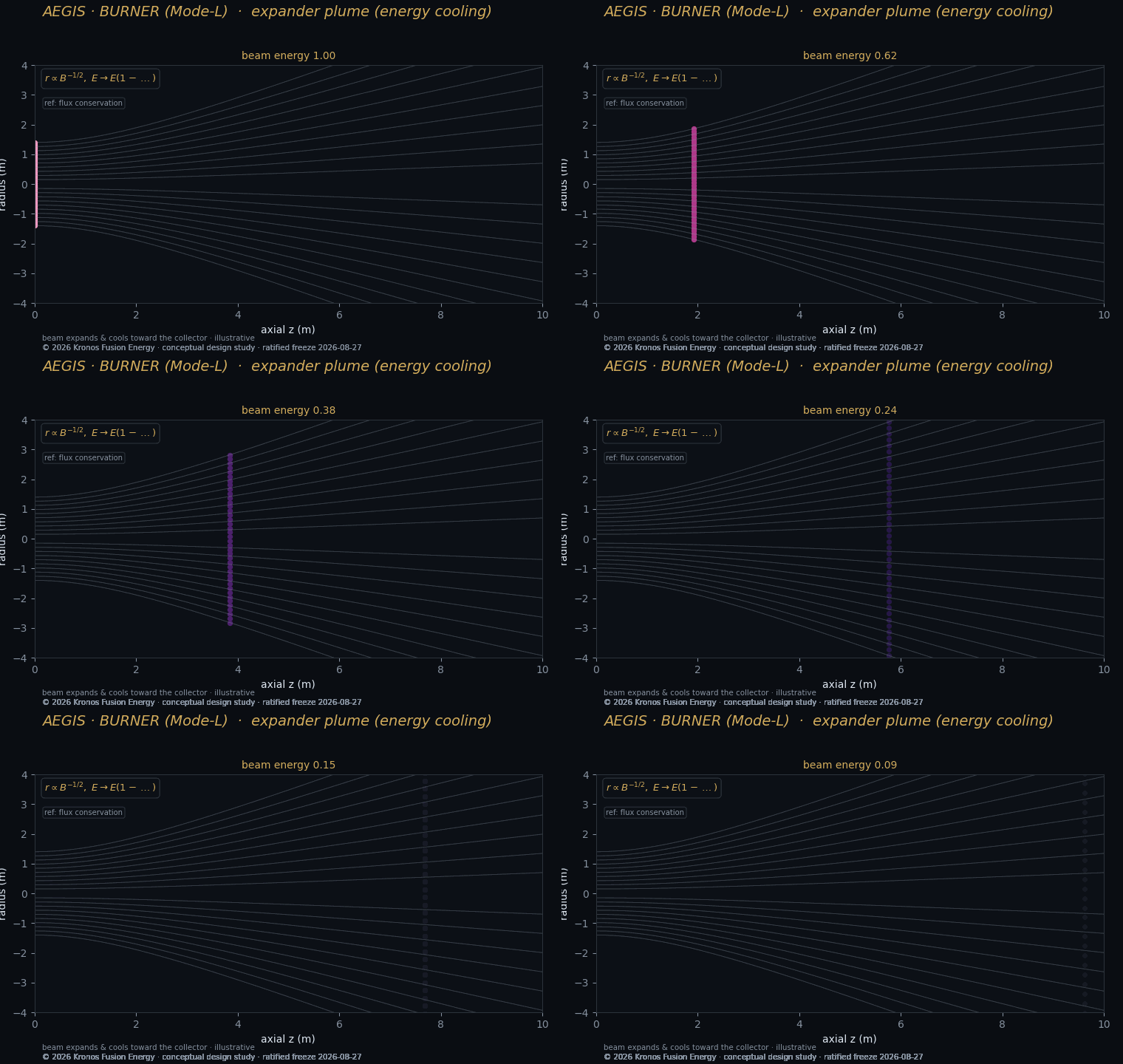
The burner is a deuterium-helium-3 tandem-mirror generator with direct energy conversion, published together with the four physics gates that make it hard.
What the burner paper describes
The burner paper presents a deuterium–helium-3 tandem-mirror generator in two housings: Aegis, for fixed defense installations, and MetroVolt, for data centers. Its design point uses a 26.49 T plug field, a 17 T throat field, and direct energy conversion — recovering charged-particle energy without a conventional thermal cycle. Because the fuel is largely aneutronic, the neutron fraction is about 5.44%.
Published with its gates
The burner is the harder of the two machines, and the paper does not hide it. Four physics gates are stated as design and validation findings, each linked here in full:
- The plug coil is overstressed by roughly 3–3.9x at the design bore — infeasible as specified; see the plug-coil gate.
- The plug operating regime is 166–830x beyond any existing device — un-post-dictable today; see the operating-regime gate.
- Helium-3 demand is about 400x domestic supply per commercial unit; see the fuel-supply gate.
- Availability of about 0.86–0.995 falls 30–100x short of hyperscale Tier III uptime; see the availability gate.
Why publish a design with open gates
A design study earns nothing by concealing where it breaks. Stating the gates in the paper does two things: it tells honest readers exactly what would have to change for the machine to be real, and it explains why the breeder and lunar helium-3 supply are part of the same program — the burner cannot be fueled at terrestrial scale today. The deposit and DOI are on the DOI map.
The burner is a target, not a claim. The paper is written so that no reader could mistake a simulated tandem-mirror point for a built generator.