Validation: Are We Solving the Right Equations
Validation compares model predictions against measured reality; where reality does not yet exist, we say the claim is unvalidated.
Testing the model against the world
Validation asks whether our equations describe nature. It requires data from experiments or operating machines, and it is where honesty about maturity matters most. We validate what we can, and we label what we cannot.
Three tiers of validation status
- Validated sub-models: components whose physics matches existing experiments and published measurements within stated uncertainty.
- Partially constrained: sub-models anchored by adjacent data but extrapolated beyond it, carrying a larger, stated uncertainty.
- Unvalidated: integrated machine performance that only the built device can settle.
The honest gates are validation statements
The burner (Aegis / MetroVolt) gates are validation facts, not opinions. Its plug operating regime sits 166-830x beyond any operated device, so integrated performance is un-post-dictable today. Its plug coil is overstressed roughly 3-3.9x at the design bore, which is a structural validation failure against known material limits. We report these because a validation program that hides its failures is not a validation program.
What FOAK validates
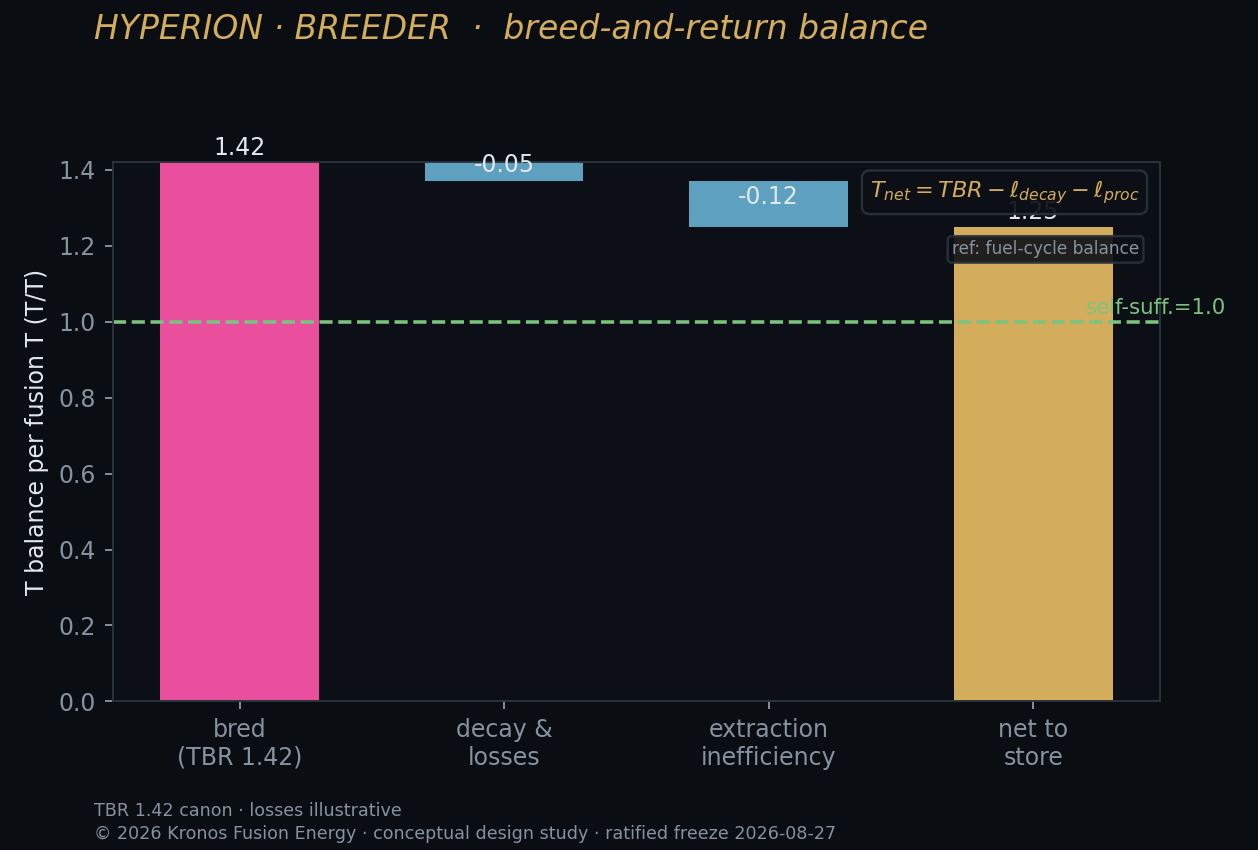
For the breeder (Hyperion), first-of-a-kind first tritium around 2030 is the first integrated validation event: it is where tritium breeding, neutron output, and power balance meet measurement instead of model. Until then we make no hardware net-gain claim. Construction begins Q2 2027; the numbers we publish before that are verified simulation awaiting validation.
Validation is slow, expensive in time, and cannot be rushed by argument. Treating it as the arbiter, rather than persuasion, is the standard. The result is a status label on every claim, so a reader never has to guess whether a number has met reality: validated, partially constrained, or unvalidated and waiting for the machine that will settle it.