
Physics Rigor: Getting the Equations Right
Before any result is trusted, the governing equations, their domain of validity, and their assumptions are written down explicitly.
The equations come first
A fusion device couples plasma physics, electromagnetics, neutron transport, heat transfer, and structural mechanics. Rigor begins by naming which equations govern each part, in what regime they hold, and where we knowingly approximate. The breeder (Hyperion) is a D-T spherical tokamak with plasma current 9.66 MA, peak field 16.84 T (8 T on-axis), and negative triangularity delta -0.30; each of those is an input or output of a specific model, not a round number chosen for effect.
Assumptions are stated, not buried
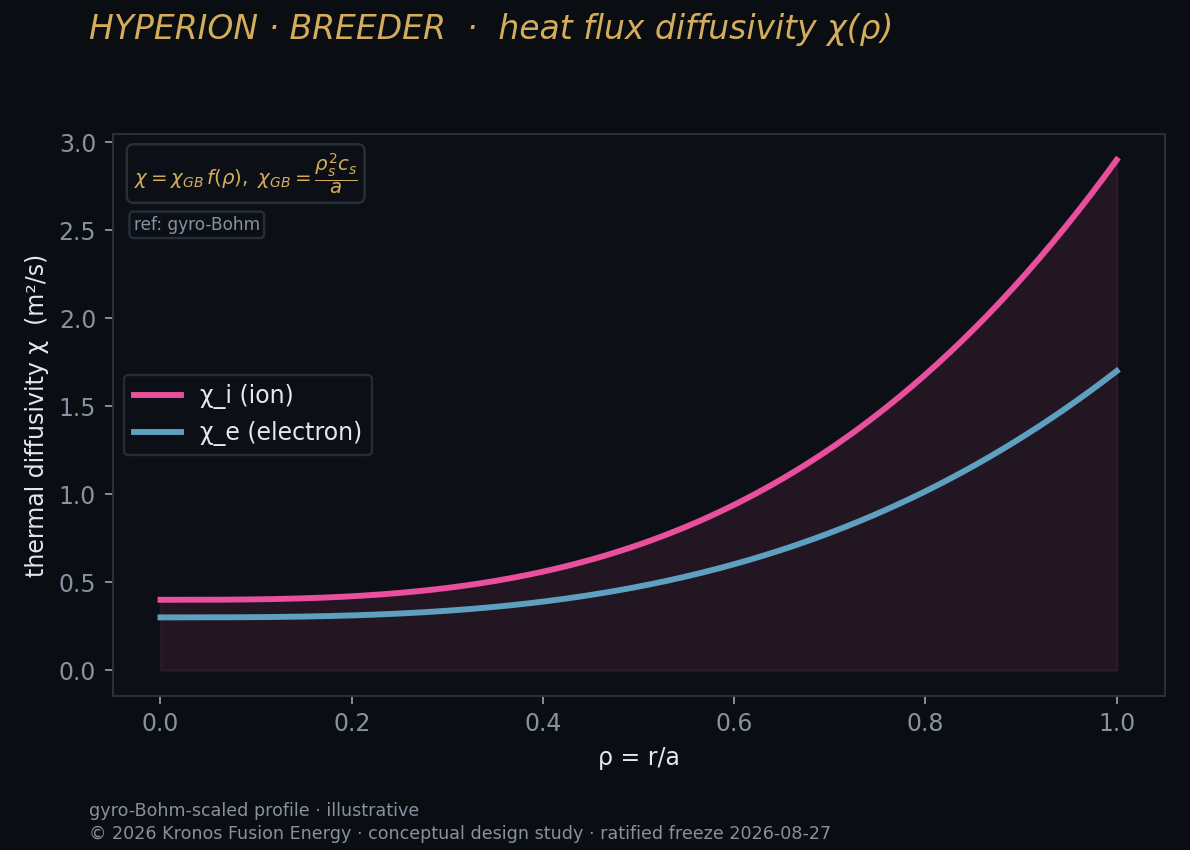
Every model carries assumptions: a transport closure, an equation of state, a boundary condition, a materials property at temperature. We list them. A reader who disagrees with an assumption can see exactly which result it touches. The design figures for fusion power (85.0 MW) and scientific gain (Q_sci 3.076) are the outputs of a stated modelling chain, and the chain is the claim, not just the number at the end.
Regime of validity is part of the result
A model that is excellent inside its regime is worthless outside it. This is why the burner (Aegis / MetroVolt) is described with its plug operating regime stated as 166-830x beyond any operated device: we are explicit that the correlations we rely on are being extrapolated far past where they were measured, so the prediction is un-post-dictable today. Saying that plainly is part of getting the physics right.
Physics rigor is not the same as being conservative or optimistic. It is the discipline of matching each claim to the model that produced it, and never letting a number travel without the assumptions that made it true.