Materials Property Provenance
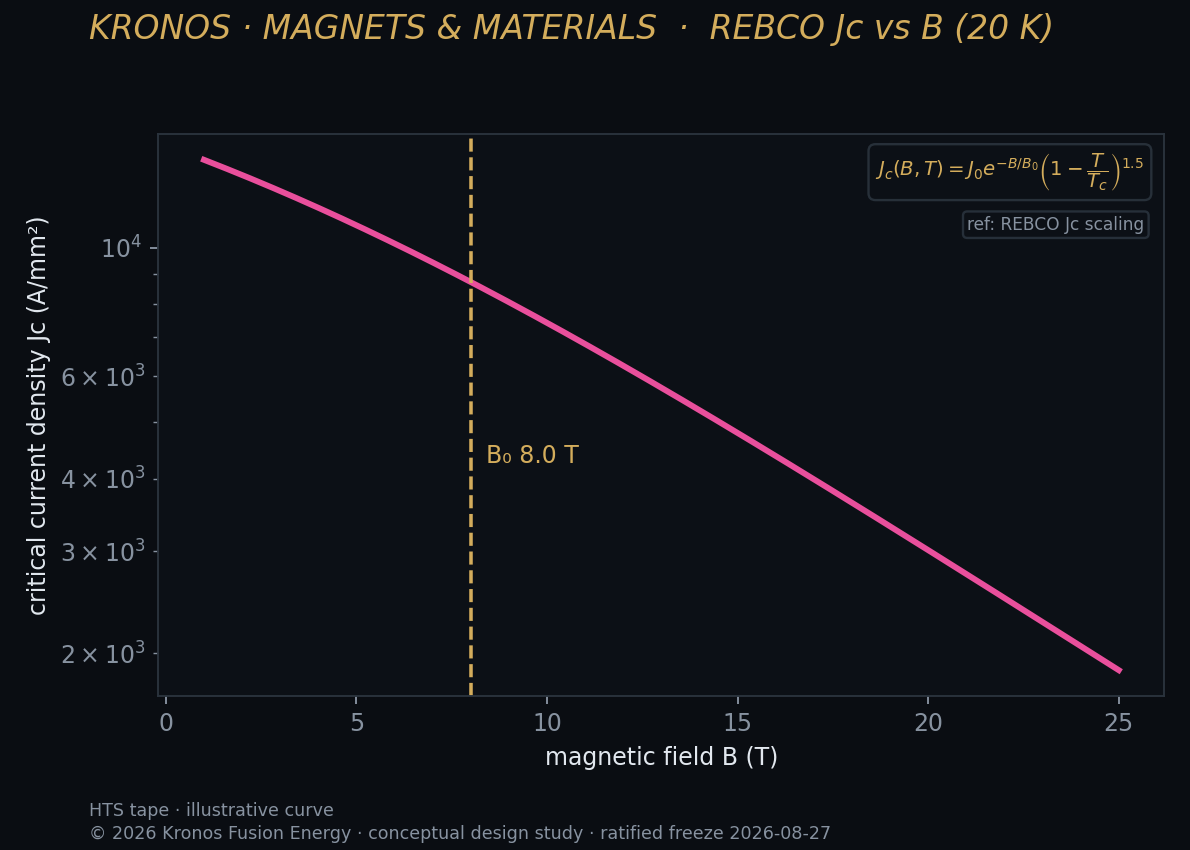
Every material property in an analysis is sourced to measured data at the relevant conditions, not assumed or borrowed from a convenient regime.
Properties are data, not guesses
A structural or thermal analysis is only as good as the material properties it uses. Strength, conductivity, and their behaviour under temperature, irradiation, and cycling all vary, and using a room-temperature value where an irradiated, cryogenic one belongs can flip a conclusion. We source every property to measured data at the conditions the component actually sees.
Conditions the property must match
- Temperature, from cryogenic magnet conditions to hot structural regions.
- Irradiation, since 14 MeV neutron exposure changes materials over time.
- Loading history, including cyclic and fatigue behaviour.
- Manufacturing state, since real parts differ from ideal samples.
Where data runs out
For some conditions -- particularly long-term behaviour under fusion-spectrum neutron irradiation -- measured data is limited. When we must extrapolate a property beyond its data, we treat it as an uncertain input with a stated range and propagate it, rather than picking a single convenient value. The honesty is in admitting where the property is known and where it is estimated.
Property provenance connects to traceability and to no-tuned-constants: a property is a constant in the analysis, and like every constant it carries a source. A design that depends on an unsourced or optimistic property has not been rigorously analyzed, however careful the surrounding mathematics. Sourcing properties honestly, and admitting where the data thins out, is what keeps a structural or thermal result from resting on an optimistic assumption dressed up as a fact -- the kind of hidden weakness no amount of surrounding rigor can rescue.